Tom Huston
“Has creation a final goal? And if so, why was it not reached at once? Why was the consummation not realized from the beginning? To these questions there is but one answer: Because God is Life, and not merely Being.”
F.W.J. Schelling, 1809
Charles Darwin did not invent the concept of evolution. In fact, he himself acknowledged that the idea, however loosely defined, had a history dating back to Aristotle. And despite the general impression offered by most scientists today, it wasn’t always a materialistic notion either. In its modern incarnation, the concept of evolution can be traced directly to Gottfried Wilhelm Leibniz, who viewed the evolutionary process as an act of God.
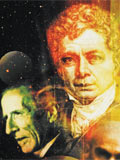
A renowned German philosopher, scientist, lawyer, linguist, mathematician, and inventor of both calculus (independent of Newton) and the binary system (the basis of computer technology), Leibniz was a man ahead of his time. Writing on “The Ultimate Origin of Things” in the year 1697—six years after speculating in his Protogaea that over the vast course of the earth’s history “even the species of animals have many times been transformed”—he stated that “a cumulative increase of the beauty and universal perfection of the works of God, a perpetual and unrestricted progress of the universe as a whole must be recognized, such that it advances to a higher state of development.” Although the idea that God’s creation was evolving in a ceaseless ascent toward perfection had already been profoundly intuited over seventy years earlier by the German mystic Jakob Böhme, it was Leibniz who first placed it in a scientific context. And to him, clearly, it was still a novel concept. “I flatter myself that I have some ideas of these truths,” he wrote to a friend in 1707, “but this age is not prepared to receive them.”
Over the next few decades, an increasing number of Europe’s brightest minds began to finally catch Leibniz’s evolutionary drift. Among those illumined ranks were names such as Diderot, Maupertuis, Buffon, and Voltaire, who all wrote about the topic of evolution but, like any self-respecting champions of the Age of Enlightenment, rarely felt compelled to inject divinity into their more scientific speculations. Indeed, by upholding the liberating power of rationality to subvert the ancient myths and dogma of the Church, many of them actively sought to draw a firm line between science and spirituality, reason and religion, bringing to sharper contrast the divide that began with Galileo’s confrontation with the religious authorities two centuries earlier. In this context, through much of the eighteenth century, the many musings about the idea of evolution frequently took on a strictly naturalistic or materialistic tone.
It was only around 1799, ten years after the storming of the Bastille, which ignited the French Revolution and cemented the success of the rational Enlightenment in the chronicles of the Western mind, that these varied intimations of evolution finally congealed into a cohesive new model of reality. Arising, once again, from the fertile depths of the German zeitgeist, it was a cosmological and metaphysical paradigm that seamlessly united science and spirituality—an evolutionary vision that stretched from the simplest atoms of the distant past to a sacred future in which human society would perfectly reflect the transcendent unity of the Divine.
Of Romantics and Idealists
On any given evening during the fall and winter of 1799, in the pastoral college town of Jena, Germany, at least one candlelit home could likely be found abuzz with the excited voices of some remarkable men and women. Meeting over fine food and wine in the home of local literary critic Wilhelm Schlegel and his brilliant wife, Caroline, an eclectic band of young artists, intellectuals, and self-styled scientists would “symphilosophize” and “sympoetize” late into the night, absorbed in a seemingly endless swirl of radically unconventional ideas. They called themselves “Romantics”: revolutionaries of the human spirit determined to infuse the Enlightenment’s increasing trend toward dry materialism with some much-needed passion and poetry. Troubled by the rational mind’s tendency to brusquely reduce the full grandeur and beauty of life to stale scientific abstraction—dissecting nature “atomistically like a dead corpse,” in the words of one of their early proponents—they strove to steer Western society in a more holistic, spiritual direction. And perhaps no individual better fulfilled that dream than the youngest member of Jena’s Romantic inner circle—the charming twenty-four-year-old wunderkind and idealist philosopher Friedrich Wilhelm Joseph von Schelling.
“He has invited me to an exchange of correspondence,” wrote the poet Novalis to a fellow Romantic upon meeting Schelling. “Before the day is out I will write him. I like him a lot—a real universal tendency in him—true radiant force—from one point to infinity.” Similar praise could be heard from nearly all who met the philosophical prodigy, including the famed poet and scientist Johann Wolfgang von Goethe. First encountering Schelling in 1798, he was immediately impressed and soon took the young man under his influential wing. For in the unique space of Schelling’s Romantic but thoroughly rational mind—molded as it was by the works of both Böhme and Leibniz—a striking reunification between science and spirit was beginning to take shape.
Expanding on a century’s worth of evolutionary thinking and the idealist philosophy of J.G. Fichte (who’d been a student of Immanuel Kant), Schelling proposed an alternative to the encroaching materialism so dreaded by his Romantic friends: an evolutionary idealism. As the opposite of materialism, the philosophy of idealism held that consciousness, not matter, was the ultimate basis of reality. And once combined with a scientific understanding of evolution, Schelling realized, idealism would represent a force with which all serious thinkers of the Enlightenment would have to contend.
Envisioning an epic process of cosmic evolution in which an unmanifest realm of pure consciousness, or absolute spirit, is actively manifesting itself as the world of time and space through a series of increasingly complex and conscious forms—from matter to life to mind and beyond—Schelling wrote:
It is the universal spirit of nature that gradually structures raw matter. From bits of moss, in which hardly any trace of organization is visible, to the most noble form, which seems to have broken the chains of matter, one and the same drive governs. This drive operates according to one and the same ideal of purposiveness and presses forward into infinity to express one and the same archetype, namely, the pure form of our consciousness.
Thus, more than sixty years before Darwin brought the scientific world to its knees with his theory of biological evolution by means of natural selection and “random variation,” Friedrich Schelling and some of his closest friends (including his newfound mentor Goethe and his former schoolmate, philosopher Georg Hegel) were already claiming that reality as a whole was going somewhere. Nature—and humanity—had a purpose and direction, aligned with a purely spiritual drive, and the striking implications of this idea for humanity’s most basic conceptions of life and God did not pass these men by. In the spring of 1800, perhaps after a typical night of creative discussion among the members of the Romantic circle, Schelling pulled out his latest manuscript-in-progress, System of Transcendental Idealism, and inscribed a simple summation of his budding evolutionary thesis: “History as a whole,” he concluded, “is a progressive, gradually self-disclosing revelation of the Absolute.”
It was the clearest formulation yet of a vision—an evolutionary spirituality—that would rock the foundations of philosophy and mysticism for centuries to come.
From East to West to Omega
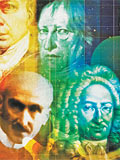
With the groundbreaking synthesis of the German idealists Schelling and Hegel, no longer did humanity need to be seen as being adrift in a state of sin and suffering, as the Church claimed, having “fallen” away from the presence of God in the primordial past. Nor did God have to remain merely a mythic remnant of a more ignorant age, as many scientists continued to insist. Instead, the reality of the Divine could now be understood to reside most fully in our collective future—to be revealed in the world, with increasing depth and clarity, as history marched forward and consciousness evolved. “God does not remain petrified and dead,” said Hegel. “The very stones cry out and raise themselves to Spirit.”
Echoing that sentiment almost two centuries later, the American integral philosopher Ken Wilber wrote, “Both humans and rocks are equally Spirit, but only humans can consciously realize that fact, and between the rock and the human lies evolution.” And in the span between Hegel and Wilber reigned numerous proponents of evolutionary spirituality in both the East and the West. From the American essayist and lecturer Ralph Waldo Emerson to the Indian scholar and statesman Sarvepalli Radhakrishnan, from the Austrian anthroposophical visionary Rudolph Steiner to the English philosopher Alfred North Whitehead, the growing number of spiritual evolutionists spanned a variety of backgrounds and disciplines, but the developmental vision that compelled them was essentially one and the same.
And perhaps no thinkers of the twentieth century took this dawning teleological perspective further and deeper than the Indian philosopher-sage Sri Aurobindo, the French philosopher and author Henri Bergson, and the French paleontologist and Jesuit priest Pierre Teilhard de Chardin.
Writing in the early 1900s, Sri Aurobindo introduced a novel dimension to the field, namely, combining the modern understanding of evolution with the traditional revelation of mystical enlightenment. After completing his studies at Cambridge in 1892, where he immersed himself in the works of the German idealists, he became a leading figure in the Indian independence movement, at one point being declared “the most dangerous man alive” by the British Empire. But he eventually left the freedom fight to devote his life to exploring liberation of an altogether different kind. After he experienced a profound spiritual awakening through the aid of an Indian yogi, Aurobindo’s consciousness opened onto a vision of human possibilities that saw the attainment of nirvana—typically held to be the goal of all spiritual pursuits—as merely the foundation for a conscious engagement with the evolutionary impulse. Leading his spiritual community in the practice of “integral yoga,” Aurobindo brought evolutionary spirituality out of the realm of abstract theory and transformed it into a practical methodology for aligning one’s life with the direction and purpose of the universe as a whole.
Around the same time that Aurobindo, in the East, was setting young Indian souls on fire with the promise of leading lives of evolutionary significance, Bergson and Teilhard, in the West, were busy attempting to salvage the basic concept of evolution from the still-growing dominion of Darwinian materialism. By explicitly interpreting the growing scientific evidence for biological evolution in a context of cosmic spirituality, they bravely attempted—much like the idealists of a century earlier—to creatively merge two increasingly distinct (and even alienated) domains.
Published in 1907, Bergson’s Creative Evolution, for instance, was widely denounced by philosophical realists such as Bertrand Russell for blurring the lines between physics and metaphysics and thereby leading to alleged scientific errors. But it nevertheless became a popular bestseller among the public at large for its compelling consideration of the “motive principle” behind evolution, which Bergson identified as consciousness itself. And although his writings had relatively limited influence on the mainstream intelligentsia at the time of their publication—only receiving a full appreciation in later years, including the award of a Nobel Prize—they arrived at a critical moment to help bring coherence to the confusing array of evolutionary ideas that were presently consuming another French thinker, the young priest called Father Teilhard de Chardin.
Like Creative Evolution before it, Teilhard’s masterwork, The Human Phenomenon, based its evolutionary speculations on widely accepted scientific knowledge, but it took an unusual turn by remaining strictly rooted in the theological wisdom afforded him by his deep Christian faith. Although his theories regarding the future cosmic evolution of consciousness didn’t win him many converts in the Catholic Church (which officially condemned his writings and prohibited him from publishing anything while alive), he has left a lasting impression on the hearts and minds of numerous evolutionary thinkers who have followed in his wake. In particular, many theorists have found immense value in Teilhard’s focus on the back-and-forth interplay of individuality and collectivity over the course of cosmic history. Teilhard envisioned the possibility that human beings, like molecules and bacteria before them, may one day come together in a higher integration, or “mega-synthesis,” of spiritual unification and collective consciousness—uniting in a kind of “thinking envelope” surrounding the earth. He dubbed this the “noosphere,” a psychic field of shared intelligence that was already beginning to slowly encompass the planet, transcending and including the geosphere (of insentient matter) and the biosphere (of life). And Teilhard foresaw the fulfillment of all evolution, both cosmic and human, in an ultimate convergence of matter and consciousness that he called the “Omega Point”—a concept that has also inspired many futurists and science fiction writers over the last fifty years.
Shortly before his death in 1955, Teilhard made the following reflection on his life and work, proving that despite the intense ideological adversity he encountered, his faith in the ever-ascending evolutionary power of divinity remained unshaken to the end:
When all is said and done, I can see this: I managed to climb to the point where the Universe became apparent to me as a great rising surge, in which all the work that goes into serious inquiry, all the will to create, all the acceptance of suffering, converge ahead into a single dazzling spearhead—now, at the end of my life, I can stand on the peak I have scaled and continue to look ever more closely into the future, and there, with ever more assurance, see the ascent of God.
At the beginning of the twenty-first century, the notion that the evolutionary process is ultimately driven by a spiritual impulse is continuing to gain traction, with a growing number of progressive philosophers, scientists, and mystics exploring its implications. To many, it is simply a compelling philosophy, uniting the revelations of science and spirituality in a way that no other theory can. But others, like Aurobindo before them, are beginning to reach beyond a theoretical discussion to wonder: What might human life and culture look like if we fully took to heart the reality of this view? Freed from the mythic dogmatisms of premodern religion, transcending the materialistic biases of modern scientific thought, and liberated from the narcissistic self-absorptions of postmodernity, what kind of new world could human beings aligned with the trajectory of a spiritually evolving cosmos actually create?
The future, as always, remains unknown. But as Hegel assured us so long ago: “We could, indeed, embrace the whole in the single principle of development; if this were clear, all else would result and follow of its own accord.”





 printer friendly
 email the editors
 advertise
 reprints