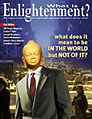
Sheikh Tosun
Bayrak
al-Jerrahi
SHEIKH TOSUN BAYRAK: Let me answer that question
by telling you a story. Ibn Arabi, who is considered to be the greatest
sheikh in Sufism, was traveling to Mecca, and he passed through Tunisia.
In Tunisia he was told that there was a holy man living there who he must visit.
This holy man was a fisherman who lived in a mud hut on the beach and caught
three fish a day, no more, and he gave the bodies of these fish to poor and
hungry people. He himself boiled the heads of the fish, and just ate the heads.
He did this day after day, year after year. He was living the life of a monastic
person, a person who has divorced himself from the world totally, and, of course,
Ibn Arabi was very impressed with this discipline. So he talked to the fisherman
and the fisherman asked, "Where are you going? Are you going to pass through
Cairo?" Ibn Arabi nodded and the fisherman said, "My sheikh lives
there. Will you please visit him and ask him for advice for me, because all
these years that I have been praying and living humbly like this, I haven't
received any advancement in my spiritual life. Please ask him to give me advice."
Ibn Arabi promised him that he would, and so when he arrived in Cairo, he
asked the people in the city where this sheikh lived and they said, "Do
you see the huge palace on the top of the hill? He lives there." So he
went to this beautiful palace on the top of the hill, knocked on the door, and
was received very well. They brought him into a large, luxurious waiting room,
gave him food to eat, and made him comfortable. But the sheikh had gone to visit
the king. And Sufis don't normally visit kings or people in high positions.
It's forbidden because they can become an additional curtain between us and
God, an additional attachment to the world.
While Ibn Arabi was in this luxurious room waiting for the sheikh, he looked
out the window and saw a procession coming. The sheikh was riding a beautiful
Arabian horse and was wearing a big turban, diamond rings, a fur coat, and had
a whole honor guard of soldiers at his side, and he arrived with great
pomp at the palace. But he was a very nice man, and came and greeted Ibn Arabi
warmly, and they sat down and started talking. At some point in the conversation,
Ibn Arabi said, "You have a student in Tunisia." And the sheikh replied,
"Yes, I know." And Ibn Arabi said, "He asked for your spiritual
advice." "Tell my student," the sheikh said, "If he's so
attached to this world, he's never going to get anywhere."
So this was confusing to Ibn Arabi, but on his trip back, he stopped in
Tunisia. He went to the fisherman there, who immediately asked, "Did you
see my sheikh?" "Yes, I saw your sheikh," he replied. "What
did he say?" asked the fisherman. And Ibn Arabi, looking uncomfortable,
said, "Well, your sheikh, you know, he lives in great pomp and great luxury."
The fisherman replied, "Yes, I know. What did he say?" So Ibn Arabi
told him: "He said as long as you're so attached to this world, you are
never going to get anywhere." And the fisherman cried and cried. "He's
right," he said, "each day, when I give those three fish bodies to
the people, my heart goes with them. Each day, I wish I could have a whole fish
instead of just a head, while my sheikh lives in great luxury but doesn't care
at all about it. Whether he has it or not, it doesn't touch him."
That's what it means to be in the world but not of the world. It means that,
as Sufis, we are supposed to be out in the world participating in the world,
but not falling in love with the world. There is a
hadith [a saying of
the Prophet Muhammad] that tells us: The world is your friend if it reminds
you of God, and it is your enemy if it makes you forget God.
WIE: One Sufi mystic is quoted as saying,
"To leave the world is not to abstain from property, wife, and children,
but to act in obedience to God and to set the things of God above those of the
world."
TB: Exactly. Another
hadith tells us
that when Allah ordered the world, he spoke to the world, saying, "World,
the one who becomes your servant, treat him as the worst of slaves. Beat him.
Make him work hard and when he dies, crush him. But if he becomes
my
servant, care for him well and when he dies, hug him like a mother would
hug her child."
That means that if you are the servant of Allah, then the world is going
to be your servant and obey you and make you rich and everything else. And when
you die, it will hug you gently like a mother caressing you. But if you forget
Allah and become the servant of the world, then the world is going to whip you,
kick you, and make you work like hell. And when you die, it's going to crush
you.
WIE: What exactly do you mean by "the
world"?
TB: Your wife, your children, your home, your
work, your money in the bank, your position in the company, your political
aspirations or affiliations, your bed at night, your shower in the morning,
your breakfast—everything!
WIE: There's a word in Arabic, dunya,
which also means "the world" or "worldly life." It seems
that it's often spoken about as something negative or as something that
tempts us away from the path.
TB: You're right. Many people think in those
terms, but let me make a correction, it's important to understand this distinction.
If
dunya makes you forget your Lord, if it makes you forget where you
came from, what your function is, and where you are going, if it makes you a
fool, then it is your enemy. But if it
reminds you that this is just
a passage, this is just a place for tests, this is just a place to prove that
you are doing what you were created for, then it is a good place, a good thing,
and a wonderful friend.
WIE: Would it be accurate to say that for
most of us, the world tends to be the former, tends to be that which draws us
away from God?
TB: It is not the world's fault. It is
your
fault. It's not the devil's fault. It is
your attachment to the world.
The world is beautiful. Allah has made it beautiful. Every spot of it is a reflection
of him. He has never created anything ugly.
You see, the Sufis believe that creation is simply a mirror. When there
is nothing in front of the mirror, it reflects nothing. But Allah is in
front of it, so all of creation is a reflection of him. We see his attributes,
the attributes of God, reflected in the mirror of creation. And that's what
we are. Everything in creation is Allah's attributes. It's not Allah, but it
is from Allah. So there is nothing wrong with the world. It is your fault that
you make a god of it. It's not the world's fault.
WIE: Many Sufi sheikhs have had wives and
families, owned businesses, and some are even said to have been great sultans.
What is it that enables a sheikh or a dervish or any spiritual seeker to live
amidst all the complexities and temptations of the world and still do the right
thing? How can we act in the world in a way that expresses nonattachment to
the world?
TB: The answer to that question is very simple.
A young German lady asked that question to my sheikh, Sheikh Muzaffer [Ozak]
Efendi, and he said, "My daughter, we are very fortunate, because we have
got a book in our hands, the Qu'ran, which we believe is from Allah, from the
Lord." The Bible is equivalent to a
hadith. In other words, it tells
us what Jesus did and what Jesus said. But we believe that the Qu'ran was
revealed by Allah and brought word by word, letter by letter, dot by dot,
to the prophet Muhammad. Through his blessed lips it came out, and not a dot
of it has changed for the last one thousand five hundred years.
We actually have three touchstones to find out whether our actions are right
or wrong. But you must act! You cannot sit on your behind, because then you're
dead. Now if the action corresponds to what Allah tells you to do in the Qu'ran,
it's definitely the right action. It is said that in the Qu'ran there are a
thousand things to do and a thousand things not to do. I certainly don't know
all of them. I know perhaps a hundred things, and even those often depend on
interpretation. So this touchstone, this test to see whether your action is
real gold or fake, is a difficult one.
The next touchstone is the imitation of the prophet Muhammad. Although he
lived one thousand five hundred years ago, the prophet Muhammad was never alone,
and everything he did and said was recorded. None of it was inconsequential—the
way he drank his water, the way he made love to his wives, the way he went
to the bathroom. There are hundreds of thousands of
hadiths of things
which he said and did, and these are easier to understand, because no interpretation
is necessary.
The third touchstone is your conscience. You have to ask your conscience,
"This action that I'm about to do, is the result going to be beneficial
for the world—for him, for her, for me, for the grass, for the cat, for the
turtle? Or is it going to be the opposite, is it going to cause pain and
hurt?" If it is beneficial, it's right; if it is not beneficial, it's
wrong.
What all of this boils down to is that we are here to ceaselessly do right
action. I just returned from a trip to Iraq to help with some of the suffering
there. I visited orphanages and hospitals and was able to donate money to help
a great many people who are suffering, especially children. And while I almost
never talk about my personal experiences, my experience there still lingers
with me, because a strange thing happened. During my few days in Iraq, I was
not there. Action was there, things were happening, but it was as if I was not
there. And I felt that that was my great, great reward which I received. And
for me that suffices.
WIE: Maybe that's the best kind of action
in the world.
TB: I hope so. Action without being there.
We have a saying in Turkish. It is
hiç, which means "nothing."
And that's the goal.
WIE: Is it ever necessary to retreat or
to step back from our involvement with the world in order to deepen our own
spiritual contemplation?
TB: There are beautiful stories about the prophet
Muhammad where he would be so lost and immersed in these intense spiritual states
that he wouldn't even recognize his own wife Aisha. He would say, "Who
are you?" and she would say, "Aisha," and he would reply, "Who
is Aisha?" You see, he wasn't there. He was so far away that he didn't
even know his own wife. But then there were other times when he would rest his
blessed head on the thigh of his wife and say, "Aisha, caress my head."
So even
he needed a little comfort. You have to come back to the
world. We are in this body, you see, and it needs things. You have to come back.





 printer friendly
 email the editors
 advertise
 reprints