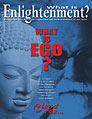
This interview was re-edited and reprinted with a special introduction for our 15th anniversary edition.
Click to read the new interview or to view the full issue.
My first encounter with Archimandrite Dionysios came,
perhaps ironically, via email. Ironic because, despite the decidedly modern
means of his communication, upon receiving it, I felt as though I had been transported
back in time a thousand years to an era when the art of writing epistles was
a revered and studied form of spiritual discourse. "Mr. Hamilton, dear
in the Lord," the letter began, "Rejoice in the Lord. It was a great
honor to receive your email of 11 September, especially after the recommendation
of our respected, common friend, in my case for a long time, the very wise Father
Basil Pennington. Please forgive me, since from the day your email came until
now I have been away . . . I will be in Greece, at the Sacred Monastery of the
Exaltation of the Holy Cross . . . and will await you there to offer you hospitality
for as long as you desire, where we can also discuss all the issues you mentioned
to me in your letter." Having written the renowned Christian Orthodox elder
to request both an interview for our magazine and advice on our upcoming pilgrimage
to Mt. Athos, the legendary "Holy Mountain" at the heart of Orthodox
monasticism, I was pleased to receive such a warm and generous response. After
a long list of suggestions for my trip, the elder added a few more kind words
of respect and appreciation, and concluded with the following: "My soul
is in trembling for fear that you will not receive my answer in time."
I had
read in the Orthodox texts of the profound humility that emanates from many
of the holy elders—men whose life of deep, contemplative prayer and asceticism
is said to have removed from them even the smallest seeds of self-concern. But
somehow, for all my searching in the scriptures, I had never expected to receive
an email quite like this. As I began to type my reply, I had the undeniable
sense, even across the fiber-optic pipeline, that the man I had encountered
was not an ordinary human being.
From
the beginning of our research for this issue, the idea of speaking with an Orthodox
elder about the ego had been an intriguing one. For although it is a tradition
in which none of us could claim expertise, we were aware that when it comes
to defining the enemy of the spiritual path, the Orthodox Christians are perhaps
in a class by themselves. To this ancient mystical branch of Christianity, which
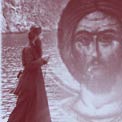
split from the Catholic Church in 1054, the total purification of the human
personality from egotism, selfishness and anything else that obstructs its capacity
to reflect the light of God is and always has been the first and final aim of
spiritual life. In sacred books with names like
The Ladder of Divine Ascent
and
The Philokalia (literally "love of the beautiful and good"),
Orthodox elders from as early as the third century write with passion and precision
about the fullblooded "spiritual combat" the sincere aspirant must
be willing to engage in if he or she is to have any hope of defeating the "demons"
within that relentlessly attack with ever new and creative tactics. In one of
countless such passages in
The Philokalia, the fourth-century desert
monk St. John Cassian writes, "[The ego] is difficult to fight against,
because it has many forms and appears in all our activities . . . When it cannot
seduce a man with extravagant clothes, it tries to tempt him by means of shabby
ones. When it cannot flatter him with honor, it inflates him by causing him
to endure what seems to be dishonor. When it cannot persuade him to feel proud
of his display of eloquence, it entices him through silence into thinking he
has achieved stillness. . . . In short, every task, every activity, gives this
malicious demon a chance for battle."
While
the word "ego" itself only appears in more contemporary translations
and commentaries, throughout even the most ancient Orthodox texts, there are
countless references to the hazards of self-love, self-esteem and the "most
sinister of demons"—pride. Considered by Christians to be the sin that
not only brought Lucifer, God's highest angel, tumbling to a fiery fate but
that also led Adam and Eve to be exiled from paradise on earth, pride is referred
to variously as "the mother of all woes" and "the first offspring
of the devil." It is also universally regarded as the most destructive
and powerful adversary on the spiritual path. As St. John Cassian writes, "Just
as a deadly plague destroys not just one member of the body, but the whole
of it, so pride corrupts the whole soul, not just part of it. . . . when the
vice of pride has become master of our wretched soul, it acts like some harsh
tyrant who has gained control of a great city, and destroys it completely, razing
it to its foundations."
To combat
the insidious ego so determined to undermine our spiritual progress from within,
the monks and nuns of Christian Orthodoxy follow a strict regime of spiritual
discipline, including silent contemplative prayer, spiritual study, group worship—and
often extreme acts of asceticism. In the belief that a life of ongoing self-deprivation
and suffering is ideal, these black-robed celibate renunciates regularly forgo
food, drink and sleep for long periods in order to purify themselves of "worldly
passions" and come closer to God.
In the
Orthodox calendar, we would learn, half the days of the year are days of fasting!
And upon reading a description of the rigorous daily monastic schedule still
widely followed in orthodox monasteries, I was dumfounded to learn that the
monks' routine of solitary prayer, work and worship, which begins at midnight,
often doesn't end until ten or eleven the next evening. As I kept searching
the schedule trying to figure out when they slept, I was informed by one father
that it is, in fact, not uncommon for monks to consistently sleep only one or
two hours per night.
And
then there are the real ascetics. . . .
In cold,
barren caves high on the slopes of Mt. Athos (a vast, rugged peninsula dedicated
entirely to monasticism), hermits spend decades in solitary prayer, often subsisting
on only "a little dry bread and water." In this ancient eremetic tradition,
dating back to the first Desert Fathers who in the third century abandoned the
world to live the solitary life, ascetic practices are at times taken to extremes
of self-mortification rivaling the most austere yogis of India. In the course
of our research, we read tales of contemporary monks who consider regular self-flagellation
with a "passion stick" to be an effective means of subduing temptation,
and others who spent years standing or kneeling in prayer on a high rock outcropping
until they became crippled. And while reading story upon story of often brutal
ascetic labors at times left me wondering whether the line between self-denial
and self-torture might have occasionally gotten blurred, I nonetheless couldn't
help but be both humbled and inspired by the lengths to which these men were
willing to go in their pursuit of life's highest aim.
For
as we would be told again and again, the asceticism practiced by Orthodox Christians
is not asceticism for its own sake but asceticism in pursuit of a very specific,
divine end—the attainment of which has come to be known as "deification."
In contrast to Western Christianity, which under the doctrine of original sin
tends to emphasize humanity's inherent frailty and imperfection, Orthodox teachings
maintain that it is not only possible—but essential—for human beings to become
perfectly transformed, radiant expressions of the Divine. Citing the words and
example of Jesus Christ who said, "Be perfect, even as your heavenly Father
is perfect," Orthodox monastics aspire to purify themselves of any trace
of ego and in so doing become an immaculate vessel for the glory and workings
of God in this world. For proof that this attainment is possible—an attainment
considered to be the singular purpose of human life and the very lifeblood of
all Orthodox aspiration—the Orthodox point always to one place: their two-thousand-year
legacy of saints, a lineage of holy men and women unbroken since the time of
the apostles.
Indeed,
in our own exploration of Orthodox mysticism for this issue, what had captured
our collective imagination most powerfully was the conviction among so many
of those we spoke with that there are in fact men and women alive today of the
same spiritual caliber as the "God-bearing" masters of old whose lives
embellish the scriptures. It was our enthusiasm to speak with such an individual
that had generated our far-ranging search for illumined Orthodox elders,
a search that eventually led us to Archimandrite Dionysios.
Born
and raised in a small town in northern Greece, it was clear from early on that
Father Dionysios would not find his home in the world. Coming from a religious
family with forefathers in the priesthood, at the age of seventeen he left home
to pursue his passion for the spirit at the historic cliff-top monastery of
Great Meteoron in central Greece. It was here that he met his spiritual father,
the widely revered elder, Archimandrite Aemilianos, and became tonsured into
the life of renunciation. When several years later the Greek tourist industry
had all but taken over the entire ancient Meteora complex, Elder Aemilianos
and his band of young monks relocated to a remote monastery on Mt. Athos and
began, along with a handful of other new brotherhoods, to reinvigorate the waning
ancient monastic haven with their zeal for the holy life.
Father
Dionysios was a bright light from the beginning, known for his unwavering devotion
to his elder and for his spirit of selfless giving, shared with all who came
to visit their monastery perched high above the Aegean Sea. It was this spirit
of generosity and passion for the monastic life that would before long bring
invitations from Europe and America and eventually lead him away from the "mountain
of silence" he called his home to help guide others along their way. Since
leaving Mt. Athos, Archimandrite Dionysios has served at a number of different
posts in Greece, Europe and America, eventually spending several years as Abbot
of Holy Cross Monastery in Jerusalem. Having recently returned to Greece, where
he was given an island on which he will soon build a monastery to house
his core group of monks, he is also overseeing a newly founded convent outside
Athens, where about forty young nuns have gathered from many different parts
of the world. It was there that I had the good fortune to spend a weekend with
this radiant elder last fall, discussing both the Orthodox teachings on the
ego and the glory and freedom that await those who make it their life's endeavor
to live beyond its confines.






 printer friendly
 email the editors
 advertise
 reprints