Mata Amritanandamayi
A tiny dark-skinned woman draped in a white sari beams as she totters down the aisle of loving devotees. Their outstretched hands are like feather plumes, waving, reaching to brush her as she leaves the crowded hall. Her face is placid, strong and fully alert, as it has been unwaveringly for the last five hours, but her exhausted body can hardly balance; it seems that she may even topple over in a faint before she reaches the waiting car outside. The right shoulder of her sari is stained dark from the sweat and tears of a thousand cheeks that have found succor there. Mata Amritanandamayi has, since early this morning, without pause for food or even a sip of water, literally held one thousand people to her bosom, listened to their troubles and their deepest spiritual longings, showered them with flower petals, pressed sweet
prasad [consecrated offerings] into their palms, blessed their photos,
malas [prayer beads] and children; and one after the other, each and every supplicant has received the same undivided cosmic love from Ammachi, the Holy Mother.
Young and old, married and single, male and female, wealthy, impoverished, beautiful, crippled, suspicious, crazy and sincere—all are welcomed without exception. And as she embraces each one, chanting softly "Ma, Ma, Ma, Ma" in each person's ear, the transmission of compassion coming from her is one steady stream that never ebbs, never wavers, and her shining face never registers even the slightest trace of preference or fear regardless of who kneels before her.
They say that Ammachi is an
avatar, an incarnation of the Divine on earth. They say that her ego has been completely destroyed, that all vestiges of identification with a separate sense of self have been annihilated. They say when she looks out, she sees only one Self in everyone.
So from one who is said to have crossed over, what can we learn about the right relationship to ego? If her eyes see only God, does the ego even exist, in her view? What is this
mahatma's [great soul's] message to true seekers of
moksha [liberation] when it comes to the most fundamental and ultimately challenging battle of spiritual life? How does her apparently infinite love manifest when it meets the enemy of her disciples, the ego?
Mata Amritanandamayi's guidance for the seeker of liberation is simple and absolute: Serve God and surrender the ego and all its desires. She says, as many of the most revered saints and sages throughout history have also proclaimed, "Contentment ensues from egolessness. And egolessness comes from devotion, love and utter surrender to the Supreme Lord."
Ammachi's public teachings take place at traditional gatherings that are called "
Devi Bhava" [literally "mood of the Goddess"] and "
darshan" [audience with a guru], where she
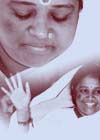
hugs and blesses all who come to see her. Almost a quarter of a million people seek her out every year, and she receives each and every one of them, giving them love and helping them with both spiritual and mundane concerns. She cannot turn anyone away, for to the Divine Mother, all are equal in their need for love. "During the
Bhava," she explains, "different kinds of people come to see me, some out of devotion, others for a solution to their worldly problems and others for relief from diseases. I discard none. Can I reject them? Are they different from me? Are we not all beads strung on the one life thread? According to each one's level of thinking, they see me. Both those who love me and those who hate me are the same to me."
Ammachi is indefatigable, or at least physical fatigue seems to weigh little on her. Her meditation on the divine current appears to drown out all bodily consciousness. Even after traveling all the way from India to Europe, or sleeping for only an hour the night before, Ammachi arrives precisely on time to give
darshan. She answers spiritual questions, distributes
bhasma [sacred healing ash] to the sick, and not until five or six hours and seven, eight or nine hundred souls later, when the very last person has been received, will she get up for food and a short rest before returning only a few hours later, again precisely on time, to chant, meditate and receive the thousand or so more spiritual pilgrims who have come for her blessing hug.
Often referring to herself in the third person, Ammachi describes the passion that animates her: "Each and every drop of Mother's blood, each and every particle of her energy is for her children [devotees]. . . . The purpose of this body and of Mother's whole life is to serve her children. Mother's only wish is that her hands should always be on someone's shoulders, consoling and caressing them and wiping their tears, even while breathing her last." Selfless service, Ammachi teaches, is the whole of her life and is the path she prescribes for spiritual seekers who are committed to transcending the ego, to destroying the separate sense of self.
By all accounts the hardest worker at her ashram in Idamannel, in southern India, Ammachi is a living example of her teaching. She can be found carrying bricks to building sites, tending cows or cleaning toilets in addition to meeting with her
brahmacharis and
brahamacharinis [male and female celibate students] and seeing to all ashram affairs. Her disciples tell stories of how, even after a long day of receiving visitors, Ammachi will cook for them and feed them like little children, with her own hand. She also fulfills a world travel and teaching schedule that keeps all of her closest devotees on the brink of exhaustion and has inspired numerous charitable works—ambitious projects that have tangibly uplifted thousands of people's lives, including a brand-new, state-of-the-art $55 million, 800-bed heart transplant hospital, an orphanage for 600 children, 5,000 free houses for the poor and one of the finest computer colleges in her native state of Kerala.
Ammachi's compassion seems virtually limitless. She is so intoxicated with God that she seems to have burned out every trace of personal desire, and many the world over revere her as the very embodiment of unconditional love. And yet, Mata Amritanandamayi, the "Mother of Immortal Bliss," has a wrathful face as well. As unconditionally accepting as she is of those who initially come to see her, for those who have chosen to live their lives under her tutelage as her disciples, she is known to be an equally demanding and exacting spiritual teacher. Her discipline can be fierce; to come close to Ammachi, her students say, is to come close to the fire.
In Ammachi's teachings, the role of the guru is to "break the ego of the disciple" so that "they can know reality." She warns them of the dangers of the ego, saying: "Blindness of the eyes is bearable and can be managed. . . . You can still have a loving and compassionate heart. But when you are blinded by the ego, you are completely blind. . . . The blindness carried by the ego pushes you into complete darkness."
Ammachi believes that the path to liberation is a path of humility and obedience, and that it is only by bowing down to the guru that the disciple can keep his or her ego in check. Long-term students readily tell stories of hardships and tests, of the "ego bashing" and "ego rebellion" that they experience at the feet of their beloved guru. They speak frequently and respectfully of the tough schedules, physical discomfort and strict discipline that have tested them more than a little. "It is not always easy being with Mother," they say, "but she helps to speed up our karma."
One Western student of thirteen years described some of the many ways Ammachi challenges her disciples and explained how in her own case Ammachi has separated her from her husband for long periods of time to help further their
sadhana [spiritual practice] and "put pressure on their egos." Ammachi's ordained students observe strict celibacy, and residents of her ashram practice eight hours of meditation a day in addition to their karma yoga [selfless service]. Her disciples sleep little, often only four hours a night, and not infrequently just one or two. "It keeps us on the edge all the time and teaches us surrender," one devotee said. "If you want for yourself, you end up frustrated and angry, so you learn to let go."
When once asked by a visitor whether hard work, like carrying bricks, doesn't unfairly tax the
brahmacharis, Ammachi without hesitation explained why she will sometimes call her students to labor even late at night after they have gone to sleep: "Amma wants to see how many of them have the spirit of selflessness, or whether they are just living for bodily comforts. On such occasions we can see if their meditation is doing them any good. We have to develop the readiness to help when others are struggling. Otherwise, what is the point of doing
tapas [austerities]?"
Ammachi knows well the weaknesses of human nature. Often when her disciples are proud or stubborn and do not heed her guidance, she will fast, refusing both food and water. Knowing that their beloved guru is going hungry on their behalf is the worst punishment they could be given, her
brahmacharis confess. "The true guru will not allow an iota of ego to grow [in a disciple]," Ammachi says. "To check the growth of pride, the guru may act in a very cruel manner. . . . People who see the blacksmith forging a hot piece of iron with his hammer may think that he is a cruel person. The iron piece may also think that nowhere can there be such a brute. But while dealing each blow, the blacksmith is only thinking of the end product. The real guru is also like this."
For some observers, Ammachi's standards for her disciples seem harsh and disconcertingly contrary to the unconditional love she expresses in her all-embracing role as the Divine Mother. And in a time when the notion of unconditional love is held so dear in the minds of many Western seekers, Mother's two opposing
bhavas [moods] challenge some deeply rooted beliefs. So what
is compassion in the face of the ego? What is the right relationship to this perennial enemy of the seeker after enlightenment? In Paris, for two and a half hours in the middle of Ammachi's
darshan, I had the rare privilege of interviewing this extraordinary woman for this issue of
WIE.





 printer friendly
 email the editors
 advertise
 reprints