No Man's LandAn interview with Mary Daly by Susan Bridle
introduction
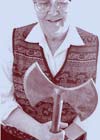
"Even if I were the only one, I would still be a Radical Feminist!" proclaims the feminist revolutionary Mary Daly in her latest book, Quintessence. Described as both "a prophet" and "the grande dame of feminist theology," Daly has, for more than three decades, committed her every waking breath to a single purpose: seeing, naming and dissecting the structures of patriarchy in order to liberate women's minds, bodies and spirits from its oppression. One of the most revered visionaries of the contemporary women's liberation movement, Daly, who holds six graduate degrees, including three doctorates in religion, theology and philosophy, lectures throughout the world, is the author of seven groundbreaking works of feminist philosophy, and has taught much-debated women-only courses in women's studies at Boston College since 1974. No stranger to controversy throughout her illustrious career, Daly is making headlines this year because Boston College, now under pressure from a conservative Washington, D.C., legal foundation, is demanding that she begin to admit male students into her classroom—or retire. The Boston Globe described Daly's latest stand against the Jesuit-run institution—from which she is not budging—as "a battle of principle, a fitting finale to a career that has sought no less than to alter the course of world civilization." Six months ago, when we first started working on this issue of WIE, we knew we wanted to speak with someone who could bring a penetrating feminist perspective to the subjects of women in religious traditions and the role of gender identity on the spiritual path. We soon found that while much important research has been done in this field over the past thirty years, if you want to speak with someone unrelentingly passionate about liberating women from the confines of patriarchal institutions and unabashedly zealous about establishing a feminist spiritual vision, all roads lead to Mary Daly. The radical nature of Daly's work infiltrates the very groundwater of the consciousness of patriarchy and attempts to unearth what holds it in place—and what is so close and so taken for granted that most, before encountering her ideas, never consider questioning. She speaks the unspoken, cataloging with razorlike acuity and freight-train force the history of ritualized oppression and violence against women, and drawing clear causal connections to patriarchal religions and gods with male names and male faces. Lauded as "a demolition derbyist of patriarchal 'mindbindings,'" she has penetrated into the structures of language, thought and image; she tears away veils upon veils; she confronts, rattles, inspires—and demands that the issues she raises be dealt with. "I came to see that all of the so-called major religions," she writes, "from buddhism and hinduism to islam, judaism, and christianity, as well as such secular derivatives as freudianism, jungianism, marxism, and maoism—are mere sects, infrastructures of the edifice of patriarchy. . . . That revelation continues to work subliminally, inspiring my humor and stoking the Fires of my Fury not merely against the catholic church and all other religions and institutions that are the tentacles of patriarchy but against everything that dulls and diminishes women. Through me, it shouts messages meant for all women within Earshot: 'Tell on them! Laugh out loud at their pompous penile processions! Reverse their reversals! Decode their "mysteries"! Break their taboos! Spin tapestries of your own creation! Sin Big!'" I was naïve enough to think, when I first approached Daly for an interview, that she would be eager to have a platform to express her views in a respected spiritual magazine dedicating an issue to the subject of gender. I couldn't chave been more misguided. When she saw the word "enlightenment" on the cover of the sample issue I'd sent her—and even worse, when she saw a photograph of the Dalai Lama—she immediately pegged the publication as a cog in the machine of patriarchy and wanted nothing to do with us. Furthermore, the idea of gender includes "men"—a word she is loathe to utter—and even the word "spiritual" is to her but another trapping of the patriarchal ideologies she left behind long ago. But after numerous telephone conversations in which I pleaded our case, she finally relented, partially through the force of my persistence and partially because she knew that I had been affected by reading her books; she sensed in me a fledgling feminist who could perhaps be "saved." When I eventually met Daly in person, in her small, cluttered apartment near Boston College, shelves, tables and hairs tumbling with books, radical feminist manifestos and posters inciting revolution curling off the walls, wide desk piled high, I met a woman who is every bit the radical feminist separatist she is renowned to be. Fierce, unbound by convention, and willing to risk everything for the sake of her mission, she is a woman who has gone so far with her ideas and her commitment to them that she truly seems to have stepped outside of the world as we know it. Championing deep identification as woman with distinctly woman's experience, she seeks to invoke an "other reality" and establish a "homeland of women who identify as women." Thrilled to finally have the opportunity to speak with her, I came armed with some challenging questions that were sure to be provocative and sure to shed light on that delicate territory where spiritual liberation meets (or doesn't meet) women's liberation. I was also very curious to find out if she really believed, as it seemed from her books, that the cause of every possible problem in this world, both inner and outer, is the evil of patriarchy, or, in other words, men. Meeting Mary Daly, if you are a woman, is meeting a muse, a Siren, who beckons you to step through the mists of time into an enchanted, gynocentric other reality, an Avalon of only women's making. If you are a man . . . well, hold on tight. For Mary Daly is still, at age seventy, a labrys-wielding force of nature who will not rest until the world as we know it is turned upside down. As she writes in her philosophical autobiography, "There are and will be those who think I have gone overboard. Let them rest assured that this assessment is correct, probably beyond their wildest imaginations, and that I will continue to do so." interview WIE: In this issue of our magazine, we're exploring gender identity in relationship to spiritual realization or enlightenment. We're speaking with a number of people who have very different perspectives on this subject, and we were very eager to speak with you because you are one of the most radical and outspoken feminists alive today as well as a visionary theologian. MARY DALY: Well, I would never create a magazine or a journal with that as a subject. It feels foreign. And I'm not trying to put you down, but what makes me feel alien from it is that it's so much in the patriarchal mode. Even to talk about "gender identity"—what the hell is that? WIE: That's what we're interested in finding out. MD: You see, I don't care. It really doesn't interest me much. I am a woman. I know that. No one's going to disabuse me of that. WIE: What is your concept of spiritual liberation? MD: It's not an expression I ever use. WIE: Another way to approach this would be to speak about spiritual aspiration. MD: Radical feminists who talk to me ask me questions in my language. You're asking: "What is your concept of . . . ?" Well, I don't have a concept of that because I'm not one of you. There was a point a few years ago when I stopped using the word "spiritual." WIE: Why is that? MD: Because it sounds too much like dichotomizing mind/body. And, in fact, when I do speak of spirit and matter, I often hyphenate it: "spirit-matter," for the reason that I don't like to dichotomize. I think matter is extremely alive and spiritual in the deepest sense. And so "spiritual" usually just doesn't do because it seems to carry with it that baggage of dichotomizing. So whenever possible I use the word "elemental." By "elemental" I mean a lot of things; the four elements: earth, air, fire, water—but also the ether. And in ancient Greek philosophy the primal sounds of the alphabet were called elemental, and angels were elementals. And the universe, the earth, stars, other planets and the suns were also called elements, or "stoicheia." It's something vast. My work follows in that tradition of bonding—recognizing and realizing, meaning also actualizing, our connection with the universe. So, the word I commonly use for the ultimate reality—I won't say "God," that's dead—is "the universe.I'll say "spirit," but meaning a principle of life within all being, including rocks. And I have used capital "B," Be-ing, to represent the verb God. WIE: Can you explain that a bit further? MD: A thousand years ago, when I was studying standard scholastic philosophy, God was called the "supreme being." And that made him a noun and something on high. Hierarchical. Yahweh. The hairy claw coming down. And that obviously is unsatisfactory. It always has images hanging around that are undesirable. Then I realized, with the help of a friend of mine, Nelle Morton, that "being" is a verb, and it should be hyphenated [be-ing]. When you do that, everything changes. I would also say that the universe is a verb. There are other ways of describing this ultimate/intimate reality. It's a mode of existence in which we profoundly realize and actualize our connectedness in multiple ways. It's Be-ing, capital "B," but understood as luminous, joyous, what Aristotle called the harmony of the spheres; representing an aspect of integrity, integrity beyond integrity. I think it's beyond spiritual. I mean, my cat wouldn't be concerned with "spiritual liberation"; she's all spirit, she's absolutely in-spirited. I used to talk about the women's movement in the seventies as a "spiritual revolution," and that's better than "liberation" to me. But then I got over that too and moved on. WIE: It sounds like the vision you're describing is a sensitivity to and a connectedness with the life force or presence in everything, animate and inanimate. MD: Yes, and it's a recognition of our connection with the entire universe—microcosm and macrocosm. We don't necessarily have to know everything that's out there—that isn't the point—but it's a sense of striving for connectedness and a joy in that. I look at the sunset here, or experiences of nature, aesthetic experiences, and experiences of creativity and of the power of fighting, overcoming fear. WIE: Do you believe that there are differences between men's and women's capacities to realize and embrace what you've just been speaking about? MD: Okay . . . I could give you some sort of answer, but it's not the kind of question that intrigues me because I don't think about men. I really don't care about them. I'm concerned with women's capacities, which have been infinitely diminished under patriarchy. Not that they've disappeared, but they've been made subliminal. I'm concerned with women enlarging our capacities, actualizing them. So that takes all my energy. I'm not interested in the differences between women and men. I really am totally uninterested in men's capacities. If you've read my books, you might notice that I don't talk about their capacities. They talk about it all the time and they try to make it inclusive: "Oh, yeah, you're included, too." But I'm talking about something else. I'm trying to name something that can only be recognized by women who are seizing back our power. But the words have been stolen from us—even though perhaps they were originally our words—they're our words, but they've been reversed and twisted and shrunken. I see myself as a pirate, plundering and smuggling back to women that which has been stolen from us. But it hasn't simply been stolen; it's been stolen and reversed. For example, the christian trinity is the triple goddess reversed. The trinity is aptly described as a closed triangle. It doesn't go anywhere. It's clonehood. WIE: What do you mean by "clonehood"? MD: "The father, son and holy ghost, the three men I admire the most . . ." In catholic or medieval theology, the father generates the son, and the son and the father together "spirate" the holy spirit. That's technical Thomistic terminology. They're coeternal, so although there's this illusion of activity, nothing is happening. It's utterly male in its stagnation and utterly male in its repetitiveness. So it's not surprising to me that ultimately they would come, in their destruction of the earth and of all living beings, to cloning. Because sameness is the name of patriarchy; it's the name of the game. WIE: You see cloning as a product of patriarchy? MD: It's the living out of patriarchal myth. They live it out through their technology as well as through their religion, their art, their societal structures, their economies and their wars. It's always the same. Their wars are the same. It's infinitely the same. "Getting their big gun off," as Valerie Solanas said. WIE: While I understand that this isn't a focus for you, I'd like to come back to the question of differences between women's and men's approaches— MD: You know, I don't mean to be unpleasant, but we're coming from different worlds. I was trained in that world of thinking, a certain christian or Western philosophical way, but I don't want to be drawn into talking that way because I don't relate to it and it irritates me. What I love is the way women think. And what's so precious about my space at Boston College is that it's women's space. When you get a teacher and students who really want to be with women, and we seize the space and read philosophical works and literature by women, they begin to think like themselves. They feel as if they've come home again. And that is the very groundwork of radical feminism. So if our space is taken away from us, which is what they're attempting to do at Boston College, then so is the possibility of that kind of, I won't call it dialogue, that kind of spinning conversation, of matching experiences. It's not debating, which is a male thing. Something new begins to happen, and that's why new words have happened for me: because the old language, the patriarchal language, does not contain words that are adequate to name women's experience. And it is so exciting. I'm talking about women's elemental experience. I was brought up in the patriarchal way of thinking. I spent years in school getting degree after degree after degree taught by patriarchs. At Fribourg I was with all male fellow students: two hundred seminarians and priests and me. I know how they think and I abhor it. WIE: So would you say that women inherently have a greater capacity to realize the interconnectedness of the entire universe that you've been speaking about? MD: Comparisons with men are beside the point. I think women have a great capacity to realize that interconnectedness. I have not seen this in men. There may be exceptions, but I'm not interested in that. In the early seventies, Susan Griffin wrote a book called Women and Nature: The Roaring Inside Her, and it was totally about the connectedness of women and nature. And I have always emphasized that myself. But one of the horrible, self-censoring and destructive events within women's studies and the so-called women's community that happened—and I'm sure it was imbedded from some alien source—was that any woman who said that women have a special connection with nature, or that there's anything like a "female nature," was called an "essentialist," and that was the "worst" thing you could possibly say. I have been accused of being an essentialist, and so has anyone else I respect. But I'll also argue that whether or not they're inherent, the fact is that the differences between men and women are there, even if it's just through millennia of conditioning. I, of course, think it's inherent. But even if it were cultural, the fact is that this is the way to go if you're biophilic. What I'm concerned with is the war between biophilia and necrophilia. It's love of life versus hatred of life. Necrophilia translates strictly into love of death, or loving the dead—actually f—ing corpses. And in general, patriarchal culture is necrophilic, fixated on hatred of life and love of death. WIE: It sounds like you're defining the male mode of expression as necrophilic and the female as biophilic. That's quite an extreme distinction. MD: Look, turn on the news anytime and see what is going on. Kosovo—are women doing that? Look at anything; it's so omnipresent that it's laughable that one would not see it. How many women rape? I'm just telling you that if I say that in a simplistic way, everyone will be on me for being an essentialist. That's why, on a certain level, my book title "Quintessence" is a joke title. I mean it profoundly for what it is. But also, I can always say, "Ah, I'm not an essentialist, I'm a quintessentialist"—I'm worse than you ever could imagine! WIE: What do you think of the idea that one is a human being or spiritual being first, and then one happens to be male or female? MD: "Human being" I got rid of a long time ago. No. Absolutely not. It's alien. I've been through that. I've been there. I've thought about that. WIE: What do you feel are the limits of that way of thinking? MD: I wrote about human beings in The Church and the Second Sex, which was published in 1968. I wanted to liberate "human beings," and I found out that the whole thing was fallacious because there's a false inclusion, as if there were greater similarity between women and men than there is difference. Let me try to put it in a way that may convey some of the landscape. If we lived in a gynocentric society, first of all, it wouldn't be matriarchal; it wouldn't be like patriarchy transposed with big mama on top instead of big papa. It would be totally different, and I believe that it was before patriarchy came—this evil. And men would be different, too. They would not have been socialized into this—assuming that they have been socialized into it and they're not all mutants—they would be different because the female way of seeing things would be, I don't want to say "dominant" because that's a patriarchal word, but it would be all-pervasive. And you do meet some men like that—I never fully trust it—but you do. Some are less tinged by the patriarchal mode. So having that in your mind, and living to some extent already in that future, an archaic future that is rooted in a deep past, I have a sense of identity that isn't easily described in this kind of discourse. These kinds of questions are always too crisp. They seem very logical, but they're not. In my opinion, they're not. I would never ask what identity is primary. In the past somehow I made a switch from being "a human being who happens to be female." But I never really believed "happens to be" because at the core of my being I'm female. I know who I am, and therefore I could not be other than a radical feminist once that idea was available to me. You're taking what I consider to be a very primitive set of ideas and asking me to speak about what I might have thought about those ideas twenty or thirty years ago. You see, "human being" doesn't really say much of anything to me. I don't know if I'm getting it through to you or not, but I'm not a member of a class called "human being." There is a tremendous uniqueness, but that uniqueness surfaces only when you have a predominantly female mode of being that is at the same time daringly, forcefully breaking out of the patriarchal mode of thinking. So, no, I don't feel at all like a human being. I hate the "human species"—look at it! I hate what it is doing to this earth: the invasion of everything. The last two frontiers are the genetic wilderness and the space wilderness; they've colonized everything else. It's a totally invasive mentality—rapist. That is alien, and insofar as I've internalized any of that, I'm sorry. I'm contaminated by it. We all are. But I try not to be, and with every step I at least try to be biophilic, which is what would be required to break out of the human species. WIE: In your book Beyond God the Father, you call into question the image of the male-gendered God. You write: "The biblical and popular image of God as a great patriarch in heaven, rewarding and punishing according to his mysterious and seemingly arbitrary will, has dominated the imagination of millions over thousands of years. The symbol of the Father God, spawned in the human imagination and sustained as plausible by patriarchy, has in turn rendered service to this type of society by making its mechanisms for the oppression of women appear right and fitting. If God in 'his' heaven is a father ruling 'his' people, then it is in the 'nature' of things and according to divine plan and the order of the universe that society be male-dominated." Your challenge of the image of the male-gendered God has without a doubt made many people deeply question the idea of a God with a male face, as well as the limiting and damaging effects of this image on our social, political and cultural structures. Now, many feminists have responded to this by replacing the word "God" with "Goddess," and by replacing the image of God as Father with the image of Goddess as Mother. Sam Keen, author of Fire in the Belly: On Being a Man, whom we also interviewed for this issue of our magazine, said that "we do not begin to get on a spiritual journey until we go beyond the gendered metaphors for God. What in the world could it possibly mean to say Mother Nature? What's motherly about it as opposed to fatherly or brotherly?" While he specifically said that he appreciates the work you've done to dismantle the image of God the Father, he also said, "I think Mary Daly should be as critical of [God the Mother] as she has been of the notion of God the Father." What do you think about this? MD: You see, I don't care what Sam Keen thinks. Do you understand? If that seems like the epitome of arrogance, so be it. How can I care what he thinks? He doesn't get it. WIE: Right. Well, I'm not so much specifically asking about him personally, but about the idea that gendered images for God—male or female—are ultimately limited. MD: Well, it's not totally adequate because it assumes that there are two sexes throughout the universe. These are the models for reality, and I don't know if there are a hundred sexes or if sex would be of any interest whatsoever in some system other than our solar system. How can I know? So it's limited, but insofar as our experience gives us images, certainly the female is more appropriate for talking about nurturing life, loving and creativity on every level. If you have to choose between the two, female obviously is better. And I don't even have to choose between the two; I mean, the other isn't worth consideration anymore. It's just hanging all over putridly. So, I wouldn't call the book "Beyond God the Father" now, I'd just say "Beyond God." Keen's perspective, aside from the fact that I would totally disagree with it, is dated. The patriarchs have more sophisticated kinds of arguments now. Particularly the postmodernists: "I'm a person gendered as feminine." Think how disempowering that is. You can't get out and say, "I'm for women. Women's liberation." It's "the liberation of persons gendered as feminine." There's nothing in that that makes your blood roar! There's no power in it. WIE: As you know, Buddhism is becoming increasingly popular in the West, particularly among men and women who for various reasons are critical of the views and structures of Christianity. Many believe that Buddhism is more in line with modern humanistic ideals. And the Dalai Lama is almost universally revered for his embodiment of what are considered by some to be exclusively "feminine" qualities—qualities such as nonviolence, compassion and concern for the environment. Interestingly, however, a number of statements attributed to the Buddha seem to reveal that he had strong convictions about the spiritual superiority of men. This has been very challenging for Western women coming to Buddhism, and has often been set to one side if not completely avoided. In the Pali Canon [principle Buddhist scriptures], the Buddha is reported to have said: "Ananda, if women had not obtained the Going Forth from the house life into homelessness in the Law and Discipline declared by the Perfect One [acceptance into the Buddha's monastic order], the Holy Life would have lasted long, the Holy Life would have lasted a thousand years. But now, since women have obtained it, the Holy Life will last only five hundred years. Just as when the blight called gray mildew falls on a field of ripening rice, that field of ripening rice does not last long—so too in the Law and Discipline in which women obtain the Going Forth, the Holy Life does not last long." MD: It's just the same old song in a different language: "Women pollute." WIE: My question is: How do you think that Gautama the Buddha could have come to such an extreme position about half of the human race? What would you say to a Western Buddhist woman wrestling with the apparent incongruity of such an enlightened being holding such a woman-negative view? MD: As I wrote in Gyn/Ecology: all patriarchal religions are patriarchal—right? They take different forms. What would I think? There's nothing to think about. It has taken another form—seductive, probably, because christianity is so overtly warlike and abusive. And furthermore, I don't know what "enlightened" means. It's not a word that's in my vocabulary. This is like a christian woman being upset over something that Paul said, instead of seeing that of course he's an asshole. He's one more very macho asshole described as a saint and as enlightened, and once you get over that, you get over it. You see it for what it is and you don't worry about why he would say such a thing. Of course he would say such a thing. That's what he is. It's really extremely simple. Stop wrestling with it; it's not interesting. Get out of it. That would be my approach to it. Misogynists! Hateful! All of them! I studied them. And finally I just didn't try to reason with it anymore. Boston College was most enlightening to me. The experience of being fired for writing The Church and the Second Sex introduced me to the idea that it's not going to change. That's the way it is—leave it. WIE: In the past couple of decades, there has been increasing interest in prepatriarchal agrarian societies that worshipped female deities. While there is evidence that these societies were more egalitarian in their views of and roles for men and women, some people criticize the current fascination with these goddess cultures as a rewriting of history, a creation of a fictional paradise lost. Once again, Sam Keen writes: "We need to question the historical romanticism of feminist ideology. . . . When God was a woman—Isis, Ishtar, Artemis, Diana, Kali, Demeter—she was a terrible mother, as bloody as God the Father. . . . If nature is the goddess we must claim her dark and demonic sides, and not merely her nurturing qualities. . . . Slavery, forced labor, injustice are not modern or 'patriarchal' inventions." What is your response to Keen's assertion that the lauding of these matrifocal societies is "historical romanticism"? MD: First of all, if it's only matrilineal and matrifocal, it's not really prepatriarchal. Prepatriarchal would be really ancient—gynocentric. And so what he's speaking about, as I understand it, is already patriarchy on the way. I'm talking about a really woman-centered society of which we have no direct memory. But, as Monique Wittig said, "If you can't remember, invent." Part of it has to be created because most of the records have been destroyed. All of what he's talking about is an intermediary stage. WIE: Because you also speak about inventing an image of an idyllic prehistoric culture, it sounds like you're not concerned with any risk of romanticization. MD: What is the risk? I mean, we live in hell. This is called hell. H-E-L-L—patriarchy. Do you watch TV and see the stuff from Kosovo? The ethnic cleansing, genocide—watching them get on trains and go off to nowhere and starve and die and have the shit bombed out of them by NATO. Is it romantic to try to remember something better than that? There's a reality gap here. How can I make it clearer? We're living in hell and he's talking about a danger of romanticism in imagining something that is a hope for something better in the future? I think that the question comes from not looking deeply enough at the horror of phallocracy, penocracy, jockocracy, cockocracy, call it whatever—patriarchy. If you experience the horror of what is happening to women all the time, it is almost unbearable, right? All the time! And a lot of it is mental horror, spiritual horror, together with the physical horror and the atrocities that I've analyzed in detail. Then, when you are acutely aware of that and desire to exorcise it, the exorcism welcomes, requires, some kind of dream. The accusation of romanticism belongs to a detached intellect, not seeing the desperate need for escape from where we are. And when I speak, it's out of desperation; I know it! I know what women's lives are like! Intuitively, instinctively, experientially, I know. I don't have to have been there in prison and had my genitals cut up and experienced the horrors that happen to women now—I am existentially aware of it. So I don't have patience with that. WIE: Some people say that exclusively blaming men for the patriarchy is misguided. Transpersonal theorist Ken Wilber, in an article entitled "Don't Blame Men for the Patriarchy," writes: "'Patriarchy' is a word that is always pronounced with scorn and disgust. The obvious and naïve solution is to simply say that men imposed the patriarchy on women. But alas, it is nowhere near that simple. . . . If we take the standard response—that the patriarchy was imposed on women by a bunch of sadistic and power-hungry men—then we are locked into two inescapable definitions of men and women. Namely, men are pigs and women are sheep. . . . But men are simply not that piggy, and women not that sheepy. One of the things I try to do . . . is to trace out the hidden power that women have had and that influenced and cocreated the various cultural structures throughout history, including patriarchy. Among other things, this releases men from being defined as total schmucks and releases women from being defined as duped, brainwashed and herded." MD: Usually for someone at that state of consciousness—which is unconsciousness—if anything would work, it would be to make the analogy with racism. Because that's back where he is in that. It would be like saying, "Well, that this is a racist society is the fault of blacks, too, and you can't just blame white people for a racist society. The others must have collaborated in it." And the fallacies become immediately obvious, don't they, when you speak of that case. So it works for me to just make that comparison and see if they can flounder their way through it. You could say certainly that some blacks would appear to have collaborated in that, but it's shallow sounding. It doesn't work, although there have been "Uncle Toms" and all that. So that's the way I would approach it. WIE: Along similar lines, Sam Keen told us: "Men and women have been in this thing together all along. . . . Any time you put the blame on one of the genders, you have rendered the other inferior. . . . In America, women are just as injurious to the world as men are." He has also written: "Are we to excuse womankind from complicity and active participation in the spoiling of the environment? Go to any mall and watch the frenzied buying of the latest fashions, any landfill and see the mountain of disposable diapers and trash, any thrift store and count the discarded items of serviceable but no longer 'stylish' clothes and appliances, and it will be obvious that womankind is as compulsive a consumer as mankind. . . . There is an existential and moral fallacy involved in seeking to transfer all the blame . . . onto the shoulders of men. The issue is not genderal. We all have dirty hands." MD: I can't stand it. He's too smart for me. It's just not worth answering. Each sentence is full of falsities. Again, it's like saying the blacks get the benefit of supermarkets over here and things that they don't have in the jungles and villages of Africa—so what? It's true that to be a feminist now absolutely requires being an ecofeminist or what I would call a "Radical Elemental Feminist." There's no way that you can accept the pollution and the destruction of animals and the harm to nature out there because what happens to nature is happening to us; we're sisters. But I just want to say that in with this "frenzied buying" statement there is nothing about the context. Why are women so frenzied to buy the latest fashions? Because their lives are so empty and they've had no opportunities. Because their self-image has been so damaged. I can go on and on about the damage that has been done to women under patriarchy. And then women are blamed for going out and buying all the time, but there's nothing left for them when their creativity has been smashed. This is very woman-hating, the way it's written. It's not that I don't get mad at women for their complicity, but it's not the same level of being mad. I can get so angry at tokenized women—women who sell their sisters out. It happens all the time on a more sophisticated level, but I always have to remind myself to go to the source. It's more annoying to see women doing it because I believe they have the inherent capacity to do better than that. But I also see how they've been smashed down, and so I always go to the source. Why are women the way they are, the ones who are woman-hating, who have all of those hideous qualities that women get in patriarchy? I hate that, too—to have to see women in that condition is hateful, it's disgusting. But you see, I have great respect for the inner power in women that can grasp far more than is attributed to them. I don't just think that I'm smarter than Sam Keen. I think many, many women are smarter than Sam Keen. One of the typical ironies of patriarchal society is that he gets to have a voice, while you can walk around and talk to many highly intelligent women on the street whose voices are not heard and who have insights he lacks. Yet he gets to have a "name"; that's the joke of it. And for me to honor that is ridiculous. No woman who is really on track would be wanting to read these men—they're boring. I think that emphasizing male authors in this context serves no purpose. Why not take some radical feminist texts and talk about them? Maybe you're writing for the wrong audience. Look, are we trying to raise the energy level, to convey joy in life, to convey biophilia and encourage the biophilia that's in women? Or are we trying to just go on dialoguing with these men? What I try to do is speak to women on the highest level of vibration that there is, and those who can hear, who can sense, on that level do get it. And then they can spread it to others; there's a ripple effect. Women, my tribe, radical lesbian feminists—the women who get it—are overjoyed to have their lives affirmed. And I want that joy to exist because that inspires courage and movement forward and creativity. That's my job. WIE: In your latest book, Quintessence, you describe a utopian society of the future, on a continent populated entirely by women, where procreation occurs through parthenogenesis, without the participation of men. What is your vision for a postpatriarchal world? Is it similar to what you described in the book? MD: You can read Quintessence and you can get a sense of it. It's a description of an alternative future. It's there partly as a device and partly because it's a dream. There could be many alternative futures, but some of the elements are constant: that it would be women only; that it would be women generating the energy throughout the universe; that much of the contamination, both physical and mental, has been dealt with. Also, my favorite word is not "postpatriarchal." It's "metapatriarchal." The prefix "meta" has four meanings. It's transformative of, in the background of, beyond, or transcending. It isn't just post or after in linear time. So we can, right now, even though patriarchy is all around, try to live metapatriarchally. You can try to be metapatriarchal by not succumbing to all the rules and roles and games of patriarchy. WIE: In Quintessence, your idyllic continent is inhabited by women only, but the rest of the world is inhabited by women and men. MD: I didn't say how many men were there. WIE: Which brings us to another question I wanted to ask you. Sally Miller Gearhart, in her article "The Future—If There Is One—Is Female" writes: "At least three further requirements supplement the strategies of environmentalists if we were to create and preserve a less violent world. 1) Every culture must begin to affirm the female future. 2) Species responsibility must be returned to women in every culture. 3) The proportion of men must be reduced to and maintained at approximately ten percent of the human race." What do you think about this statement? MD: I think it's not a bad idea at all. If life is to survive on this planet, there must be a decontamination of the Earth. I think this will be accompanied by an evolutionary process that will result in a drastic reduction of the population of males. People are afraid to say that kind of stuff anymore. WIE: Yes. I find myself now thinking that's a bit shocking. MD: Well, it's shocking that it would be shocking. WIE: So it doesn't sound like your vision of a separate nation for women is something you see as an interim stage that would eventually lead to men and women living together in true equality. MD: No. That's a very old question. I answered that to audiences twenty-five, thirty years ago. I just don't think that way. See, right now, I would be totally joyous to have a great community of women—whether men are somewhere out on the periphery or not. I don't have this goal of: "Oh, then we can all get together again!" That doesn't seem to be a very promising future. So why would I think about it? I think it's pretty evident that men are not central to my thought. WIE: I have one last question. At the beginning of this interview, you spoke about the experience of being deeply at one with that which animates all of life. I wanted to ask you what you think about the possibility of becoming identified with that as who one ultimately is, having that as one's ultimate resting place, or ground, so to speak, and where one's gender would no longer be a primary reference point. MD: I don't know if that has anything to do with my experience. I have my own experience of oneness. Sometimes I have ecstasy and a kind of active repose in connection with nature. It's tremendous. But I never forget that I'm a woman, because this is me. I know who I am. I have Female integrity. |