The memory is still crystal clear in my mind. It was the summer of 1996, and like most days in Marin County, California, the sky was blue, the sun was shining, and a warm breeze was blowing in off the San Francisco Bay. I had been working for about twelve months as sales manager of a company that provided screenprinted sportswear to the Bay Area's multibillion-dollar software industry, and at the end of what had been a banner week in an unbelievable month of sales, I had just had my most profitable day yet. "I can do no wrong!" I thought to myself as I cleared the last bits of paperwork off my desk and began to close down the office for the weekend. "What will it be next?"
In my brief tenure with the company, I had more than doubled its sales volume, and in what seemed an almost uncanny run of good luck, I had just closed three of my biggest deals ever and over the last four hours had received about half a dozen calls from clients placing substantial reorders. As I locked the door and made my way out to the parking lot, I could hardly contain myself. It seemed that the telephone had become a sort of golden pipeline from which flowed an almost endless stream of business, and that I had somehow become the Midas whose touch made it all happen. The sunshine and sea breeze only magnified my sense of exhilaration, and as I climbed into my newly purchased Saab and slipped a CD into the stereo, a strange and irresistible ecstasy started to well up inside me. Suddenly it all seemed so effortless. All those months of pushing through my own resistance, of challenging head-on my fear of failure (and of success), of questioning, questioning, questioning my approach, and of making that extra push to be sure I was giving one hundred percent had somehow come together in a sort of crescendo of positivity, of possibility, of unstoppable confidence. Driving home, I felt almost like I was having a spiritual experience. I couldn't stop smiling, and at times even laughing, as wave after wave of this ecstatic feeling of invincibility, of freedom from limitation, washed over me.
But for all of its vibrancy, all of its utterly life-affirming radiance, there was something about my ecstatic reverie in the car that day that made me hesitate. Having lived at that point for four years in a serious spiritual community under the guidance of a powerful teacher of enlightenment, experiences of ecstasy, joy and liberation had become a frequent occurrence in my life. But I had never experienced
anything like
this—anything simultaneously so powerful and so . . . well, so full of
me. At the time, I didn't quite know why, but I just had a sense that the freedom and power this current of explosive possibility seemed to offer was not what I was looking for. I put on the brakes—metaphorically speaking—and although I never fully understood what happened that day, and have wondered ever since just what that power, that thrill, could have been, as I exited the freeway and made my way down the last few tree-lined blocks toward home, I decided to leave it behind.
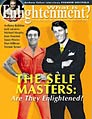
Fast forward to fall 1998, present day, Berkshire mountains, Massachusetts. In preparing for this issue of
What Is Enlightenment?, we are studying the works of the greatest Self Masters of our time and asking what, if anything, their teachings have to do with enlightenment. For the last few nights, we've been

reading and discussing the books of the world's most popular motivational speaker, Anthony Robbins, and tonight we're listening to his tape
Awaken the Giant Within. On it, he speaks passionately about the liberation and exhilaration he experienced in transforming his life from one of failure to one of unbelievable success, and implores each of us to take control of our destiny by harnessing the unstoppable power of decision and "taking massive action." All of a sudden, like a flashback, like déjà vu, it hits me. This was my experience in California! This must have been what it was all about! What he is describing must be the freedom, the sense of possibility and enormous power that I had experienced that day in the car. I recall that I rejected it at the time as being at cross-purposes to my pursuit of enlightenment. I wonder if, in the context of our investigation into the relationship between self-mastery and enlightenment, I will be able to reject it so easily now.
Prior to beginning our research for this issue of
What Is Enlightenment?, when I heard the name Anthony Robbins I thought of the can-do guy with the million-dollar smile whose late-night TV infomercials had catapulted him to international success as a motivational speaker. And granted, if Robbins has a trademark, his videotaped poolside chat with former football pro Fran Tarkenton about the potential we all have to master every aspect of our lives is certainly it. In fact, as a result of those infomercials, Robbins holds the unique position of having sold more audiotapes worldwide than Michael Jackson—over thirty million to date. But Anthony Robbins, I would soon discover, is much more than a charismatic speaker with a good marketing campaign. In his inspired call for greatness in all areas of life, he has profoundly impacted leading figures in fields from athletics to the arts, from business to politics, from education to philanthropy.
Robbins's list of clients reads like a veritable
Who's Who in the field of excellence. He has been personal "peak performance coach" to the President of the United States, Fortune 500 CEOs, professional sports teams, world-class musicians and champion athletes. He has addressed distinguished audiences from Great Britain's Parliament to Harvard Business School, and the International Chamber of Commerce recently honored him as one of the ten "Outstanding People of the World." He is the owner of nine companies, and the head of a national foundation that organizes and sponsors projects to serve the homeless, inner-city youth, prisoners and the elderly. His two books,
Unlimited Power and
Awaken the Giant Within, have collectively sold over three million copies, and his seminars, now taught worldwide—with titles such as "Unleash the Power Within," "Life Mastery," "The Competitive Edge," and "Date with Destiny"—draw thousands, and have inspired hundreds of thousands to walk barefoot across a bed of red-hot coals. When Anthony Robbins talks about self-mastery, it would seem, the world listens.
In preparing for this issue of our magazine, while we examined the work of many of today's leading authorities in the field of self-mastery, few captured our interest like Anthony Robbins. In fact, there are few individuals alive today with as much experience as Robbins in helping people to go beyond their self-conceived limitations and reach for their highest potential. Who is this human phenomenon, we wondered, who, with only a high school education, had earned his first million dollars by the age of twenty-two, and who now, at the age of thirty-eight, has won the respect and attention of many of today's most successful and influential people? Where does his overwhelming positivity and confidence, his almost religious zeal, come from? And what have his years of pushing the edge of human potential taught him about self-mastery? About enlightenment?
Robbins's life story is the kind of rags-to-riches tale that makes red-blooded Americans burst into song at the sight of the flag. Born and raised in a low-income suburb of Los Angeles and kicked out of his house at the age of seventeen for being "too intense," he quickly found his first vocation: sales, a career which, combined with his voracious appetite for personal growth books (he read over seven hundred such books in a period of a few years), soon found him in the seminar business, initially selling tickets for a popular motivational speaker. While his remarkable ability to sell tickets to almost anyone (he broke all the sales records in his first month) soon catapulted him from his four-hundred-square-foot apartment into an income bracket beyond his dreams, it wasn't until he started giving his own seminars that his destiny began to take shape.
It was early 1983 when Robbins first encountered NLP (Neuro-Linguistic Programming), a radical and relatively new therapeutic technique promising to deliver instant transformation by directly altering unconscious "programs." After only a brief introduction to the NLP principles, Robbins took the technique on the road, appearing on radio and television stations throughout Canada and eventually the United States, touting the wonders of this new "technology of change." So confident was he in his ability to induce dramatic change that he began to publicly challenge psychiatrists (many of whom had expressed skepticism and even outrage at his claims) to give him a chance to work with their toughest cases in front of a live audience. After curing a woman's phobia of snakes in fifteen minutes—a phobia her psychiatrist had been treating for seven years—he writes, "I became a wild man! I stormed across the country demonstrating to people how quickly change could occur." He even started offering personal therapy sessions, first for $500, then $1,000, then $5,000 per hour, guaranteeing transformation in one session and proclaiming, "If you see your therapist more than twice, your therapist has no integrity." Interest in his seminars began to grow, and after a financial roller-coaster ride that lasted for several years and through a number of partnerships, the rest, as they say, is history.
As a teacher of self-mastery, Anthony Robbins is a force to be reckoned with. He is a gifted speaker—at once entertaining, educating, inspiring and challenging. The essence of his message, simply stated, is that we all have within our grasp the ability to profoundly transform our lives if only we are willing to make clear decisions and take dramatic action to follow through on them. He writes: "I believe life is constantly testing us for our level of commitment, and life's greatest rewards are reserved for those who demonstrate a never-ending commitment to act until they achieve. As simplistic as this may sound, it is still the common denominator separating those who live their dreams from those who live in regret." Using his own life story as an example of the commitment to change he teaches, he is unabashed at pointedly challenging others to reach for their own highest potential, and it is apparently this passion for living on the edge of the possible that infuses his work with such a contagious positive energy.
When we approached Anthony Robbins for an interview, we weren't sure what to expect. While we had no doubt that he, like perhaps no one else in the world, would be able to speak eloquently and passionately about self-mastery, we had no idea what, if anything, he would have to say about enlightenment. Surely, we thought, anyone who had spent so much time and energy encouraging and challenging others to break through their limiting ideas, to reach for the highest, would have to have come to some sort of reckoning with the spiritual dimension of life. But we wondered: With his predominant focus on the achievement of material success, how deeply would he have thought about the ultimate goal of the spiritual quest, the final leap beyond all ideas? What would someone who has spent most of his life helping others to get what they want have to say about coming to the
end of wanting? And how would a man whose stated aim is to help people take control of their lives relate to the idea of surrender, of giving up control altogether? This, we thought, was sure to be a fascinating discussion.
I spoke with Anthony Robbins by phone from his office in La Jolla, California. And despite having just returned from a week-long session of his "Mastery University" in Hawaii, despite having just completed a full day of back-to-back meetings and being in the midst of preparations for another seminar starting the next morning, he was brimming with enthusiasm and to my surprise even offered to extend our scheduled hour for as long as I needed. From the first word of our conversation, I felt as though I had been catapulted into the front carriage of a moving locomotive, as he passionately poured out his full-hearted response to every question I asked and then some. And for the next two hours, I found myself on the receiving end of an almost nonstop volcanic intensity, at times struggling to get a question in edgewise, as Anthony Robbins, true to his own teachings, gave himself completely and generously to the discussion.
His thoughts on self-mastery were, as could be expected, powerful, direct and alive with insight born of his own experience, proving that when it comes to taking charge of one's life, Robbins knows whereof he speaks. But reflected in his inspired answers was also the fact that he has indeed thought deeply about spirituality and, as in most areas of life, has come to some strong conclusions. In fact, in light of our inquiry into the relationship between self-mastery and enlightenment, what was perhaps as intriguing as the content of the interview itself was the way it revealed the unexamined and potentially limiting preconceptions that those on either side of this line tend to hold about the other's approach. For while I fully anticipated that what Anthony Robbins would say to me would be different from what he said to Fran Tarkenton, I never expected to hear this man of infomercial fame speak so passionately about the spiritual dimension of life, the larger context in which the quest for personal power and mastery must occur. And while Robbins clearly had more respect for the pursuit of enlightenment than I would have guessed, his almost categorical dismissal of single-pointed spiritual practice and his uncouched skepticism about the lofty aims of enlightenment teachings made me wonder whether, in his attempt to portray all of life as spiritual, he might not be glossing over some important distinctions.
Yet given Robbins's own admission that spirituality—and particularly enlightenment—is not a subject that he speaks about or even directly contemplates with any regularity, what was perhaps as surprising as the strength of his opinions about it was the depth of humanity that at times seemed to come out of him when he spoke. As the interview progressed, Robbins gradually revealed not only an unusual warmth and genuine care for the welfare and upliftment of others, but a rare openness to questioning his own ideas and a deep reverence for a God greater than himself. In the end, my conversation with Anthony Robbins turned out to be a fascinating encounter, revealing a seldom seen side of one of today's most powerful Self Masters, and raising some of the most important questions facing those who aspire to go beyond limitation in any arena of life.






 printer friendly
 email the editors
 advertise
 reprints