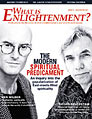
Andrei Codrescu
I first heard of Andrei Codrescu when someone asked me if I had seen
Road Scholar, his 1992 documentary, in which the Romanian-born American poet and National Public Radio commentator drives across America in a red Cadillac convertible, stopping at unpredictable destinations to take the spiritual pulse, like a sincere but bemused country doctor, of his adopted homeland. No, I hadn't seen
Road Scholar—in fact I had never heard of it—but as a member of a radical spiritual community, the odds were good that when I did, it would be in a communal setting at least superficially similar to some of those Codrescu had visited and filmed. And so it was that one evening last winter, in a makeshift screening room filled to capacity with many of my closest friends, I first made the acquaintance of Andrei Codrescu.
Road Scholar proved delightful and captivating. Codrescu's unique vantage point—expatriate of totalitarian post—Stalinist Romania and astute critic of the totalistic superficiality of modern America—gives the narration its delicious irony. His is a complex sensibility in which cynicism and idealism vie for supremacy and neither (at least in the film) ever conclusively wins. This tension creates a transparency through which those he interacts with are able to reveal themselves completely. Yet at the same time Codrescu is thoroughly and unapologetically opinionated, and his voice-over pronouncements are deadpan but deadly. At one point he says, "I felt that somehow I knew all these folks. They were the friends I lost to gurus in the sixties and seventies, grown a bit older. . . . They made me uneasy. Is there something wrong with the rest of us? . . . Probably—speaking for myself. On the other hand, the oddness of a theocratic hierarchy right in the middle of a representative democracy isn't calculated to make me feel any better." When the show was over and the lights came on, I looked around the room and asked myself, "What would Andrei Codrescu make of us?"
As this issue of
What Is Enlightenment? began to take shape, my question acquired intriguing new dimensions. The commercial triumph of popular spirituality in the West was a phenomenon we wanted to examine in the most rigorous context possible, taking as our standard the arduous challenges and awesome potential that characterize the highest spiritual teachings. We hoped to create a forum in which it would be possible to discriminate clearly among the incredible variety of paths and approaches being propagated today in the name of transformative spirituality or enlightenment. And we felt certain that the unique insights of a social critic such as Andrei Codrescu could help us to understand some of the cultural factors which contribute to the epidemic blurring of what we feel are crucially important distinctions. But I wondered . . . did we speak the same language?
"That's right up my alley," Codrescu told me on the phone from his office in the English Department at Louisiana State University, after I had sent him my proposal for an
interview. "I wrote a book about this which you might want to read. It's called
The Disappearance of the Outside."
The Disappearance of the Outside (subtitled
"A Manifesto for Escape") is unlike any of the numerous kaleidoscopic volumes of poetry, memoirs and often hilarious social commentary that Codrescu has also published. It is a profound and intricately reasoned indictment of contemporary Western society, in which the cultural economy of the capitalist West is shown to be as oppressively destructive to the human spirit as were the Orwellian regimes of the Soviet-dominated Eastern Bloc under which he grew up. The promise that Western-style democracy appears to hold for Eastern European countries newly open to its influence is deceptive and dangerous, Codrescu asserts, not only to their own citizens but to humanity as a whole. Why? Because the collective consciousness of the West, which threatens now more than ever before to become the dominant consciousness of the world, is unnaturally suffused with images, images designed to disconnect human beings from the uncontainable mystery of what Codrescu calls "the Outside."
"The difficulty of distinguishing between the illusions of commodity culture and reality haunt the art of our time," he writes. "Memory, never very reliable, is easily fooled. The copy cannot be told from the original. When the memory of the 'real' goes, the image may not even bear much resemblance to the original. . . . We will live in an abstract world (if we don't already). The real will have become strictly mythical. We won't notice the disappearance of the Outside, or our lack of desire for it."
Codrescu's analysis helped to explain our frequent bewilderment when confronted with so many popular and presumably convincing approaches to spiritual life that begin to seem dubious the moment they are examined in the context of that rarest but most authentic of attainments, that "pearl of great price," the literal human embodiment of perfect goodness, of that which is truly sacred. His revealing description of America as "an uninterrupted anthology of fads chasing each other faster and faster across shorter and shorter time spans" is recognizably the condition of much of the modern spiritual world, and there is certainly more than enough evidence to suggest that things in general are every bit as bad as Codrescu says they are.
In the course of our conversation, Codrescu readily admitted that growing up in the shadow of a communist dictatorship has left him with the indelible conviction that perfect goodness is neither attainable nor desirable, and that the very aspiration to realize it can only be motivated by a desire to impose on oneself and others a standard of morality and conduct that is suspiciously absolute and almost inevitably oppressive. But at the same time, he derives and transmits a palpable joy from peering with relentless clarity beneath the rampant superficiality of American culture, and his unusual willingness to face reality directly reflects an inspiring commitment both to the discovery of truth and to the preservation of mystery.




 printer friendly
 email the editors
 advertise
 reprints