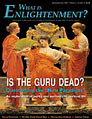
For many of us today the very word authority sounds strangely incomplete without its common prefix "anti." If you've lived through Watergate, through Contragate, or through any number of the other abuses of the trust reposed in our leaders, it is difficult to prevent the reflexive arising of a deeply negative response when authority rears its head. A long history of suffering and disappointment has caused the concepts of authority and authoritarianism—the misuse of authority for its own selfish ends—to become synonymous in many people's minds. In the arena of spirituality, the scandals of the past twenty years or so surrounding numerous gurus and spiritual leaders make the response of antiauthoritarianism to the concept of spiritual authority almost inevitable. So it is not surprising that of late there has been a rising tide of voices suggesting that the entire idea of authority in the spiritual world would best be resigned to the junk heap of history, to join other concepts which most modern educated people agree have outlived their usefulness, such as the divine right of kings and papal infallibility.
But none of the critics of the guru go as far as Joel Kramer and Diana Alstad, authors of
The Guru Papers: Masks of Authoritarian Power. Their book is said to have had a profound influence on, among others, the vocal anti-guru convert Andrew Harvey during his time of spiritual crisis, when he broke away from Mother Meera, whom he had only recently declared the avatar who would save the world. Because of their influence on some of those who are most vocal in articulating the anti-guru "new paradigm," I knew I had to speak to Kramer and Alstad for this issue of
What Is Enlightenment?, which examines the role of purity and authority in the spiritual life.
Joel Kramer is a trained philosopher, having completed most of his studies towards a Ph.D. in Western philosophy before dropping out to pursue Eastern philosophy and yoga. When we met, Diana Alstad told me, "He studied Western philosophy and got it. Then he studied Eastern thought and got it, too." He taught at Esalen in the 1960s and is a self-proclaimed hatha yoga adept. Diana Alstad's credentials are impressive as well. She received a doctorate from Yale University and taught the first women's studies courses at Yale and Duke universities.
The Guru Papers is the only published portion of a far larger and more ambitious work called
Control. It is perhaps the most articulated attempt to deconstruct the entire concept of spiritual authority and the philosophies underlying its uses and abuses.
When I called Joel Kramer, he readily agreed to an interview. At his request I reread the last chapters of his book. I also sent him the last two editions of
What Is Enlightenment? A few days before our interview, however, he telephoned me and said that he had decided to call it off. We were too far apart, he told me. He had no respect for my point of view, or that of our magazine. He did not wish to grant us an interview, he said. I told him that an interview would give him a chance to reach the very people he was trying to help, seekers interested in the philosophies he saw as so dangerous and damaging. I reminded him that I was even willing to take the journalistically unorthodox step of granting him the right to review all of his statements for accuracy and completeness to ensure a fair treatment of his views. But he told me that this did not matter. He was not interested in trying to reach our readers, he said. Then he said something that sent off shock waves of the sort I imagine might occur in the far reaches of outer space when matter and antimatter collide. He told me that what bothered him was that our publication's point of view is that of a morality based on selflessness. He said that moralities based upon selflessness are a major source of the problems and dysfunctionality of the world. He went on to say that the major themes presented by the people included in our forum—themes he identified as those of impersonal love, detachment and egolessness—are the ideas responsible for the horrible mess that our planet is in. While listening to him, for no apparent reason an incongruous memory of walking down a desert highway in the heat of the midday sun entered my consciousness. I remembered the eerie sense of dislocation caused by the shimmering heat waves that surrounded me, how the colors of the landscape around me began to sickeningly undulate, shift and dissolve.
Somehow, reading
The Guru Papers had not prepared me for the vehemence with which Kramer attributed the world's troubles to the influence of such ideas as selflessness, impersonal love, nonattachment and self-sacrifice. I found his position fascinating—and utterly incomprehensible. I had to go back and read his book again. And there it was in black and white. Why hadn't I seen it before?
In
The Guru Papers, Kramer and Alstad do not only attack the institution of the guru due to its recent record of scandal and abuse. They go further and reject as inherently abusive and authoritarian the entire morality which they say underlies spiritual authority. The heart of their work is their critique of this morality, what they call "renunciate morality," which they see as dangerously flawed because it teaches the possibility and desirability of attaining selflessness. They say that renunciate morality, by teaching that selflessness and self-sacrifice are possible and are superior to self-centeredness, causes people to doubt themselves, and thus become susceptible to authoritarian manipulation. It is simply impossible to have selflessness without also having its opposite, self-centeredness, they say, and to teach otherwise is just a way of confusing and controlling people. According to Kramer and Alstad, moralities that teach selflessness as the highest goal are responsible for the mess that the world is in today, a mess that threatens humanity's very survival. When it really hit me that this was their underlying premise for rejecting what they call "the guru system," it shook me up, unsettled and even scared me, in part because I could see the alluring attraction of the idea that selfishness is natural, inevitable and OK.
During our telephone conversation, Kramer went on to say that although he would not do an interview, he was very interested in speaking to me personally about our views. Who knows? he said, he might change his mind about the interview after we spoke.
When we finally met, it became clear that Joel Kramer had never been serious about the possibility of changing his mind. But we did engage in a discussion, a debate and an encounter that lasted over four and a half hours. This encounter revealed more than a simple interview would ever have been likely to do. It left me feeling, both as a journalist and a human being, that I would be remiss in my duty to anyone serious about spirituality and its difficult challenges if I failed to recount at least a portion of what I saw of the psyche behind the mask of antiauthoritarianism that
The Guru Papers's
author presented.





 printer friendly
 email the editors
 advertise
 reprints