Seeking Truth Beyond Left and Right


An interview with Arianna Huffington
by Elizabeth Debold


“Courage is knowing what not to fear,” Arianna Huffington likes to say, attributing the quote to Socrates. Arianna HuffingtonTo her, that means that we shouldn’t fear other people’s perceptions or disapproval of who we are and what we do. It is a motto that she has obviously lived by; Huffington has steered an iconoclastic course through life that has often puzzled, if not infuriated, those who would pin her down. Her political leanings have swung from Jerry Brown–style california liberalism to Newt Gingrich’s conservative revolution to running for governor of California as an independent to now declaring her position as beyond left, right, or center. It’s not the political label or any labels that have been thrown at her that matter to her—she’s on a mission to bring intelligent debate, truth seeking, and justice into politics. Even in creating The Huffington Post, she went up against a naysaying media establishment that ridiculed her and her idea to develop the first internet newspaper. Three years later, the HuffPo, as it’s known, gets nearly four million hits per month and has won the Webby Award for Best Political Blog two years running. Huffington has clearly hit her stride. With a penchant for pushing the edge of our thinking, she embodies a restlessness with the status quo of shallow consumerism and a passion to lift our collective aspirations to change the world.
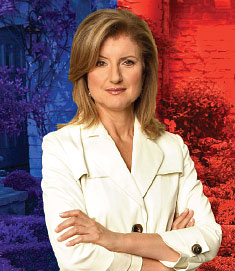
Born in Greece to an intellectually engaged family, Huffington comes naturally by her active interest in deep inquiry. Her mother loved the work of the great sage J. Krishnamurti, and her father’s desire for new journalistic adventures brought the family repeatedly to bankruptcy. At the age of sixteen, Huffington set off to India to study comparative religions at Shantiniketan University, near Calcutta, before heading to Cambridge University in England. At Cambridge, she overcame her heavy Greek accent to become only the third woman, and first foreigner, to be elected president of its prestigious debating society, the Cambridge Union. Her first book, The Female Woman, published when she was twenty-three, became an international bestseller and brought her, as she said, “a lot of the things that I thought would take me a lifetime to achieve, such as financial independence and recognition. It also brought about a midlife crisis in my early twenties and led me to ask, ‘Is that all there is?’ ” That precocious crisis led her to read all of Carl Jung and dive deeply into philosophy, which set her in the pursuit of answers to questions that have guided her over the past thirty years: What is the relationship between politics and our deeper values? How do we have to change to create the world that we long for?

In this EnlightenNext interview, Huffington speaks about her understanding of the spiritual life and the importance of truth as a personal and political value.



EnlightenNext: In the past twenty or so years, many spiritually minded individuals who have searched for inner truth have often been disaffected by politics, steering away from the political arena for fear that it would compromise their ideals. You, however, have pursued political engagement as part of your spiritual path. Do you see any tension between spiritual idealism and political pragmatism?

Arianna Huffington: I have chosen both to be on a spiritual path and to be politically engaged, and I don’t see any tension between the two, provided I remember to “render unto Caesar the things that are Caesar’s, and unto God the things that are God’s.”

There are a lot of religious traditions that require isolating oneself from the world and praying—the monastic traditions. My form of spirituality is not a form of withdrawal but of engagement, personal and collective. For me, engagement in the world is an extension of my spiritual life. And that comes partly from my own Greek tradition. The word idiot comes from ancient Greek—an idiot was someone who was not engaged in public life. So there is a deep Greek tradition of engagement. It’s part of what has shaped me.

EN: What initially sparked your interest in the spiritual life?

AH: It’s hard to know, because I feel that I was born with it. I remember being really young, before kindergarten, and praying to the Virgin Mary in difficult times. As I grew up, I wanted to explore every aspect of spirituality, so I started by reading voraciously, which is usually my first approach to things. Of course at some point that became like trying to find water by reading a water almanac—it doesn’t quench your thirst. What became more important was putting these things into practice and practicing them myself. But after reading both the Western and Eastern spiritual literature, I came to believe that the spiritual instinct is in all of us. Whether we call ourselves atheists or believers, we have this in us—I call it the “fourth instinct.”

EN: Can you say more about this fourth instinct?

AH: The idea is that most psychologists and biologists look at human behavior in terms of three instincts: survival, sex, and power. I believe, however, that you cannot understand human behavior without recognizing a fourth one—the instinct for transcendence, the instinct to connect to the part of us that goes beyond our materiality and survives our death, that connects with our soul. That’s what explains our search for meaning, whether it drives us to art or to religion or to altruistic behavior that cannot be explained purely in terms of self-interest. Of course, part of the quest for meaning is often to get involved in something that takes us beyond ourselves.

You could say that the fourth instinct drives the evolution of consciousness—and the evolution of consciousness is the foundation of everything. The more each one of us evolves, the greater the impact it has on culture. And at the same time, there are things that can be done culturally that can enhance what is happening at the individual level. While it’s not a linear evolution, because we have progressions and regressions, I believe that it is an upward spiral. Ultimately, I’m an optimist.

EN: What is the role of political leaders in catalyzing such change?

AH: Great leaders can inspire that change to begin. Leaders lead either by appealing to the best in us or by appealing to the worst in us. We have both types, as you know. Great leaders appeal to the “better angels of our nature,” as Lincoln called it, and bring people together for great undertakings—whether it is Lincoln ending slavery or F.D.R. and the New Deal or Bobby Kennedy really tapping into people’s longing for fundamental change. In his own way, Barack Obama has done that. Or leaders can appeal to our fears the way George W. Bush did. As we’ve seen, it is all too easy to appeal to our lizard brain and to be a fearmonger!

EN: Susan Neiman, author of Moral Clarity and a blogger on The Huffington Post, argues that in the past twenty years, the right has given individuals ways to connect with what you call the fourth instinct and progressives haven’t. The right offers people moral ideals to which they can aspire, whereas the left offers only material, economic solutions, demonstrating real discomfort even with the word “morality.” Can you comment on this?

AH: First, to be clear, I don’t see the world through a right-versus-left prism. The most significant moral challenge facing both progressives and conservatives is to live by the biblical admonition that we shall be judged by what we do for the least among us. There are many progressives, such as the Reverend Jim Wallis, who are framing poverty-fighting in both spiritual and political terms.

In my latest book, Right Is Wrong, I make the point that looking at American politics through the right-versus-left prism is obsolete and does not really deepen our understanding of what’s happening. One of the most interesting things that has happened in the last few years is that the American public has shifted. What used to be considered left-wing positions—on health care, on bringing the troops home from Iraq, on doing something about global warming, on corporate responsibility—are now solidly mainstream positions. Given that, to continue looking at them through the prism of left versus right is lazy.

EN: Aren’t you also challenging us, and the media, to value truth over so-called impartiality?

AH: Well, impartiality and fairness are great values, but I’m pointing to a kind of fake neutrality. It’s the idea that somehow you’re doing your job as a journalist if you act like Pontius Pilate: “Well, here is Al Gore talking about the dangers of global warming, here is Senator Inhofe talking about how global warming is a fraud, and my job is simply to present those points of view.” That’s a fake neutrality that really undermines what I believe is the heart of journalism, which is the pursuit of truth.

And of course, getting closer to the truth has always been a big part of our cultural/spiritual tradition, from the Greeks’ “Know thyself,” to Shakespeare’s “To thine own self be true.” All those admonitions are really about constantly aspiring to the truth about ourselves, about our lives, and about our world. It’s definitely one of the greatest aspirations we can have as we progress through life.