“Courage is knowing what not to fear,” Arianna Huffington likes to say, attributing the quote to Socrates. 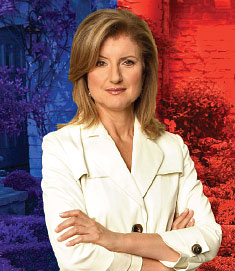 To her, that means that we shouldn’t fear other people’s perceptions or disapproval of who we are and what we do. It is a motto that she has obviously lived by; Huffington has steered an iconoclastic course through life that has often puzzled, if not infuriated, those who would pin her down. Her political leanings have swung from Jerry Brown–style california liberalism to Newt Gingrich’s conservative revolution to running for governor of California as an independent to now declaring her position as beyond left, right, or center. It’s not the political label or any labels that have been thrown at her that matter to her—she’s on a mission to bring intelligent debate, truth seeking, and justice into politics. Even in creating The Huffington Post, she went up against a naysaying media establishment that ridiculed her and her idea to develop the first internet newspaper. Three years later, the HuffPo, as it’s known, gets nearly four million hits per month and has won the Webby Award for Best Political Blog two years running. Huffington has clearly hit her stride. With a penchant for pushing the edge of our thinking, she embodies a restlessness with the status quo of shallow consumerism and a passion to lift our collective aspirations to change the world.
Born in Greece to an intellectually engaged family, Huffington comes naturally by her active interest in deep inquiry. Her mother loved the work of the great sage J. Krishnamurti, and her father’s desire for new journalistic adventures brought the family repeatedly to bankruptcy. At the age of sixteen, Huffington set off to India to study comparative religions at Shantiniketan University, near Calcutta, before heading to Cambridge University in England. At Cambridge, she overcame her heavy Greek accent to become only the third woman, and first foreigner, to be elected president of its prestigious debating society, the Cambridge Union. Her first book, The Female Woman, published when she was twenty-three, became an international bestseller and brought her, as she said, “a lot of the things that I thought would take me a lifetime to achieve, such as financial independence and recognition. It also brought about a midlife crisis in my early twenties and led me to ask, ‘Is that all there is?’ ” That precocious crisis led her to read all of Carl Jung and dive deeply into philosophy, which set her in the pursuit of answers to questions that have guided her over the past thirty years: What is the relationship between politics and our deeper values? How do we have to change to create the world that we long for?
In this EnlightenNext interview, Huffington speaks about her understanding of the spiritual life and the importance of truth as a personal and political value.



 printer friendly
 email the editors
 advertise
 reprints