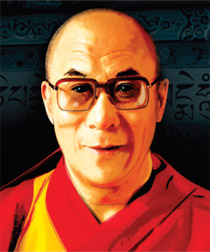
Sometimes his generosity is uncomfortable. At the same procession in Bodh Gayā, he interrupts the proceedings to give me a condensed history of Buddha’s enlightenment under the bodhi tree. A hundred thousand Tibetans plus a host of Indian dignitaries stare incredulously as I’m treated to a five-minute, one-to-one tutorial on the most basic story in the Buddhist canon. The mantle of intellectual authority conferred on me by my role as a BBC journalist feels distinctly brittle.
This easy familiarity seems characteristic of his contact with Westerners. While he is careful to preserve his authority in front of Tibetans, carefully respecting the social hierarchy of that society, a striking feature of his contact with Western guests, peers, and friends is a total disregard for rank or social status. This was never more apparent to me than when we first met.
Because my first two written requests to the Dalai Lama’s private secretary were rejected, I had applied for the job of Joanna Lumley’s cameraman on her visit to Dharamsala with documentary photographer Tom Stoddart. My idea was that the big man had likely not even heard of my request and that face-to-face both he and his rather medieval-like guardians would be persuaded of the benefits of the film. It would replace the reams of homogeneous, formulaic television appearances—noble restatement of nonviolent approach, mischievous giggle, delightful gaze—and the predictable response they uniformly elicit: “What a charming man; truly spiritual presence; what he and his people must have endured!” A sustained fly-on-the-wall picture following him through all areas of his life would provide insight into what he is up against and a glimpse behind the mask—the man going about his business of spiritual leader, politician, international celebrity, and everyday monk.
Besides, even in March 2004, there was a real need for the film. The Chinese strategy of casting him as a separatist radical who is hell-bent on an independent Tibet freed by any means possible, despite appearing to us as extreme propaganda, seems to be filtering into the consciousness of many spectators in the West. Fanned by the disingenuous pronouncements of Rupert Murdoch—who even back in 1989 dubbed the Dalai Lama “a monk who wears Gucci shoes” as Murdoch himself lobbied the Chinese authorities for greater access for his Star TV network in the south of the country—revisionist opinion is questioning his motivation. With this film, audiences will be able to judge his sincerity for themselves.
This project was a world away from all of my earlier work. Of my previous films for the BBC, one involved scrutinizing the Los Angeles Police Department in the aftermath of corruption claims and another involved following criminal gangs in Central and South America. But in this case, and given the rather worthy tone of my pitch, the idea of persuading the Nobel laureate and bodhisattva of compassion of the need for a documentary on his efforts to seek a reconciliation with the Chinese government was a long shot, to say the least. But as he walks into the impressively decorated antechamber of his residence in Dharamsala, immediately my nerves evaporate. It’s hard to know with someone this famous how much of the magnetism arises from my expectations, but he’s irresistible. The enormous smile, bright eyes, and enveloping charisma are undeniable.
I’m immediately struck by how equally he is treating each of us. He is introduced to an internationally feted actress, a photographer who has documented thirty years of the world’s conflicts, and a rather ungainly six foot, three inches of faux cameraman. Yet each of us is afforded the same intensity of attention, the same degree of questioning and listening, the same mesmerizing eye contact.
I’m later reminded of his apparent disregard for status when I follow him to a meeting he had with Jack Straw. The then–British foreign secretary is welcoming his guest to his parliamentary office with a rather dry tour of dust-coated portraits of foreign secretaries of yesteryear. Straw is pontificating slightly, not quite rising to the task of keeping his evident pride totally free of pomposity. The Dalai Lama relieves a moment that is veering toward tedium with the suggestion that Straw may be the reincarnation of Charles Fox, the UK’s first foreign secretary. The atmosphere is immediately lifted, stuffiness gone, lightness restored. There is something playfully irreverent in his tone, which satirizes Straw’s ponderousness under the cloak of parodying the Dalai Lama’s own beliefs about reincarnation. Certainly, it’s hard to imagine the Pope quipping about immaculate conception with the same mischievous humor. But what strikes me is the Dalai Lama’s disregard for occasion and position in favor of moment and humanity.
This playful teasing is a defining feature of the man I got to know over three years of filming. With no intimate knowledge of any others, I’m still prepared to bet that this celibate monk, brought up from age two as the living embodiment of his nation’s most precious deity in a royal palace with attendants ministering to his every whim, is the most mischievous, bawdy, and irreverent statesman in the world. On a trip to Scotland, halfway through addressing a delegation of senior North American statesmen, including Canadian Prime Minister Stephen Harper, he excuses himself to go to the toilet. Knowing full well his radio microphone is still turned on, he treats me to an audio account of his visit before winking in my direction on his way back to the meeting. On a subsequent visit to Dharamsala, I’m partway through what I feel is a fairly testing interview with him, one of our last, when my newly tailored Indian suit splits around the groin. “My word, Josh is very pleased to see me this morning,” he ejects before bursting into a minute or so of hysterical laughter.
Notwithstanding this roguish sense of humor, and while he may find his position as a living god isolating at times, an episode in Dharamsala last autumn left me in no doubt of the core strength of this man’s identity and rootedness as a Tibetan. The Dalai Lama was receiving an old member of his exiled government, a man who had contributed greatly to building the government and infrastructure for Tibetans in India. The ex-official has been suffering from cancer for several years and now, knowing that he is soon to die, wants to bid his leader a last good-bye. It is, as you would expect, a very emotional farewell that involves few words but much communication. The old man has tears in his large eyes as he looks up adoringly at his guru and friend. For his part, the Dalai Lama seems, for the first time in our acquaintance, genuinely moved. As he takes his diminutive friend’s bald head in his hands in a benevolent embrace, he is giving him instructions on how to die. In a gentle tone he explains how the friend should imagine his Tibetan saint seated on his head, and picture, as he dies, his spirit passing up through the crown of his head to commune with him. He tells him to pray to be reborn close to the Dalai Lama and that he will do the same.
This brief parcel of unselfconscious spiritual instruction was conducted in the glare of about eight spectators and a camera. (The quality of the Dalai Lama’s relating, I noticed, was entirely unaffected by the size of his audience.) Their common theology seemed to provide a context and a lexicon for the exchange of feeling that in other religions—or at least in more secular traditions of dying—would have been absent. It facilitated a recognition of the strength of the friendship and a complete understanding of his power to provide reassurance, and it showed that the companionship could be a source of sustenance even in the final moments of life. It was a gentle, quiet, lingering exchange: two old comrades gently savoring each other’s company for the last time. And it provided me with perhaps the only glimpse of the huge well of feeling in the Dalai Lama that years of strict spiritual practice have kept carefully measured.
What I saw that day sticks in my mind in part because it represented a tantalizing glimpse of a depth of feeling that the man is reluctant to share. Throughout the time that I followed him—roughly six months if measured continuously—I sensed a reluctance to open up completely. This limit on how close to him people are allowed to come is something I sense remains a frustration to Westerners who seek a level of personal or professional intimacy with him: supporters of the Tibetan cause, Buddhist students, politicians, actors, and members of the media. Certainly for each of these groups, he has very good reasons for maintaining his distance—the independence of the religious teacher, the balanced diplomacy of the politician. But the truth is that the Dalai Lama doesn’t really “do” friendship. There is something at his core, instilled I suspect by the loftiness of his upbringing and the sacredness of his position, that prevents his being able to relate on equal footing. Even his own family maintains a respectful distance. His brother, who shows the most ease and familiarity—and appears periodically in the film combining the roles of trusted adviser and Harlequin trickster, clearly a family trait—maintained throughout, in his movement and addresses to his brother, a notably humble bearing.
One particular moment last year provided me with an insight into what is behind this deep-set emotional independence. On one of my final filming trips to Dharamsala, the Dalai Lama invited me to accompany him on a visit to southern India, which houses the largest population of exiled Tibetans in the country. I explained that I had already been a long time away from my children and wouldn’t be able to travel with him. He seemed genuinely disappointed; it was something he wanted to show me and felt was an important part of his story. This occasioned a rare reflection that crossed the massive cultural divide that separated us as he observed, “On the one hand, you have love, but on the other hand, you have no freedom.”
This musing on the difference in our positions was accompanied by the alluring choreography that characterized his moments of reflection: a Yoda-like affectionate grunt, pause, and focused look to the middle distance. But for a moment I was released from the tenacious grip of this glowing charisma. I was not with the leader of the Tibetan people, human deity, international superstar, and the world’s leading proponent of nonviolence. This was the monk, his life devoted to prayer, celibacy, and a high degree of social isolation, reflecting on the trade-off. He is also by nature an academic, fiercely intelligent in debate, a passionate student of the endless canon of Buddhist philosophy, and a strict practitioner of meditation, which occupies the first three to four hours of every day. And this is where I think his heart lies, embracing the freedom from family ties to develop the intellectual and emotional wisdom gained from the reflective life. It is through this practice that he sustains the extraordinary energy required to provide spiritual sustenance to Tibetans, Chinese, and Westerners while he battles with an endemically suspicious Chinese regime for a solution to the desperate issue of his country’s future.
“In my dreams I am just monk, not Dalai Lama,” he added later, with his signature disregard for the definite article. It didn’t surprise me at all.
Joshua Dugdale is an award-winning documentary filmmaker and a producer of foreign and current affairs programming at the BBC. His film about the Dalai Lama, The Unwinking Gaze, is available on DVD.