From an early age, when I discovered a reproduction of a painting by Paul Gauguin on the wall of a family friend’s home and was transported to another realm by the beauty and exoticism of the image, I’ve been roaming the halls of art museums and the pathways of spirituality in search of more visions of radiance. The two pursuits—artistic and spiritual—fed each other for many years, an encounter with a painting fueling my interest in the source of the sublimity I had beheld, and vice versa. Things began to change in the sixties as pop art started filling the walls of art galleries and pop culture was revolutionizing the lives of my rebellious peers. By the time the New Age took hold and the posturing of postmodern art became ubiquitous, a separation between art and any kind of eloquence or deeper meaning appeared complete.
Over the years, there have been few signs that the split between art and spiritual content would end. Only an occasional exhibit such as The Spiritual in Art: Abstract Painting 1890–1985, curated by Maurice Tuchman; an inspiring book such as Roger Lipsey’s lucid history, An Art of Our Own: The Spiritual in Twentieth-Century Art; or the work of an occasional artist such as Bill Viola, a video artist whose work is fueled by his knowledge of several religious traditions, held the promise of anything different. So when I heard that Adi Da Samraj, one of the more notable (and notorious) spiritual teachers of our time, had been chosen as a collateral artist at this year’s prestigious Venice Biennale, I was eager to make my way to the famed city of canals.
The Venice Biennale has been attracting lovers of art for more than 110 years. In fact, the Biennale is such a fixture in the city’s cultural life that it is housed in permanent quarters on parklike grounds whose large Italian pavilion and twenty-nine smaller national pavilions were built exclusively to showcase art. Today, the Biennale—an exhibition that lasts for five months every two years—has expanded to other sites, including the nearby naval shipyard, where fleets of the Venetian Republic were once built, and many temporary venues throughout the city. The scope of the festival has also grown. Historically, only artists selected by the country of their origin or invited by a guest curator for a theme show were able to participate. Now artists not affiliated with a country can undergo a jury process and be invited to exhibit. It is in this capacity as a collateral artist that Adi Da Samraj is showing his work in Venice.
My knowledge of the American-born Adi Da was less extensive than my familiarity with the Biennale, which I had attended twice before. It was only after I had viewed his exhibit, entitled Transcendental Realism, that I delved into who he was and what had shaped the course of his life and relationship with art.
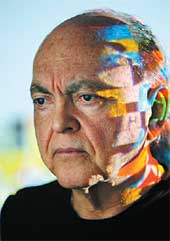
Adi Da has written voluminously about his life, about his spiritual awakening, and about the ultimate nature of Reality. He has gone by several names during the course of his lifetime: his given name, Franklin Albert Jones; Bubba Free John; Da Free John; and others. The first thirty years of his life were dedicated, according to him, to two fundamental activities: an investigation of the means by which one can realize truth and the development of the ability to communicate truth via literary and artistic means. These two pursuits took him through the channels of traditional academic study and on an independent quest for spiritual knowledge, under the guidance, at times, of several spiritual teachers in the East and West. Today Adi Da is recognized as much for his spiritual brilliance as for his radical and often controversial methods as guru to many devotees around the world.
Like many artists who came of age in the 1950s, Adi Da’s artistic and literary formation was shaped by the giants of Modernism, those writers and artists (mostly European) who defined a movement in culture that sought to break with the realist traditions and bourgeois conventions of the nineteenth century. They embraced all that was new, from motor cars to abstraction, from the unconscious to stream of consciousness. They were progenitors of the avant-garde, valuing experimentation and free expression. Adi Da wrote his master’s thesis at Stanford University on the innovative writings of Gertrude Stein and the circle of artists and intellectuals who frequented her legendary salon in Paris during the 1920s. He references the work of Paul Cézanne, the painter who unmoored geometry from realistic representation, and he inherited the heroic sensibility of those idealistic artists who “aspire to a complete and radical reconstruction of society,” as stated in a manifesto written in 1938.
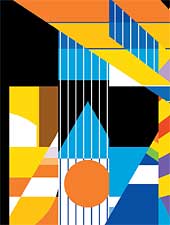
The evolution of Adi Da’s artistic output began in the early 1960s when he started working with still photography, both black-and-white and color. He also produced a body of drawings, paintings, and sculptural forms up to the mid-1990s. In 1998, after redirecting his primary creative focus away from verbal communication to visual expression (Adi Da has written over sixty books, including an epic drama, or “prose opera,” entitled The Mummery Book), he entered a period of concentrated work using photography and video to produce more than sixty thousand images. The images themselves, now almost all digitally generated, then become the basis for what he calls “fabrications,” which can be anything from a photographic print to a multimedia projected performance event.





 printer friendly
 email the editors
 advertise
 reprints