In the hurtle of history from the ancient past to the present, the doings and thinking of men appear to be the narrative line and motive force lifting humanity out of the depths of unconsciousness. I mean men specifically—the male of our species. For most of us, history is synonymous with the deeds of men: Plato, Aristotle, Alexander, Christ, Charlemagne, Da Vinci, Copernicus, Galileo, Descartes, Bacon, Locke, Kant, Hegel, Lincoln, Gandhi . . . up to and including the postmodern revolution defined by Einstein, Heisenberg, Picasso, Foucault, and Derrida. Sure, there are women—Cleopatra, Eleanor of Aquitaine, Betsy Ross, Queens Victoria and Elizabeth, Sojourner Truth—enough to be collected and commemorated in U.S. schools by Women’s History Month in March of each year. Needless to say, there is no men’s history month, and so this exception seems to prove the rule. Making a mark on history is man’s work; women keep the home fires burning . . . or so the saying goes.
Is it true? With a quick look back over my shoulder, I can certainly see generations of women’s lives centered on home and hearth—the manicured suburban lawns of the 1950s, the Victorian “angel in the house,” the farmhouse and feudal cottage, the tribal woman grinding grain with an infant in a sling. As paleoanthropologist Richard Leakey points out, the mother-child relationship “is the social unit out of which all higher orders of society are constructed.” Without children, a culture cannot survive, and through the millennia, the mother-child dyad has been a fixed and protected center point around which culture has developed. Women have thus played a fundamental and conservative role in virtually every society. I mean “conservative” in the strictest sense, because women conserve and protect the cultural status quo by raising children who will embody societal norms and values.
But looking back, I also see something else: women revolting in the 1960s, women marching for civil rights and the abolition of slavery, women crossing the frontier, women defying church authority, women praying at the foot of Christ’s cross when his male disciples had abandoned him. It’s often hard to make out the faces or name the individuals. But if we look at the times and places in history where women have been on the move, we begin to see something different about the role of women in history than what might first appear when we tick off the names of great individuals or search for the great women who supposedly lurk behind every great man.
“The history of the world,” writes philosopher Georg Hegel, “is none other than the progress in the consciousness of freedom.” Hegel saw something larger than the actions of individuals at work in history; he saw that there is a direction and intention toward the gradual awakening of humanity to unity with Spirit. Such a perspective leads us to ask different questions of history. It compels us to discover how new ideas of freedom emerge in human consciousness—and how, then, these ideas become social structures that support greater liberty. And it opens the question of how the experience of the liberation of consciousness—which is spiritual freedom—relates to cultural change.
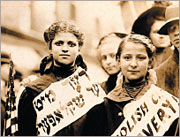
Looking at history with this in mind, I begin to see a fascinating relationship between women’s spiritual uprisings and shifts in culture. From time to time in the course of Western history, by the necessity of larger survival needs or an unknown imperative from Spirit itself, women have taken off their aprons, handed over the sleeping child, stepped outside the snug harbor of the home, and abandoned themselves to a spiritual vision and consciousness that threw the accepted roles and strictures for women into the air. Virtually every time this happens, a leap in culture, a move toward greater social freedom, erupts, often with revolutionary force. But then it seems, over and over again, women return to the protected circle of home and hearth.
As mothers of both the status quo and of revolution, women have played a paradoxical role in the evolution of culture. This comes as no surprise to those Jungians among us who divide the currents of consciousness into “masculine” and “feminine” principles and argue that the role of the feminine is this paradox: both static perpetuation of the species and movement toward the new. Poet and cultural philosopher William Irwin Thompson, for example, uses a Jungian lens to interpret prehistory and argues that it was through hominid females changing from estrus to menarche—that is, from being “in heat” several times a year to constant sexual receptivity—that “a social and cultural revolution” was created on the savannahs where Homo sapiens evolved. Thompson, supported by others such as Riane Eisler, also argues that the Neolithic revolution—where early humans began to grow plants—must have been largely due to discoveries made by women.
My interest, however, is in the times in our past when women made conscious choices toward the new. In pointing out the relationship between women’s uprisings of consciousness and cultural shifts, I can’t claim that the former caused the latter, as intriguing as this might be. There are myriad causes—technological, economic, environmental—for any epochal change in history. And the complexity of history itself makes it possible for Jungians to find all the evidence they want to give the feminine a special role in cultural change. There may or may not be more to this than wishful thinking. But at the same time, there is a certain logic to it: When the keepers of culture step outside their prescribed roles, something has got to give.
Right now, we are at an interesting point in our culture. So many women (and men) who are at the leading edge are calling for a resurgence of the feminine and a new and larger role for women in changing the world. Yet the place we tend to look for what women will bring to the table is to women’s traditional caretaking roles. A recent article on Hillary Clinton’s bid for the presidency even argued that “mamisma”—the emphasis on women’s nurturing qualities and the opposite of the machismo often seen in politics—might carry a woman into the White House. Are women’s traditional qualities what will bring about cultural change? To answer this question, I am going to sweep through the last three thousand years to locate breakthrough moments in women’s history: When did they occur? What qualities did women show? How might these breakthroughs relate to the epochal shifts in Western culture? And finally, is there anything we can learn from our history that might give us clues to what women need to do now to move Western culture forward?
Martyrs, Mystics, & Revolutionaries
The beginnings of human culture are lost to us. Over twenty-five thousand years ago, human beings first began to create paintings on cave walls for reasons we don’t understand. Perhaps ten thousand years ago, women somehow figured out how to grow plants, giving birth to horticulture and enabling the first large human settlements. Eventually horticulture led to agriculture, which in turn led to trade, writing, and the first large-scale societies and empires. In the process, men’s and women’s roles increasingly differentiated. To keep society growing, women needed to bear and raise children, an often life-threatening task that kept them close to home. By the time the first five books of the Old Testament (between 1150 and 250 BCE) and the Greek epics (around 700 BCE) were written, warrior cultures were well established, in which women needed the protection of men in order to survive and raise children. In these cultures, women stayed home.
Out of these warrior cultures Christianity emerged, and women emerged with it as conscious actors in history, willing to step outside the enclave of male protection. Then and now, Christ’s message was unthinkably radical: Every human being is equal in God and every human being can find freedom through a direct relationship with God. As Paul says, “In Christ . . . there is neither male nor female.” The response of women from all walks of life—women who had almost no public role in the ancient world—was remarkable. “Some ten to twenty years after Jesus’ death, certain women held positions of leadership in local Christian groups; women acted as prophets, teachers, and evangelists,” explains Elaine Pagels in The Gnostic Gospels. And the force with which Christianity emerged may even be due to the numbers of women who were enlivened and emboldened by Christ’s message. “In the fourth century,” write historians Bonnie S. Anderson and Judith P. Zinsser in A History of Their Own, “Bishop Palladius estimated that twice as many women as men had chosen to live as solitary ascetics.”
It is difficult to imagine how revolutionary these women were. Pagels, in her book Adam, Eve, and the Serpent, tells a number of compelling stories of women who defied their parents’ authority by refusing to marry, embraced the danger and uncertainty of poverty by giving away any money they had, challenged hierarchy by living with slaves and in partnership with men, and broke with convention by taking vows of celibacy at a time when both Jews and pagans saw women’s primary duty as bearing children (preferably sons). Thecla, a woman who eventually preached alongside Paul, roused her mother to fury for refusing to marry the man who was selected for her. Her mother had Thecla tried in court and wanted her killed so that her example would make other young women think twice before disobeying custom. She was nearly burned alive and raped before she finally dressed as a man to escape and follow this higher calling. Hearts aflame with passion for God, the first Christian women were formidable opponents to the Roman order—stories of their singing praises to God as they were burned at the stake or sacrificed in some gruesome Roman spectacle spread throughout the empire. They were fearlessly independent of worldly authority.
Could the soaring transcendent consciousness and new moral conscience of these women have led to Christianity becoming the state religion of the Roman Empire? I can’t say, but it certainly had an effect on Constantine, the emperor who made the fateful decision to transform the pagan empire into a Christian power. He himself is said to have converted out of respect for his Christian mother, Helena, who was well known for her bold acts to further her faith.
In the tumultuous centuries as Rome was falling and a new Christian culture was on the rise, women were at the forefront of change even as the developing precepts of Christianity disparaged them. Many refused to fall into line with church authority and were attracted to gnostic cults that allowed them the spiritual and social freedom to preach, prophesy, and find God within their own hearts. Tertullian, an early church leader, speaks about the outrageousness of these women when he says: “These heretical women—how audacious they are! They have no modesty; they are bold enough to teach, to engage in argument, to enact exorcisms, to undertake cures, and, it may be, even to baptize!” From the first century of the Christian era, women began to gather together, seeking the protection of a collective in order to be free to explore their commitment to a higher truth. By 800, convents and monasteries (often for both men and women) dotted the landscape of Europe. These structures gave women a spiritual home and created a blueprint for a new form of culture that would unite Europe in a common worldview. Gradually, however, the freedom that women found in early religious life was quashed by a male-led church that denied women any authority. “These eras of ferment, experimentation, and change passed rapidly,” note Anderson and Zinsser. “Each was succeeded by a far longer period of consolidation and conservatism.” Women stayed home to be helpmates, wives, and mothers.
Then in the twelfth and thirteenth centuries, the fire for freedom in women’s hearts flared again. For no earthly reason that I can find—perhaps it was just the maturation of Christianity—there was an outburst of spiritual passion that led to a resurgence of mysticism. Far more women than men elected to abandon the world and give themselves fully to God in this way. Sometimes sent by their families to the convent as an offering, sometimes running away from a stultifying home life, these women mystics developed an unusual autonomy, free from the bonds of husband and children, free to become vehicles for the love of God. Many of these women engaged in ascetic practices that demanded both intense discipline and boundless trust. In their writings, a power comes through them, a conviction and clarity that still vibrate on the page. At the same time, a new type of love was finding expression—courtly love—through the songs and poetry of male troubadours and, as Riane Eisler points out, female trobaritzes. Courtly love was an idealized love of a knight for a noblewoman that ?was never consummated. Woman, for perhaps the first time, was celebrated in culture for her capacity to catapult her admirer into transcendent rapture.






 printer friendly
 email the editors
 advertise
 reprints