Kicking Ass and Taking Names
Damanhur works as a human body. If there are parts that don’t work, the body rejects them. This is a society of warriors, not peacemakers. Because the Enemy is inside. It’s there, what we have to fight.
Oberto Airaudi, aka Falco
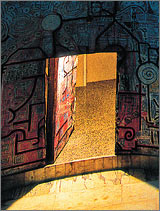
My favorite mural in the temples depicts what Falco calls the Enemy of Mankind, an impersonal force of stasis, inertia, and conditioning represented by an evil horde of faceless warriors pouring over the plains like a dark tide. These gray soldiers of the Enemy are locked in combat with the colorful citizens of Damanhur, whose own faces are filled not with hatred or anger but with laughter, determination, and a certain steely-eyed joy. “As the Enemy can be identified with an absolutely negative force with a lot of power but very little intelligence,” Falco explains, “the way to oppose it is to use fantasy, invention, and creativity. You can consider the Enemy a rigid and unavoidable opposition that can be contrasted only with elasticity and fantasy.”
Just don’t confuse his emphasis on the power of lightheartedness and imagination with being soft. On the contrary, over and over again throughout Damanhur’s history, Falco has not hesitated to shake things up when necessary in order to break through the structures of habit and complacency that tended to form between people over time. It first happened in 1983. Work on the temples was hopping, and life at Damanhur had gotten comfortable. Too comfortable. So Falco left. By the time he came back three months later, he had a whole bevy of new recruits with him, and soon the original group was vying with the younger one for his attention. His response? Deliberately sowing dissension between them, he eventually set up a no-holds-barred multiday version of the children’s war game “capture the flag.” Predictably, the mock fighting heated up till it hit fever pitch, but just as it threatened to come to actual blows, Falco called a halt and made the two sides sit down with each other to talk about their experience, and the rift between them finally unraveled.
That’s how the Damanhurian tradition called the Game of Life was born. It would become a central factor in the ongoing evolution of their communal society, a way to optimize the development of interpersonal relationships by playfully pushing against people’s natural leanings toward rigidity, security, and isolation. Since then, there have been many of these developmental exercises—artistic battles, traveling quests and journeys, wilderness survival challenges, the fifteen-year-long Risk game, and more—all emphasizing the confrontation with and the breaking down of boundaries between people. And the Damanhurians see the task of incorporating what they learn through the Game of Life into the constantly shifting structures of their community as a way for them to put their spiritual principles into practice, principles that call them to seek change, embrace uncertainty, and take personal responsibility for their own transformation.
The more I learned about the Damanhurians’ willingness to consistently reinvent themselves as the community has evolved over time, the more I got a sense of how they’ve been able not just to survive but to thrive through the years while so many utopian experiments before them have folded up shop or simply faded into the history books. I’ve lived in several communities myself—first on an egalitarian farm in rural Missouri and now as a member of the dedicated spiritual collective that is home to WIE—and I know from experience that getting people to come together, work together, and most of all stay together for the sake of a larger common mission is not always easy. For starters, one tends to have to work against the culture of extreme individualism and narcissism that most of us are automatically a part of simply by virtue of the times we’re living in, and that’s no small thing, to say the least. But in the battle against all the obstacles that inevitably confront those who try to forge extraordinary societies out of ordinary individuals, with all our many human foibles, frailties, and less-than-wholesome motivations, Damanhur has at least one big advantage going for it: Falco himself.
I first met him at a public lecture he gave to a crowd of about two hundred Damanhurians while I was there, a lecture I expected would finally give me the chance to see members of the community engaging with him directly about some aspect or another of community life, maybe even about their esoteric research if I was lucky. But what happened that night was a good deal more radical than that—and by the number of mouths I saw dropping open in astonishment, not something that happened very often. You see, just ten minutes into his talk, Falco abruptly stood up, threw his microphone down on the table, and walked out of the room. He was upset about the community’s reticence to make some long overdue changes at one of their projects, changes having explicitly to do with honoring their spiritual commitments. So upset, in fact, that he issued an ultimatum promising to dump the whole venture or even kick out the people who were dragging their heels if that’s what it took to get things back on track.
“I can’t believe that people who are making a spiritual journey decide to stop and don’t move from where they are,” Falco said to me the next day when we sat down to talk about his role as Damanhur’s spiritual teacher. “To stop for me means to go backwards. This is what happened last night. So we will see what people will be able to do in a very short time. Otherwise, I will have to select a smaller group who will move forward very quickly and let the others stay behind. But we still always try to push a certain edge that will keep the others above a particular level. Unfortunately, this has already happened many times in the past. We’ve had many moments in our history when we had to increase the level, to make it higher. If we hadn’t, everything would be superficial. So our system is very selective. Someone who is not involved enough in the main things, who stays on the side, is more and more on the side until we invite them to leave.”
“That’s beautiful,” I said, immediately regretting my choice of words.
“It’s not beautiful,” he corrected me, “but it’s the reality.”
The night before, someone had told me they felt Falco was being too harsh, more like a father scolding his kids than the leader of a community of mature adults. But when I mentioned this to him, he said, “That’s the last thing I’m interested in. Many people who want a teacher are only looking for a substitute for their parents. They only want reassurance, but the goal is to become divinity. To grow, and not to look outside yourself for what can only be found inside.”
“So would you say that your goal is to help people discover real independence?” I asked.
“Yes—and in that, to become able to live together with others. When we speak about enlightenment, the idea is that people cannot be enlightened alone. Enlightenment can happen only with the help of others. In this way, we bypass the selfishness of the single individual who only wants to be enlightened for themselves.”
In the Big Rock Candy Mountains
One evening as the sun went down and the jungle fire was burning
Down the track came a hobo hiking and he said boys I’m not turning
I’m headin’ for a land that’s far away beside the crystal fountains
So come with me we’ll go and see the Big Rock Candy Mountains
Harry McClintock, aka Haywire Mac
There’s an old country song called “Big Rock Candy Mountain” by a Tennessee troubadour known as Haywire Mac that reminds me a little of Damanhur. It’s a classic hobo ballad from the turn of the twentieth century, the tale of a comic utopia where the lakes are made of whiskey, the cops have wooden legs, the hens lay soft-boiled eggs, and there are always plenty of boxcars to sleep in. The song is based on a famous medieval paradise called the Land of Cockaigne (cakeland), a place where the peasants get rained on by honey waffles, the fences are made of sausages, and grilled geese fly right into your mouth.
Don’t get me wrong. I’m not saying Damanhur is anything like these farcical lands of plenty where everything is handed down free and easy on silver platters from on high. To the contrary, the multifaceted success of this utopian community may be outshined only by the scope of the effort, daring, and dedication that built it. Yet Damanhur’s fondness for forgotten civilizations and lost esoteric mythologies does imply a certain fascination with the idea of paradise all the same. On one hand, they’re some of the most practical-minded people you’ll ever meet; on the other, they’ve clothed themselves in a sort of storybook metaphysics, a great cosmic plot line that brings order and stability to their world and infuses it with a mythic sense of nobility and meaning. And perhaps the most interesting, most challenging, and most confounding aspect of my time there was trying to sort through this study in contrasts, to make sense of a society that was down-to-earth and veiled in mystery all at the same time, working like gangbusters to build a better future while concentrating great parts of its attention on the cryptic antiquities of the past.
By the time I left, I was still struggling with the question of how it all fit together. On one side of the equation, the impressive testimony of Damanhur’s accomplishments seemed virtually endless. They mint their own coins, for Pete’s sake. They’re producing hand-painted textiles for some of the top fashion houses in Milan. I got to see their new temple structure—or rather the incredible hole in the ground that will one day be their new temple structure, a megalithic glass-domed auditorium with a world-class library of esoteric books underneath, all connected to the current temples by an underground train. And although it seemed to me that it would take at least twenty years to complete it, they said they would finish it in two. If I were a betting man, I wouldn’t bet against them. They’ve triggered the economic, cultural, and political revitalization of a whole district in the Piedmont Alps. They count one local mayor and twenty-two council members from nine different towns among them, and they have townships where none of them even live asking them to run for office because of everything they’ve done in their own region and all the national grant money they’re bringing in. They’re so confident of their ability to foster healthy communities that they even submitted a proposal to NASA offering to act as consultants to the space program, to help with the design of future orbital colonies.
The Temples of Humankind are now recognized by the Italian Heritage Ministry, the regional beaux-arts authority, and Guinness World Records; and with Alex Grey’s new book, Damanhur: Temples of Humankind, now on the shelves, they may soon be reaching a broader audience. “We just don’t see contemporary sacred spaces that are not aligned with known world religions but that still articulate a devotional relationship to the cosmos,” Grey told me when I got back to New York. “We’ve been adrift for so long, and the story of art in the twentieth century has been filled with such titanic egos. It’s all about me and my new ‘ism,’ my own particular way of seeing the world. But the temples of Damanhur are more than one man’s vision. This is coming from all of them. I don’t know of anywhere else on the planet where artists and artisans are working communally this way to create sacred space. You’d probably have to go back hundreds of years, maybe even all the way to the medieval craft guilds that built places like St. Mark’s Basilica in Venice. It took them five hundred years to do those mosaics. And I think it’s an astonishing achievement to begin to evolve a community like this today.”
The flip side of Damanhur’s undoubtedly astonishing achievements is that everything they’re doing is based on the romanticized ideal of a long-gone golden age.“Through learning about Atlantis and the fabled past of our planet,” they explain, “we will have a better understanding of the ‘Great Plan’ that has been unfolding through time to bring humanity to higher levels of consciousness and harmonious living.” Damanhur’s version of the Atlantis myth can be traced fairly directly to the late-nineteenth- and early-twentieth-century exemplars of Western esoteric thought, especially Madame H.P. Blavatsky, Rudolf Steiner, and the great American psychic Edgar Cayce. Most of Damanhurian philosophy, in fact, seems to come straight out of this same esoteric milieu, so I was surprised when they told me it was all entirely original. Ironically unaware of their roots in a philosophical tradition without which their own ideas probably could never have existed in the first place, they seemed comfortable ignoring history. We still haven’t found any credible archaeological evidence for a historical Atlantis ten or twelve or twenty thousand years ago, at least as far as I’m aware, but if it did exist somewhere, it probably would have borne a greater resemblance to the prehistoric cultures of the time than to the futuristic techno-Eden the Damanhurians make it out to be. Plus, I couldn’t help but notice that the paintings the time travelers profess to have made of their visits to Atlantis showed an architecture more like that of Mussolini-era Italy (with an Art Deco twist) than, say, the world of Ancient Greece.
But perhaps the biggest drawback of golden age thinking in general is its tendency to pull you out of step not just with the past but with your very own times. I keep coming back to the disconcerting experience of slipping back through time that I had inside the temples, where intimate portraits of Damanhur’s communal history were placed side by side with the sweeping frescoes of an impersonal cosmic story. It was like another world down there, another era of myth and magic that for a moment seemed to wrap me up in its wide, enchanting arms. And that world surprised me. It was strangely comforting to what I think of as an older (perhaps even ancient) structure within my own psyche, a part of me that hungers for safety, familiarity, and, above all, certainty in the midst of a twenty-first-century life that is far too complex and far too insecure for its liking. But that longing for existential security was double-edged, because to another part of me, it felt claustrophobic, stifling, almost as though I was being drawn back into the mind of the mythic worldview of yester year, a state of consciousness where everything was known, fixed, sorted out, and tucked into place—including my own particular place in the overarching scheme of things. As comforting as it initially seemed, when my fascinating excursion through this subterranean wonderland came to an end, I was surprised at how relieved I was to come back out into the air and the daylight again.
Still, we do need some broader perspective to orient us in this age of fragmentation, some larger context of shared purpose and common value that can give us reasons for being that transcend whatever private fears and dreams we each happen to be haunted or inspired by. And for all its downsides, Damanhur’s golden age mythology is a pretty good example of why. The Damanhurians are some of the happiest and healthiest people I’ve ever seen. I mean, even the teenagers seemed happy at Damanhur. The people I met were almost uniformly passionate about a mission greater than themselves. Most of them came to Damanhur when they were young and idealistic, and ten, twenty, even twenty-five years down the road, most of them are very much idealists still. Life is full, and full of challenges. They’re very busy, but they’re happy to be busy because they feel themselves to be a part of something inherently meaningful. They take care of each other, and even better, they really seem to depend on one another. “It’s very difficult to see yourself objectively,” one of them told me. “We tend to fall into habits, to repeat the same situations and get stuck in our own ways of thinking, and that’s why we need the others. You can always see yourself in the mirror of relationships. It can be intense living this way, but for us, living together is really the cauldron where the alchemy of transformation takes place.”
In taking up the mantle of the utopian dream with a fertile imagination and no small measure of good old-fashioned perseverance, the Damanhurians stand out against the cynical bottom line of contemporary culture—and most importantly, they’re doing it together. Whatever you think of their metaphysics, the fact is, they’ve found a way to consistently tap into the deep strength of soul and self that can be liberated through a sustained, committed, and creative engagement with others. That’s what stuck with me the most when I came out from the temples and onto the landing at Porta del Sole, the “Gateway to the Sun.” The Damanhurians had first started digging there on a warm August night almost thirty years ago, making their first marks on the mountain with a single shovel and a pickaxe. Falco had been waiting for the right sign to appear before he told them about their real mission there—to build a hidden temple beneath the mountain—and it had come that evening while they sat together around a fire: a shooting star that blazed up and fell down in dazzling slow motion across the summer sky.
Who can say where Damanhur’s star is leading them now? I’m every bit as amazed and perplexed as I was when I first set foot there, and I haven’t even told you the half of it. Would you believe some say that Falco doesn’t just travel backward through time but that he actually came from the future in the first place? Six hundred years in the future, to be exact, when the world is apparently on the verge of apocalypse and a messenger is chosen to journey back to the past and set things aright. Your guess is as good as mine on that one, but whatever light it is that ultimately guides this modern-day utopian experiment, it seems to be growing brighter all the time. “This temple you have seen has been made by less than a hundred people,” Falco told me. “Now we are over a thousand. And we like to think that if all goes well, our future achievements will be proportional to that.”