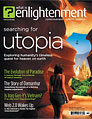
WIE visits one of the world’s most successful communal experiments—the Federation of Damanhur—and explores the ins and outs of esoteric spirituality, the secrets of time travel, and what the utopias of tomorrow have to do with yesterday’s golden age.
What would you say if I told you there was a place nestled in the foothills of the Italian Alps, by the wild gray waters of the Torrente Chiusella, where dreams are not just for children, and magic has not yet gone from the world? A place where men and women live together in harmony with the land and in tune with the cosmos, working and building, playing and cooking, ringing out the evening’s greeting on conch shells that echo from village to village across the forested valleys, gathering at night to revive the lost rites of history’s great kaleidoscope of sacred traditions in underground halls and temples under the moon? It is a place washed by mysterious energies, where people seem to age more slowly and latent creative abilities bubble up spontaneously in young and old alike. A place where artists and artisans, merchants and councilmen, poets and architects all walk the paths of a university dedicated to the quest for esoteric knowledge and the spiritual advancement of humankind. You might even hear stories of quantum physicians plying the borders of matter and energy who claim to have penetrated the information codes underlying human DNA; or psychic technicians who speak of traveling the earth’s planetary energy lines, slipping backward in time to set events in motion that may be destined to change the course of the distant future . . .
What would you say if I told you the story of a people, a vision, a whole society that sounded less like anything you’ve ever heard of in this world and more like something Gene Roddenberry dreamed up for an episode of Star Trek—one of those classic undisturbed planets, idyllically isolated from the rest of the galaxy, where people wear colorful flowing robes, the kids run right up to the crew of the Enterprise because they never learned to be suspicious of strangers, and the atmosphere is perfumed by a sort of quaintness and real dignity and also by a certain feeling of doomed innocence? Would you even believe me if I told you this was no science fiction utopia at all but was every bit as real as the stone farmhouses and stone-covered hills of the Italian countryside that surrounds it, just fifty kilometers north of the city of Torino?
The First Spiritual Autonomous Region of the New World
A map of the world that does not include Utopia is not worth even glancing at, for it leaves out the one country at which Humanity is always landing. And when Humanity lands there, it looks out, and seeing a better country, sets sail. Progress is the realisation of Utopias.
Oscar Wilde
Here at WIE, we’re lovers of innovation, fans of the unusual, and suckers for the radical. So when we heard about an intentional community in northern Italy’s Piedmont Alps so bold as to call itself “the first spiritual autonomous region of the new world,” suffice it to say it piqued our curiosity.
The more we learned about this place, the more intrigued we became. For one thing, it’s no small-time operation: More than a thousand people live there, spread across an entire subalpine valley and deeply incorporated in the local community, culture, and economy. Two, their society is based on something that is all too rare in this cynical world—unrestrained, unabashed optimism—and they have consciously dedicated their lives to what they see as the reawakening of the divine within both the individual and the larger collective. Three, perhaps more successfully than hundreds if not thousands of other communal experiments founded on utopian ideals over the last fifty years, they have not only stood the test of time but prospered. Established in 1975, they seem to have remained in a state of dynamic growth for more than three decades now, boasting dozens of thriving businesses; their own daily newspaper; their own currency, constitution, and government; their own schools, political movement, and fire department; and, most of all, a spirit of passionate self-reinvention that consistently refuses to be quenched.
And there’s more. For all you esotericists out there, the citizens of the first spiritual autonomous region of the new world also claim to be inheritors of the mystical legacy of Egypt and Atlantis, guardians of a lost and ancient knowledge they fervently believe is going to help awaken and evolve human consciousness. All that Star Trek stuff I said before about quantum technology and time travel and DNA codes and such? It barely scratches the surface of their belief system. They’ve even codified and immortalized their entire esoteric scheme into sacred architecture, in the form of a gigantic chain of underground temples that looks like it came straight out of the pages of Tolkien. But these adherents of a philosophy so heady and complex it would take me every page of this magazine to explain it are somehow, at the very same time, unusually down-to-earth and refreshingly action-oriented. After all, they excavated every last square inch of these “Temples of Humankind” by hand, with no help at all from professional engineers. “The search for the inner self and God,” they explain on their website, “is founded on . . . a harmonious and continuous inner transformation, the overcoming of personal limits, the capacity to measure ourselves through action and practical work, [and] the respect for all forms of life, be they subtle or physical.”
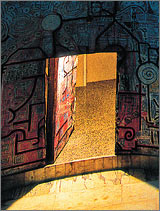
For all that, you probably haven’t heard of them before. They kept a low profile over the years for several reasons, not least of which is that they lacked permission to be digging out a seventy-meter-deep, six-thousand-cubic-meter series of tunnels and caverns underneath a local mountain. And they haven’t exactly gotten a lot of good press for the whole time-travel thing. Italy is a conservative country, nearly ninety percent Catholic, and this curiously inspired group of occultist communitarians was probably wise to play it conservative themselves. But you can’t keep a secret forever, and in recent years they’ve opened their doors to the world and are beginning to travel more and more to share their ideas and the lessons of thirty years of hard work. Visionary artist Alex Grey has taken an interest in the extraordinary painting, sculpture, and glasswork of the Temples of Humankind, now recognized as an Italian national treasure and featured in a new coffee table book out last fall from Grey’s Chapel of Sacred Mirrors Press. They’ve got twenty affiliated centers now in Italy, with twenty more in Europe, Japan, and the United States. They’re stepping up their involvement on the international stage, taking a leadership role in the Global Ecovillage Network and hosting a major conference next summer for the International Communal Studies Association called “Communities: Yesterday’s Utopia, Today’s Reality.” And they’re hard at work on their next temple project, a massive thousand-seat underground amphitheater they plan to offer to the United Nations.
Our interest was piqued all right. Remember, we’re talking about more than one thousand people here. From everything we could tell, they seemed to have tapped directly into something remarkable, some deep creative drive that has kept them growing and evolving all these years, aligned under the unifying banner of a shared commitment to higher ideals. They also seemed to have devoted incredible amounts of energy and attention to arcane philosophies and sci-fi mythologies, not just one or two but whole grandiose hosts of them, and although I’m as big a fan of a good sci-fi mythology as the next guy, it wasn’t yet clear how it all fit together. In short, from the communities of Auroville in South India to Findhorn in Scotland to the Farm in Tennessee, you’d be hard-pressed to find a more fascinating—or more enigmatic—example of the age-old utopian impulse manifesting itself in modern times.
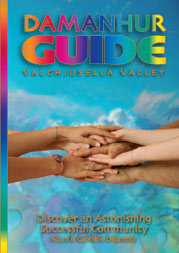
They call it the Federation of Damanhur, and when the opportunity presented itself last summer to spend a few days there, we simply could not pass it up.






 printer friendly
 email the editors
 advertise
 reprints