A Philosopher of Everythingby Carter Phipps You won't see him talking to world leaders on CNN. You won't see him schmoozing with politicians at Davos. You won't see interviews with him on 60 Minutes, Frontline, or C-SPAN. You can even be an educated, thoughtful, well-informed citizen of the Western world and never have heard his name. But make no mistake about it, Ken Wilber is important. His work and ideas—what he calls “integral philosophy”—are quietly affecting the way hundreds of thousands if not millions of people think about the world they live in. Ever since publishing his first book, The Spectrum of Consciousness, in 1977, Wilber's work has chipped away at the philosophical foundations of our postmodern age, clearing out contradictions and confusion and articulating new models and maps of reality that may shape the contours of our future culture. If postmodernism can be defined, as Lyotard famously put it, as “incredulity toward meta-narratives,” then Wilber's integral theory is the perfect antidote. With books called A Brief History of Everything and A Theory of Everything, Wilber has sought to create the sort of Holy Grail of grand narratives, a framework that allows for the integration of all categories of human knowledge. Just try to name another philosophy that can easily bring together most of religion, art, morality, economics, psychology, and all of the major sciences into one theory and you start to understand that when Wilber uses the world “integral,” he really means it. Wilber is not the founder of the relatively embryonic field of integral philosophy. That distinction might better be placed at the feet of Indian sage Sri Aurobindo, or perhaps with philosopher Jean Gebser. Some would even go as far back as Hegel, though the German idealist never specifically used that word. But Wilber is the current laureate of the integral world. His work has transformed integral theory from a loose collection of ideas garnered from a few visionaries into an important movement, a powerful set of foundational notions about reality that are beginning to have influence at the highest levels. Witness Bill Clinton's recent reference to Wilber's work in a speech at Davos, where he mentioned the integral approach as a powerful prism through which to understand and relate to our globalizing world.
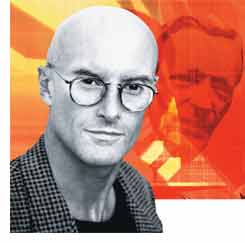
The appeal of integral theory is its inclusiveness, its comprehensiveness, its capacity to reframe and reorganize the vast complexity of human knowledge into useful coherence. And Wilber is the man most responsible for giving it that reputation. Indeed, with a mind that is both brilliant and broad-ranging, he is as at home discussing the dynamics of Jungian psychology as he is the epistemes of Foucault, the hard problem of cognitive science, and the nature of emptiness in Vajrayana Buddhism. And he writes about all of it with a popular touch that educates the layperson even as it draws one into entirely new and quite sophisticated perspectives on reality. Wilber began his career exploring the connections between psychology and Eastern spiritual traditions, making the bold move of integrating their insights into one comprehensive “spectrum of consciousness,” a map of psychological and spiritual development from birth to Buddhahood. Such connections were radical for the time, earned him wide acclaim, and essentially inspired the entire field of transpersonal psychology (a field that he has since disassociated himself from). It also established him as a true champion of the insights of the great enlightenment traditions, East and West, and he has argued that they represent a fount of knowledge that must be dealt with by any genuine “integral” theory. It is a deeply felt passion, and a personal one, as Wilber himself is a spiritual practitioner with experience in several paths, most notably Zen and Tibetan Buddhism. He calls himself a “pandit,” borrowing an Indian term for a learned scholar who defends the true dharma* against all who would do it harm. This ongoing advocacy has earned him the deep appreciation and respect of many, including the editors of this magazine, who feel that a robust religious and spiritual discourse is essential for the health of our contemporary culture, and for its further evolution. Of course, Wilber's placement of spirituality at the heart of his philosophical framework has not endeared him to a skeptical Western intelligentsia. But even at the beginning, he knew that his own philosophy would run counter to the dominant intellectual currents of the day: One thing was very clear to me, as I struggled with how best to proceed in an intellectual climate dedicated to deconstructing anything that crossed its path: I would have to back up and start at the beginning, and try to create a vocabulary for a more constructive philosophy. Beyond pluralistic relativism is universal integralism; I therefore sought to outline a philosophy of universal integralism. Put differently, I sought a world philosophy. I sought an integral philosophy, one that would believably weave together the many pluralistic contexts of science, morals, aesthetics, Eastern as well as Western philosophy, and the world's great wisdom traditions. Not on the level of details—that is finitely impossible; but on the level of orienting generalizations: a way to suggest that the world really is one, undivided, whole, and related to itself in every way: a holistic philosophy for a holistic Kosmos: a world philosophy, an integral philosophy. This fall, Wilber will end a four-year publishing drought with the release of his twenty-third book, Integral Spirituality, which seeks to shed a brilliant new light on the role and significance of spirituality and religion in the modern and postmodern world. This deceptively slim volume presents a powerful context for understanding the central dilemmas facing religious traditions today—their declining influence, their ongoing debates with science, their struggle with various forms of extremism, and so on. It seeks to resuscitate religions' key insights while shedding the outdated mythic belief structures common to most traditions. The book also examines many of the core issues facing today's postmodern spiritual seekers—the role of therapy, the limitations of meditation, different approaches to and types of enlightenment, pluralistic interpretations of God, and the challenges faced by American Buddhism. Though Wilber's legend is already firmly established in the East-meets-West spiritual subculture, in the field of transpersonal psychology, and among many of the so-called cultural creatives, Integral Spirituality is a work that should raise his profile in the eyes of mainstream culture. And by showing off the power of the integral model to make sense out of one of the most complex and important areas of human life, Wilber may also earn himself more attention from the greatest critic of all—history. Now 57, Wilber is more prolific and productive than ever. A “collected works” edition of his books and writings has been published, pointing to the sheer volume of material this sage of synthesis has managed to churn out in less than three decades. He has also recently completed volume two of what is destined to be a series of three books elucidating the core ideas of his philosophy. The first installment of this “Kosmos Trilogy,” as he calls it, was Sex, Ecology, Spirituality, published in 1995. The second is tentatively titled “Kosmic Karma and Creativity” and will be published in 2007, with the third already partially written and presently titled “God, Sex, and Gender.” In between these weighty intellectual treatises, Wilber has mixed in a variety of other writings and books, some addressing specific fields, like Integral Psychology (2000), some dealing with contemporary cultural issues, like Boomeritis (2002) and The Many Faces of Terrorism (forthcoming), and some, like the popular A Brief History of Everything (1996), acting as more easy-to-read, abbreviated versions of his core trilogy. ![]() Taking a page from the great Athenian tradition, Wilber has also formed an academy of his own, Integral Institute, a high-level think tank/educational institute that disseminates and applies integral theory to various fields of knowledge. Wilber's thought has always been too expansive and category-breaking to be easily accepted within the more conservative, more specialized environment of the conventional academic world, and so initially, he took his ideas straight to the people, so to speak, writing for a general, if highly educated, audience. But with great success comes great opportunity, and Wilber's large popular following, along with the tremendous accolades his work has garnered (he has famously been called the “Einstein of consciousness”), has allowed him to transcend his status as an independent philosopher and build relationships with individuals in many mainstream institutions, including government, business, and higher education. Perhaps the most dramatic example to date of the practical impact of these ongoing relationships is Integral University, a just-launched online “learning community” with tremendous ambitions. Indeed, with Integral Institute's support and Wilber's ongoing guidance, it has set its sights on becoming an accredited university unlike any other, bringing together a global network of scholars, theorists, practitioners and supporters, working in a rigorous, peer-reviewed context for the further development and expansion of integral theory into some twenty or more separate disciplines. In the midst of all of this activity, the integral model itself continues to develop. In fact, one of the most striking aspects of Wilber's body of work is its ongoing evolution over the years as he incorporates disparate theories, ideas, and knowledge into his theoretical matrix at a furious pace. He sees integral theory not so much as a new field in and of itself but as an overarching context that, when applied to any area of study, will act as a sort of epistemological and ontological strainer, filtering away outdated assumptions about the nature of reality that might still exist in that field while at the same time radically reorganizing its contributions in light of a more comprehensive, inclusive worldview. Steadily, from ecology to anthropology to art to politics to economics to law to science to psychology to spirituality, he is endeavoring to bring the major categories of human knowledge into an integral embrace. All Quadrants, All Levels One of the best examples to date of the sort of integration espoused by integral theory is Wilber's signature insight (introduced in Sex, Ecology, Spirituality in 1995) into the four fundamental perspectives on reality, a breakthrough model he calls the four quadrants. Based on the actual perspectives from which we view the world around us—first-person, second- person, and third-person—these quadrants provide a unique and comprehensive window through which one can examine just about anything. The genesis of this insight wasn't sudden illumination or divine guidance. In fact, it was more grit than grace. Determined to understand how different kinds of knowledge systems fit together, Wilber spent years trying to understand the actual relationship between different disciplines and fields of study. But every school of thought seemed to have its own unique way of organizing reality, its own way of hierarchically ranking and categorizing knowledge. In search of a holistic model, Wilber struggled mightily with how to make sense out of these vastly discrepant systems: At one point, I had over two hundred hierarchies written out on legal pads lying all over the floor, trying to figure out how to fit them together. . . . There were linguistic hierarchies, contextual hierarchies, spiritual hierarchies. There were stages of development in phonetics, stellar systems, cultural worldviews, autopoietic systems, technological modes, economic structures, phylogenetic unfoldings, superconscious realizations. . . . And they simply refused to agree with each other. . . . Toward the end of that three-year period, the whole thing started to become clear to me. It soon became obvious that the various hierarchies fall into four major classes (what I would call the four quadrants); that some of the hierarchies are referring to individuals, some to collectives; some are about exterior realities, some are about interior ones, but they all fit together seamlessly. The rest, as they say, is history. The four quadrants model is perhaps Wilber's most celebrated insight. And justifiably so. He suggests that almost anything can be looked at using these four inherent perspectives—the interior and exterior perspectives on the individual and the interior and exterior perspectives on the collective. Want to know why science and religion have difficulty finding common ground? Why Marxism failed? Why neuroscience's search for God is misguided? Why the linguistic turn in twentieth-century philosophy was so important? It's all there in these simple but remarkably profound four quadrants. One can imagine a future in which high school students are drilled in this model of reality in the same way they learn the periodic table of the elements today. *Dharma is a Sanskrit word that means natural law, or reality, and with respect to its significance for spirituality and religion, it might be described as the way of being that conforms to universal law, or the essential nature of things. And the four quadrants are just the beginning. Another core insight for which Wilber has become well known over the last decade is his recognition that there is an emerging consensus, coming from very different streams of thought, that human development, individually and to some extent culturally, goes through specific levels or stages of consciousness. For example, there are the cognitive stages of psychologist Jean Piaget, the moral stages of American academic Lawrence Kohlberg and women's studies pioneer Carol Gilligan, the cultural stages of philosopher Jean Gebser, the spiritual stages of Indian sage Sri Aurobindo, the color-coded stages of Spiral Dynamics coming from the work of psychologist Clare Graves as well as Don Beck and Christopher Cowan, and many more. Taken as a whole, they present a powerful message to the integral mind. Human consciousness develops, they suggest, and in very specific ways through very specific stages. And we can see these stages, or levels, of consciousness not only in the development of individual psychology, from infancy to adulthood, but in the development of human culture over millennia. We can even see these different developmental levels alive and active in the world today, for better and for worse, in the so-called clash of civilizations and in the ebb and flow of global politics. Wilber was one of the first to highlight just how remarkably similar some of these developmental systems are and to begin to incorporate that knowledge and apply it.

Wilber's model of these “stages of consciousness” points to an overall pattern in human development, a hidden method to the meanderings of the human condition and even a subtle trajectory to human evolution. Here again he presents a powerful but relatively simple framework, or map, of reality that does not reduce or deny the complexity of human nature but rather teases out larger patterns in that complexity. Of course, the test of any effective model is how well it equips you to make sense of the world. And this is where Wilber's integral philosophy shines. Once you start viewing reality as a four-quadrant affair and human life as an ever-unfolding developmental process passing through specific stages and spiraling up into greater and greater evolutionary heights of increasing complexity and consciousness, each new level transcending and including the levels that came before, you'll wonder how you ever conceived of life in any other way. These two conceptions—quadrants and levels—are just the most rudimentary building blocks of Wilber's long-developing integral model, or “all quadrants, all levels” (AQAL)** approach. They represent the basic structure of his “theory of everything” and the foundation of his “integral operating system,” as he now refers to his core philosophy. And together with new contributions to the integral model articulated in Integral Spirituality, they comprise the fifth major stage in the development of his work. “In every work of genius,” wrote Emerson, “we recognize our own rejected thoughts; they come back to us with a certain alienated majesty.” Wilber's work is no exception. His theory has that unique trait of explaining the world in a way that seems completely novel yet somehow familiar at the same time. His analysis is so clear and obvious—after it is explained. He takes your own deepest perceptions and turns them into conceptions, fulfilling that characteristic trait of great theory, what media critic Thomas de Zengotita describes as the ability to reveal “what you already knew but didn't know you knew.” And now, returning again to the domain of life that originally inspired him to take up the sword of philosophy in the name of the good, the true, and the beautiful, he has focused his powerful integral lens on the vast and ancient landscape of religion and spirituality. Living in a Post-metaphysical World Integral Spirituality is a work that furthers many of Wilber's core ideas and expands his always-evolving integral framework to include more of . . . well, “everything.” But it is Wilber's diagnostic work on the problems besetting both religion and spirituality in our contemporary society that is the highlight of the book. He outlines the reasons why the meditative and contemplative disciplines have been dismissed by today's progressive thinkers and carefully outlines a path forward that integrates spiritual awakening into the leading currents of human thought. Unlike many contemporary philosophers, Wilber has always treated the great wisdom traditions as full participants in his “universal integralism.” But that creates a problem. And it's a problem he states at the beginning of chapter one. He writes: We start with the simple observation that the “metaphysics”*** of the spiritual traditions have been thoroughly critiqued—“trashed” is probably the better word—by both modernist and postmodernist epistemologies [ways of knowing], and there has yet arisen nothing compelling to take their place. It's true that religion is sort of the Rodney Dangerfield of modern culture. It doesn't get any respect. Indeed, it doesn't take a great historian to notice that ever since the Western Enlightenment, religion and spirituality in all their many forms have been at best tolerated and at worst dismissed by the most progressive currents of thought in Western culture. And the gap between the secular and the spiritual is not shrinking. Just look at the intelligent design/evolution debates, the last U.S. Presidential election, or even the continuing global saga of religious violence. All expose the long-standing tensions between religion and secular modernity, pressure points that are at play both nationally and globally. Wilber, however, bypasses the superficial layers of these culture wars and goes deeper, drilling down to the philosophical roots of the problem. Like a good doctor, he first diagnoses his patient (religion and spirituality) and clearly elucidates the nature of the disease. Using his trademark integral model, he illustrates how the last several centuries of philosophical thought were devastating to all forms of spirituality. Indeed, he details how science and the philosophical traditions of the European Enlightenment fundamentally undermined the metaphysics, or belief structures, of the religious traditions to such a degree that they simply never recovered. Enlightenment thinkers questioned both the veracity of religious belief systems as well as the way in which they arrived at those beliefs, demanding evidence for religious claims about reality. Religion stumbled on all counts. It is, in fact, a well-documented story, one that has received much attention as of late in the many science and religion debates that dot the intellectual landscape. And it also explains why, in the last several decades, there has been a great attempt by spiritual thinkers to ground their ideas in science, thereby hoping that they would gain broader acceptance in the culture. Wilber, however, bucks this conventional wisdom and places responsibility for spirituality's stunted standing in the contemporary West at a different doorstep. He feels that it was the insights of postmodernity, or postmodern philosophy, that killed the contemplative traditions in the eyes of serious thinkers, and he suggests that until that issue is addressed, no marriage of science and spirit, no synthesis of quantum mechanics and mysticism, no tao of physics, no dancing Wu Li masters, however profound or popular, is ever going to change things. This is because postmodernist thinkers pointed out a different problem. And it is a problem, Wilber gently explains, that many of today's most popular spiritual and religious thinkers are unknowingly perpetuating. He calls it the “myth of the given.” The myth of the given goes by various names among various thinkers (the phrase itself comes from an essay by analytical philosopher Wilfrid Sellars; Jürgen Habermas, one of the most respected thinkers alive today, refers to it as the “philosophy of consciousness”). It essentially disputes a fundamental assumption of the meditative and contemplative traditions—that knowledge gained through introspection is trustworthy. Indeed, the myth of the given refers to the assumption that what is “given” to my consciousness is real, that I can perceive objective reality solely through my personal experience. Nonsense, claimed postmodern thinkers. If a Christian monk has a vision of Jesus, he may believe that he is seeing an objective spiritual reality. But he fails to recognize, these thinkers tell us, that his vision is inevitably being influenced by tremendous cultural and social conditioning that is all taking place prior to and outside of the monk's immediate awareness. Like Hindus witnessing a vision of Krishna, or Tibetans a powerful visitation from a bodhisattva, he is mistaking a cultural archetype for truth. Most of us fail to take into account, Wilber explains, how the ever-present collective, or intersubjective, context in which we live shapes our perceptions. Before one ever sits down on the meditation cushion, he writes, “vast networks of intersubjective systems . . . are governing one's awareness and consciousness.” We may think that we perceive reality as it is, but in fact, we are more like the main character in our own Truman Show, and we cannot see the subtler cultural forces that are invisibly shaping all of our perceptions—even our most cherished spiritual experiences. Examine any religion, any ancient philosophical system, and even most contemporary spiritual teachings, Wilber suggests, and you'll find that they are shot through with the myth of the given—unknowingly and innocently perhaps, but that does not mitigate the indictment of postmodernity. “Between the critiques of modernity and postmodernity,” Wilber writes, “what was left of the Great Traditions could be put in a teaspoon.” But Wilber is a compassionate doctor, and despite the seriousness of the disease, he does not pronounce it terminal. Instead, he presents a cure that he calls “integral post-metaphysics.” Integral post-metaphysics is multilayered and profound, and there is not enough space here to convey its full significance. But it is important to grasp the scope of Wilber's ambition and its implications for spiritual thought in the twenty-first century. He is trying to carve out a space within the most sophisticated intellectual currents of the day for the relevance—indeed, the desperate necessity—of a spirituality that has incorporated the last three centuries of philosophical insight. He does not suggest that we throw out all of history's extraordinary religious revelations and the metaphysical systems they inspired. He does not think we should pronounce as illusion all the knowledge contributed by our wisdom traditions just because the sages of yesteryear lacked the perspective of postmodernity. Rather, he feels that we must entirely reframe the way we think about those ancient systems, jettisoning their outdated metaphysics but preserving their extraordinary contributions. And we must do the same for contemporary teachings as well. It is a revolutionary prescription for spirituality in the new millennium, one that radically transcends and yet includes religion's staunchest critics, from Voltaire to Kant to Foucault. And Wilber encourages all contemporary spiritual thinkers to recognize what is at stake—evolution or irrelevance. “Spirituality,” he asserts, “to survive in the present and future world, is and must be post-metaphysical.” The theme of integral post-metaphysics is the primary message of Integral Spirituality, but even as he is building the core argument of the book, Wilber also covers a wide swath of important territory, ranging over a number of topics. For example, the book includes a fascinating discussion of the differences between spiritual states of consciousness and psychological stages of development, and it features the Wilber-Combs Lattice, an innovative graphical representation of the subtle and complex relationship between these states and stages. Integral Spirituality also explores the dynamics of religious extremism and outlines the critical role religion can, and in fact must, play in defusing the battle raging globally between the values of modernity and the values of more traditional cultures—or, as Thomas Friedman puts it, between the Lexus and the olive tree. It examines the limitations of meditation and why the psychological shadow, or the disowned and disassociated parts of one's own psyche, can never be fully integrated through spiritual practice alone—a problem, Wilber says, American Buddhism has yet to fully grasp. And much more. “Philosophy is . . . the front trench in the siege of truth,” the great historian Will Durant once wrote. “Science is the captured territory and behind it are those secure regions in which knowledge and art build our imperfect and marvelous world.” Durant's words still ring true, even though today we have often forgotten the symbiotic relationship between the leading edges of human thought and the future of human culture. Wilber's integral approach transmits a tremendous faith in that future and suggests that we can make sense, profound sense, out of our world. At the same time, it offers a sober, unvarnished analysis of the difficult problems we face as a species. One of those problems is humanity's complex and troublesome relationship to ultimacy. We live in an age in which religious fanatics on one side of the world want to blow up modern civilization in the name of God, while science and spirit advocates on the other side imagine that they have found God in quantum physics. The beauty of Wilber's Integral Spirituality is that it is comprehensive enough to explain both. **AQAL is a Wilber term that originally stood for “all quadrants, all levels” but it has been expanded to mean a perspective that includes all quadrants, all levels, all lines (of development), all states (of consciousness), and all types (of awareness). ***The term metaphysics, in the way that Wilber uses it, refers to those issues that deal with fundamental levels of being, or reality, and how we come to know about reality. |