You won't see him talking to world leaders on CNN.
You won't see him schmoozing with politicians at Davos. You
won't see interviews with him on 60 Minutes, Frontline,
or C-SPAN. You can even be an educated, thoughtful,
well-informed citizen of the Western world and never have heard
his name. But make no mistake about it, Ken Wilber is important.
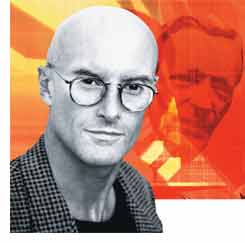
His work and ideas—what he calls “integral
philosophy”—are quietly affecting the way hundreds
of thousands if not millions of people think about the world
they live in. Ever since publishing his first book, The
Spectrum of Consciousness, in 1977,
Wilber's work has chipped away at the philosophical
foundations of our postmodern age, clearing out contradictions
and confusion and articulating new models and maps of reality
that may shape the contours of our future culture. If
postmodernism can be defined, as Lyotard famously put it, as
“incredulity toward meta-narratives,” then Wilber's
integral theory is the perfect antidote. With books called A
Brief History of Everything and A Theory of
Everything, Wilber has sought to create the sort of Holy
Grail of grand narratives, a framework that allows for the
integration of all categories of human knowledge. Just try to
name another philosophy that can easily bring together most of
religion, art, morality, economics, psychology, and all of the
major sciences into one theory and you start to understand that
when Wilber uses the world “integral,” he really
means it.
Wilber is not the founder of the relatively embryonic field
of integral philosophy. That distinction might better be placed
at the feet of Indian sage Sri Aurobindo, or perhaps with
philosopher Jean Gebser. Some would even go as far back as
Hegel, though the German idealist never specifically used that
word. But Wilber is the current laureate of the integral world.
His work has transformed integral theory from a loose collection
of ideas garnered from a few visionaries into an important
movement, a powerful set of foundational notions about reality
that are beginning to have influence at the highest levels.
Witness Bill Clinton's recent reference to Wilber's work in a
speech at Davos, where he mentioned the integral approach as a
powerful prism through which to understand and relate to our
globalizing world.
The appeal of integral theory is its inclusiveness, its
comprehensiveness, its capacity to reframe and reorganize the
vast complexity of human knowledge into useful coherence. And
Wilber is the man most responsible for giving it that
reputation. Indeed, with a mind that is both brilliant and
broad-ranging, he is as at home discussing the dynamics of
Jungian psychology as he is the epistemes of Foucault, the hard
problem of cognitive science, and the nature of emptiness in
Vajrayana Buddhism. And he writes about all of it with a popular
touch that educates the layperson even as it draws one into
entirely new and quite sophisticated perspectives on reality.
Wilber began his career exploring the connections between
psychology and Eastern spiritual traditions, making the bold
move of integrating their insights into one comprehensive
“spectrum of consciousness,” a map of psychological
and spiritual development from birth to Buddhahood. Such
connections were radical for the time, earned him wide acclaim,
and essentially inspired the entire field of transpersonal
psychology (a field that he has since disassociated himself
from). It also established him as a true champion of the
insights of the great enlightenment traditions, East and West,
and he has argued that they represent a fount of knowledge that
must be dealt with by any genuine “integral” theory.
It is a deeply felt passion, and a personal one, as Wilber
himself is a spiritual practitioner with experience in several
paths, most notably Zen and Tibetan Buddhism. He calls himself a
“pandit,” borrowing an Indian term for a learned
scholar who defends the true dharma* against all who
would do it harm. This ongoing advocacy has earned him the deep
appreciation and respect of many, including the editors of this
magazine, who feel that a robust religious and spiritual
discourse is essential for the health of our contemporary
culture, and for its further evolution.
Of course, Wilber's placement of spirituality at the heart of
his philosophical framework has not endeared him to a skeptical
Western intelligentsia. But even at the beginning, he knew that
his own philosophy would run counter to the dominant
intellectual currents of the day:
One thing was very clear to me, as I struggled
with how best to proceed in an intellectual climate dedicated to
deconstructing anything that crossed its path: I would have to
back up and start at the beginning, and try to create a
vocabulary for a more constructive philosophy. Beyond
pluralistic relativism is universal integralism; I therefore
sought to outline a philosophy of universal integralism.
Put differently, I sought a world philosophy. I
sought an integral philosophy, one that would
believably weave together the many pluralistic contexts of
science, morals, aesthetics, Eastern as well as Western
philosophy, and the world's great wisdom traditions. Not on the
level of details—that is finitely impossible; but on the
level of orienting generalizations: a way to suggest that the
world really is one, undivided, whole, and related to itself in
every way: a holistic philosophy for a holistic Kosmos: a world
philosophy, an integral philosophy.
This fall, Wilber will end a four-year publishing drought
with the release of his twenty-third book, Integral
Spirituality, which seeks to shed a brilliant new light on
the role and significance of spirituality and religion in the
modern and postmodern world. This deceptively slim volume
presents a powerful context for understanding the central
dilemmas facing religious traditions today—their declining
influence, their ongoing debates with science, their struggle
with various forms of extremism, and so on. It seeks to
resuscitate religions' key insights while shedding the outdated
mythic belief structures common to most traditions. The book
also examines many of the core issues facing today's postmodern
spiritual seekers—the role of therapy, the limitations of
meditation, different approaches to and types of enlightenment,
pluralistic interpretations of God, and the challenges faced by
American Buddhism. Though Wilber's legend is already firmly
established in the East-meets-West spiritual subculture, in the
field of transpersonal psychology, and among many of the
so-called cultural creatives, Integral Spirituality is
a work that should raise his profile in the eyes of mainstream
culture. And by showing off the power of the integral model to
make sense out of one of the most complex and important areas of
human life, Wilber may also earn himself more attention from the
greatest critic of all—history.
Now 57, Wilber is more prolific and productive than ever. A
“collected works” edition of his books and writings
has been published, pointing to the sheer volume of material
this sage of synthesis has managed to churn out in less than
three decades. He has also recently completed volume two of what
is destined to be a series of three books elucidating the core
ideas of his philosophy. The first installment of this
“Kosmos Trilogy,” as he calls it, was Sex,
Ecology, Spirituality, published in 1995. The second is
tentatively titled “Kosmic Karma and Creativity”
and will be published in 2007, with the third already
partially written and presently titled “God, Sex, and
Gender.” In between these weighty intellectual treatises,
Wilber has mixed in a variety of other writings and books, some
addressing specific fields, like Integral Psychology
(2000), some dealing with contemporary
cultural issues, like Boomeritis (2002) and The
Many Faces of Terrorism (forthcoming), and some, like the
popular A Brief History of Everything (1996), acting as
more easy-to-read, abbreviated versions of his core trilogy.

Taking a page from the great Athenian tradition, Wilber has
also formed an academy of his own, Integral Institute, a
high-level think tank/educational institute that disseminates
and applies integral theory to various fields of knowledge.
Wilber's thought has always been too expansive and
category-breaking to be easily accepted within the more
conservative, more specialized environment of the conventional
academic world, and so initially, he took his ideas straight to
the people, so to speak, writing for a general, if highly
educated, audience. But with great success comes great
opportunity, and Wilber's large popular following, along with
the tremendous accolades his work has garnered (he has famously
been called the “Einstein of consciousness”), has
allowed him to transcend his status as an independent
philosopher and build relationships with individuals in many
mainstream institutions, including government, business, and
higher education. Perhaps the most dramatic example to date of
the practical impact of these ongoing relationships is Integral
University, a just-launched online “learning
community” with tremendous ambitions. Indeed, with
Integral Institute's support and Wilber's ongoing guidance, it
has set its sights on becoming an accredited university unlike
any other, bringing together a global network of scholars,
theorists, practitioners and supporters, working in a rigorous,
peer-reviewed context for the further development and expansion
of integral theory into some twenty or more separate
disciplines.
In the midst of all of this activity, the integral model
itself continues to develop. In fact, one of the most striking
aspects of Wilber's body of work is its ongoing evolution over
the years as he incorporates disparate theories, ideas, and
knowledge into his theoretical matrix at a furious pace. He sees
integral theory not so much as a new field in and of itself but
as an overarching context that, when applied to any area of
study, will act as a sort of epistemological and ontological
strainer, filtering away outdated assumptions about the nature
of reality that might still exist in that field while at the
same time radically reorganizing its contributions in light of a
more comprehensive, inclusive worldview. Steadily, from ecology
to anthropology to art to politics to economics to law to
science to psychology to spirituality, he is endeavoring to
bring the major categories of human knowledge into an integral
embrace.
All Quadrants, All Levels
One of the best examples to date of the sort of
integration espoused by integral theory is Wilber's signature
insight (introduced in Sex, Ecology, Spirituality in
1995) into the four fundamental perspectives on reality, a
breakthrough model he calls the four quadrants. Based
on the actual perspectives from which we view the world around
us—first-person, second-
person, and
third-person—these quadrants provide a unique and
comprehensive window through which one can examine just about
anything. The genesis of this insight wasn't sudden illumination
or divine guidance. In fact, it was more grit than grace.
Determined to understand how different kinds of knowledge
systems fit together, Wilber spent years trying to understand
the actual relationship between different disciplines and fields
of study. But every school of thought seemed to have its own
unique way of organizing reality, its own way of hierarchically
ranking and categorizing knowledge. In search of a holistic
model, Wilber struggled mightily with how to make sense out of
these vastly discrepant systems:
At one point, I had over two hundred hierarchies written
out on legal pads lying all over the floor, trying to figure out
how to fit them together. . . . There were linguistic
hierarchies, contextual hierarchies, spiritual hierarchies.
There were stages of development in phonetics, stellar systems,
cultural worldviews, autopoietic systems, technological modes,
economic structures, phylogenetic unfoldings, superconscious
realizations. . . . And they simply refused to agree with each
other. . . . Toward the end of that three-year period, the whole
thing started to become clear to me. It soon became obvious that
the various hierarchies fall into four major classes (what I
would call the four quadrants); that some of the hierarchies are
referring to individuals, some to collectives; some are about
exterior realities, some are about interior ones, but they all
fit together seamlessly.
The rest, as they say, is history. The four quadrants model
is perhaps Wilber's most celebrated insight. And justifiably so.
He suggests that almost anything can be looked at using these
four inherent perspectives—the interior and exterior
perspectives on the individual and the interior and exterior
perspectives on the collective. Want to know why science and
religion have difficulty finding common ground? Why Marxism
failed? Why neuroscience's search for God is misguided? Why the
linguistic turn in twentieth-century philosophy was so
important? It's all there in these simple but remarkably
profound four quadrants. One can imagine a future in which high
school students are drilled in this model of reality in the same
way they learn the periodic table of the elements today.
*Dharma is a Sanskrit word that means natural law,
or reality, and with respect to its significance for
spirituality and religion, it might be described as the way of
being that conforms to universal law, or the essential nature of
things.






 printer friendly
 email the editors
 advertise
 reprints