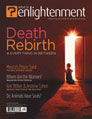
Thirty years ago, Mother Antonia left behind her life as a mother of seven in Beverly Hills to care for thousands of inmates within the hellish confines of a Mexican prison—the place, she says, that “freed” her.
When you think about it, very few of us ever come in contact with holiness in our lifetime. Most of us have to dust the word off just to use it. We may have visited sacred sites such as cathedrals in Europe that house holy relics—the ancient remains of a saint tightly sealed within a crypt, a mummified toe or a bone maybe. But authentic holiness, what the German theologian Rudolf Otto called Ganz Andere, “Total Otherness”—that type of holiness capable of melting our personal significance into its greatness—remains largely alien to us. No doubt, it’s in part due to the times we live in. Most of us have been raised in a secular culture that avoids even the intimations of hierarchy and absolutes, perfection and reverence. Look “holiness” up in the dictionary and you’ll find that someone who is holy is by definition morally and spiritually perfect; they evoke reverence in those around them as a result of their conviction and fearlessness; they are in a persistent state of godliness. Do we believe in perfection nowadays? Are we capable of reverence? Is godliness something we bother to strive for?
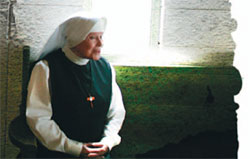
These were the sorts of questions I found myself absorbed by while reading about the life of Mary Clarke. In a new book called The Prison Angel, Pulitzer Prize–winning journalists Mary Jordan and Kevin Sullivan tell the story of how Mary, the daughter of Irish immigrants, grew up in glamour-infused Beverly Hills, was married twice, and raised seven children in relative domestic bliss. Then, at the age of fifty, she experienced a calling to serve God so strong that it led her to literally sew her own habit and move to one of the most infamous penitentiaries in Mexico in order to help the inmates there. For nearly fifteen years, she had no ecclesiastical support for her work at the prison. Now eighty years old, Mother Antonia, as she is known, is considered by many to be a living saint, someone who has walked directly into the middle of prison riots and gunfire to save lives. By all accounts, there isn’t anything she wouldn’t do for her “beloved hijos” (sons), and she has given everything to them, unconditionally, for nearly thirty years. To this day, she lives in a small cell, unequipped with either heat or hot water, alongside drug addicts, murderers, and the poor.
I spoke with Mother Antonia several times in the process of writing this article, and I can tell you that she is perhaps the most effusive and enthusiastic person you could ever meet. “I have not been depressed one day in thirty years,” she once marveled. “Perhaps sad, but never depressed.” Indeed, after every conversation with Mother Antonia, I found myself strangely lifted, as if I had been in touch with the Divine. Though I was in awe of her seemingly bottomless joy, like others I was also mystified by it. “The first time you meet her, you think she’s not real,” a friend explains in The Prison Angel. “She’s nuts, she’s not normal. But in twenty years I’ve never seen her change. . . . There’s an exuberance about her relationship with God. . . . It is normal. It’s what we’re supposed to be and we all wish we could be.”
Ever since she can remember, Mother Antonia was drawn to help the poor and the disenfranchised, even while growing up and then raising her own seven children in Beverly Hills among movie stars and directors. In 1965, a priest by the name of Henry Vetter heard about her ambitious charity work sending clothes, medicine, and supplies around the world on container ships whose captains she had coerced into helping her. He invited her to go on a tour of Tijuana with him, and during the trip they stopped at a prison called La Mesa. At that time, La Mesa was already well on its way to earning its reputation as what some have called the “Black Legend,” a place overrun by corruption and human rights violations. Mother Antonia relates the horror of seeing “F-Tank” for the first time—nothing more than a stretch of dirt behind chain-link fence where insane prisoners were kept without access to running water or toilets. But most striking to her was what happened when they visited the prison’s infirmary. As soon as the sick inmates saw Father Vetter and Mary, they instantly stood up from their cots out of respect. “I immediately felt this caring and a love for them,” she told me. “I felt their goodness.” Over the next decade, Mary began to travel to La Mesa more and more—often several times a week—bringing anything she could to help the prisoners. “Charity is not a thing you do,” she says in The Prison Angel. “It’s love. It’s who you become. I was a salesman for the poor.”
In 1977, when all of Mary’s children were independent and her second marriage had ended in divorce, she had a life-changing realization: “I’d been an outsider to suffering all my life. I had been on the outside helping people on the inside, whether it was in Africa or Bolivia or anywhere else.” As she explained to me, “I think there comes a time when it’s not enough for us just to help other people. There’s something inside us that yearns to give ourselves up for the sake of other people. Sacrifice is the language of love. Without sacrifice, there is no love.” Indeed, Mary felt that she was being called to give up her life “completely.” She sold everything she owned—her business, her house, her belongings—donned a black dress and veil that she had sewn herself and believed looked “nunny,” and took the name Mother Antonia in honor of her deceased spiritual mentor, Monsignor Anthony Brouwers. Before he died, he had told her, “That little cottage that you wanted to go away to and make Toll House cookies—that wasn’t meant for you. This was meant for you. The front lines. God put you in that role.” With that, she crossed the border into Tijuana for good.
Unlike other prisons in Mexico or the United States where individual cement cells are used to contain inmates, La Mesa’s system of incarceration was highly unusual: located within the prison walls was a kind of miniature city called El Pueblito, or “Little Town,” a city built by the inmates themselves. Though surrounded by guard towers, the squalid streets of El Pueblito were relatively unpoliced and contained thriving businesses—taco shacks, tequila bars, brothels—run by the prisoners. The inmates lived in a mixture of shantytown-like sprawls where the very poorest struggled to survive and small apartments where entire families lived, wives and children moving in with convicts and leaving the prison walls every day for work or school. Dotting the city were luxury apartments replete with hot tubs, televisions, tiled bathrooms, and cell phones; some sold for as much as thirty thousand dollars on the prison’s black market. It’s said that the richest drug lords would have prostitutes brought to them every night and their favorite dinners flown in from San Diego. If a prisoner couldn’t afford to pay for one of the available dwellings or build one himself, he slept outside on the bare cement.






 printer friendly
 email the editors
 advertise
 reprints