One day when yoga instructor Kari Harendorf was practicing backbends, her dog Charlie padded over and started stretching out beneath her on the hardwood floor. In a flash of insight that may or may not recall some ancient yogic pioneer’s moment of inspiration for Downward and Upward Dog, the modern-day discipline of doga was born. Doga, or doggy yoga—“the path to enlightenment for humans and their pets”—is the subject of Animal Planet’s new show “K9 Karma,” cohosted by Kari and Charlie; it’s also the topic of recent books like Bow Wow Yoga and Doga: Yoga for Dogs. “My relationship with Charlie is definitely special,” Harendorf says. “It’s intangible, and it goes beyond language, beyond a species barrier. He’s just . . . he holds my heart, and I hold his.”
From man’s best friend to man’s soul mate and partner on the path of spiritual liberation? If the picture of a New York City yoga studio full of people chanting “ Om” to their pit bulls and Pomeranians seems both comical and slightly strange, consider for a moment that popular curiosity about animals’ spiritual status has never been higher. Nowadays, twice as many American households include pets as include children, and even mainstream religion is embracing questions like “Do animals have souls?” Animal souls? Actually, Americans are split down the middle on this one—of the ninety-some percent who believe in heaven, roughly half think their pets will join them there. Theologians are grappling with the question, too, rethinking whether or not Benji or Fido is going to make it through the Pearly Gates when he dies. And priests and ministers are doing their part to breathe new life into the phrase “pets are people too” by performing official blessings, burials, and even marriages for animals.
Wait a minute. Heaven in the next life and marriages in this one? What’s going on here? I’ve never been much of a pet person myself—too many dogs ran me down and bit me when I was a kid—but in spite of that, I can certainly appreciate the impulse to find meaning in animal relationships. My brother and I used to love chasing after sandpipers on the beach, and I searched endlessly for crayfish in the streams near my house with my friends. As I got older, I spent more and more time in the mountains, trailing deer through the trees and keeping my eyes peeled for elusive black bears. But what has opened my eyes more than ever before to the mystery and beauty of our animal kin has been the enlightening onrush of stories that began, interestingly enough, with my research for this piece.
They came across my desk one after another, too fast to process, about all manner of animals and their relations—relations with their own kin, with individuals of different species, and, of course, with people too. There were cutting-edge studies of animal cognition and moving descriptions of compassion in elephants and morality in coyotes. There were unbelievable tales of wolves who practiced aikido with a human master, stories of great apes instant-messaging each other on AOL, even astonishing reports of a telepathic parrot. Some stretched my mind in directions it had never been stretched before; some pulled unfamiliar strings in my heart; more than a few seemed completely outlandish. But through it all, there was the ever-deepening realization that I knew a lot less than I thought I did about the puzzle of life and evolution, about the soul’s elusive temperament, and, most of all, about the boundary lines between animal and man.
The impulse to make contact
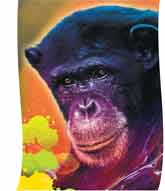 When world-famous primatologist Jane Goodall was only eighteen months old, she gathered up a handful of earthworms from her parents’ London garden, brought them inside, and made a little nest for them in her bed. After her mother patiently informed her that the worms could never survive in this dirtless environment, she hurried to get them back home again among the flowers and weeds. But the little girl who would one day travel farther than anyone before her across the borders of the nonhuman world had taken her first steps toward her destiny. What was it that gave birth to this impulse in one so young, the impulse to make contact with another species? What deeply felt curiosity or connectedness did she experience that drew her to want to be closer to them?
Oftentimes during her lectures and travels, Goodall tells the story of a man named Rick Swope who risked his life to save a chimpanzee named Jo-Jo from drowning in the newly constructed moat surrounding his enclosure at the Detroit Zoo. Among this particular posse of Michigan chimps, Jo-Jo was the head honcho, but when a younger and stronger alpha-wannabe threw down the gauntlet one day and attacked him, Jo-Jo ran, wisely or not so wisely, over the safety barrier and into the water. Chimps can’t swim, which is why zoos build moats around them in the first place; chimps are also very dangerous, which is why the zookeeper on duty that day made no attempt to rescue Jo-Jo when he panicked and sank like a stone. Against the keeper’s dire warnings, and much to the distress of his wife and kids, Swope jumped in and lifted the 130-pound ape as well as he could up the embankment. “I looked into his eyes,” he said later. “It was like looking into the eyes of a man. And the message was: Won’t anybody help me?”
What was it in Jo-Jo’s eyes that made Swope keep himself in jeopardy (three angry males were charging down the bank toward him) in order to support the stunned and waterlogged chimpanzee until he could finally grab a tuft of grass and pull himself to safety? Are the eyes, as the saying goes, really windows to the soul? I can still remember the day when, after an embarrassingly great many years of unsuccessful fishing trips with the Boy Scouts, I finally caught my first fish. As I tried, also unsuccessfully, to extract the hook from its mouth and throw it back, I gazed into its eyes and saw something I thought was sadness. It was hard not to flinch away from that dying look, in which I could see my own carelessness nakedly reflected, but somehow I felt honor-bound not to disturb this intimate channel that, for a brief moment at least, had been opened up between us.
I made other efforts at “interspecies communication” when I was a kid, walking through the woods with my Audubon bird call and mimicking the chirps and trills I heard up above. And though I have no evidence of any definitive success, my crude attempts at avian language were nevertheless a kind of animal soul music, at least in my own mind—a curious call to the nonhuman world in search of the echo of consciousness returning back to me. Who, or what, I wanted to know, was out there listening?
Guitarist Jim Nollman must have been wondering something similar when he anchored his boat off the coast of Vancouver Island, dropped a submersible speaker overboard, plugged in, and tried to get the dolphins and killer whales to jam with him. From recordings he’s made using underwater microphones to capture their hornlike whistles and songs (Nollman compares one particularly responsive whale to Bitches Brew–era Miles Davis), he appears to have succeeded. Other Western musicians whom Nollman has invited aboard to try out his gear have tended to elicit either clear responses from the whales or no interest at all. A Tibetan lama chanting religious prayers, on the other hand, brought forth a palpable hush. As he intoned his Himalayan melody, the whales approached the speaker quietly and just huddled there, listening.






 printer friendly
 email the editors
 advertise
 reprints