Sign Up for Our Bi-Weekly Email

Expand your perspective with thought-provoking insights, quotes, and videos hand-picked by our editors—along with the occasional update about the world of EnlightenNext.

Privacy statement

Your email address is kept confidential, and will never be published, sold or given away without your explicit consent. Thank you for joining our mailing list!


I Have No Choice


An interview with Tex Gunning
 

WHAT IS ENLIGHTENMENT: In Asia, you have been taking your people on what you call “a journey to greatness” to discover what makes leaders and companies outstanding. What have you learned?

TEX GUNNING: Average leaders take care of themselves and their families. Good leaders take care of themselves, their families, and some of the community. Great leaders—and great companies—not only take care of these stakeholders but also want to change the world. They want to leave the world better than they found it. We have made the choice to have our business intent become a missionary intent that will make a difference in the lives of Asians who have either health problems, nutritional problems, or well-being problems.

The core insight about great leadership and great companies comes down to service. We as individuals should entirely integrate our personal lives and our search for meaning with our business lives. Businesses with a meaningful intent will bring meaning to the lives of their employees. Then it will be as if we were volunteers—paid volunteers—in a community service organization. And we'll only need half the policies, half the training, half the values statements that are usually needed in business, because people will be living out their deepest values everywhere in their lives.

WIE: Could you speak about the “missionary intent” you have taken on at Unilever?

GUNNING: I would love to make a difference in the lives of the unbelievably poor children in Asia. Their suffering is just unimaginable. I said to myself, I have no choice. We've got to do this. So we decided to start in India where the problem is at its biggest in terms of scale. It's a very complicated country. If we can crack it there, we can crack it anywhere. It's an interesting process because the more I look at it, the more I think I am tackling something that I can never, ever solve. But simultaneously, I'm very optimistic because there's beginning to be a groundswell of people around the world who are saying, “This is unacceptable.”

You see, the paradigm that divides the world into the social sector, the private sector, and the governmental sector is not working. It creates artificial barriers. We are each a constituent of the problem, so we have to combine our forces, our efforts, and our competencies. We cannot solve these problems on our own. We all share this planet together; none of us can live a meaningful life when in Bangladesh, in China, in Darfur, hundreds of thousands of people are in need of help. I get my energy to persevere because I meet so many people around the world who share the same realization that this world is entirely connected.

WIE: Despite the fact that we are all connected, working across these barriers that are now built into the system is not easy. How do you propose that the for-profit and the not-for-profit systems work together?

GUNNING: Our suggestion is to bring into the social capital markets the efficiencies and accountability that you find in the financial capital markets.* So, for example, Unilever would submit a proposal for funding with partners like UNICEF or the World Food Program. Our competitors would do the same thing, and the proposals could compete with each other. Through competition, we could bring into the social capital market the best that the financial capital market has to offer. I bet this will increase creativity, increase accountability, and therefore increase efficiency and effectiveness. Because for businesses, unlike NGOs, it is a core competency to compete and to deliver—or else you're out of business.

If this works, it would be the first time that we would be working not only with Unilever capital but with capital that came from others. And even if we fail significantly, we can then use what we learn to be even better. We might be a bit ahead of our times, but somebody has to start this groundswell in business.

WIE: Isn't it dangerous to give organizations that are motivated by profit access to funds that are aimed to help the poor?

GUNNING: Of course, the moment that people in business realize that you can compete for social capital, the ugly side of human beings will also emerge. But we have to take the risk. The capitalist system was built both by people who were genuinely trying to save the world and by those who were just genuinely trying to fill their own pockets. And while they were filling their pockets, they created a better world in many ways. But although we've realized that economic development can be good for the world, the moment that seventy or eighty percent of the world is not participating in a manner that is equitable, then the system is failing. So an awareness is emerging that the capitalist system itself is failing.

If a few of us can prove that it makes good business sense not just to be socially responsible but to make a serious social mission intrinsic to one's business, then this is going to be written about, studied, and publicized. Because nothing is transferred faster than a success story in business. So I am very optimistic that if a few businesses can set an example here, we can make a tipping point out of it. And at this point, we really have no choice.

*The financial capital markets are the funding sources for private industry. They serve the creation of private wealth and provide the financial foundation for businesses (such as Unilever). The social capital markets serve the public welfare and are made up of foundations, donations by individuals, and first world government or international aid that goes to NGOs, nonprofits, and governments in the developing world that are trying to solve social problems.


Subscribe to What Is Enlightenment? magazine today and get 40% off the cover price.

Subscribe Give a gift Renew
Subscribe
 

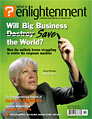
This article is from
Our Business Issue


Advertisements


» Advertise with us