“Once you start using violence, there is no way
back,” the young peace protestor said to me, his eyes
shining with conviction. “Bush is determined to drag us
into war in Iraq, and we have to stop it.”
“I'm not anxious to go to war either,” I
replied, but even as I said the words, I could hear the
uncertainty in my voice. “I'm just not sure that peace is
the answer.”
Maybe this was a mistake, I thought to myself. Driving
through the Green Mountains of Vermont on a beautiful October
day, I had come across this small antiwar demonstration in a
local town square. Stopping for lunch, I had gotten embroiled in
a discussion with the protestors on the hot political topic of
the day: Iraq. It was thirteen months after 9/11, and with all
indicators pointing to an imminent invasion, peace protests were
popping up all over.
“Peace is the only answer,” the man
responded, looking at me in slight disbelief. I had the feeling
he could sense that I was genuinely uncertain about the issue,
and perhaps he thought he could pull me back to the light.
“If we use violence, how are we better than anyone else?
Violence just feeds on itself. We have to find another way.
Peace is the only answer,” he repeated.
I found it disconcerting to be on the other side of the
demonstration. After all, a few years earlier, it might have
been me saying those words. I had spent many years passionately
supporting the peace movement. In fact, one of my early heroes
had been the great twentieth-century spiritual teacher J.
Krishnamurti—a committed pacifist, who remained so even in
the midst of WWII, a morally unambiguous war if ever there was
one. But that was then and this was now.
For the first time, I noticed the sign that the protestor
was carrying. Scrawled with magic marker on white cardboard was
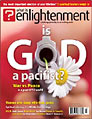
the phrase: God is on the side of peace. “Do you
really think God is on the side of peace?” I asked.
“Well, let me put it this way,” he said with a
smile. “I'm quite sure that he's not on the side of
war.”
As I headed back to the car, I reflected on the growing wave
of protests. The demonstrators were certainly right that our
president seemed quite intent upon war. As the administration's
attention was slowly but inexorably shifting from the mountains
of Afghanistan to the deserts of Iraq, Saddam Hussein was
looking like a man in the crosshairs. And the Western world was
having to come to terms with the fact that for the first time in
a generation, the future was looking more dangerous than the
past. The wreck of the World Trade Center was in the process of
being made into a memorial, the anthrax killer was still at
large, and on the radio, Bruce Springsteen's “The
Rising” was paying musical tribute to the 9/11 firemen who
had the faith and strength to walk “up the stairs, into
the fire.” Fear and uncertainty still lingered in the air
as the American populace adjusted to the new color-coded
“threat levels” signifying the likelihood of
imminent terrorist attacks. For a period of time, the barrage of
warnings—some frightening, some bizarre—was fast and
furious. Jogging by the local country lake in the morning, I
remember having strange images of Al Qaeda scuba divers coming
up out of the water, as per Ashcroft's recent suggestions, ready
to launch massive chemical weapons assaults on local farmhouses.
As the initial unifying shock of 9/11 was beginning to wear
off on the American polity, two very different visions of our
role in the world were emerging in the fractures. One was held
by the more conservative, or neoconservative, faction—a
majority if you believe the polls—who were gradually
coming to accept a more interventionist role for America in the
world. They believed in the use of military force and were ready
and willing to head into the minefield of Middle East politics
to rid the world of a dangerous dictator. In the name of
democratic values, the argument went, we must be willing to
break the back of tyranny in a part of the world that has often
been the seedbed for terrorism. On this end of the spectrum were
much of the traditional religious community—mainstream
Christians, Evangelicals, American Baptists, conservative Jews,
and so forth. And the implication of the position, whether
stated directly by the Pat Robertsons of the world or simply
suggested by Bush's “axis of evil” doctrine, was
that God was on the side of America in this particular
confrontation—that God was a supporter of freedom and of
democracy and would like nothing more than to see the American
eagle triumphant in the unfortunate but fundamentally good war
on the globally destabilizing reality of rogue states and
international terrorism.
On the other side of the fence was the more liberal
cross-section of the country, including parts of the Democratic
Party, which staunchly opposed the idea of war and roundly
denounced the administration. This faction included the more
liberal, ecumenical members of the mainstream religious
community, and they were joined by a number of other spiritual
or pseudo-spiritual movements, including American Buddhism, the
self-help movement, the New Age, New Thought Christianity, et
cetera. They took a resolutely pacifist stance, criticizing all
talk of war. And the strong implication was unavoidable: that
God, the spirit, or at least the moral and spiritual high
ground, was in fact on their side—the side of pluralism
and tolerance, the side of peace and reconciliation, the side
that would not so easily kill in the name of a dubious American
agenda to unilaterally order the world as we saw fit. “God
is on the side of peace,” read the man's sign in Vermont.
God is on the side of peace. As I drove through the
golden hills on that warm autumn day, the phrase tumbled around
in my mind. Is God really on the side of peace? It did seem
almost a truism. God and peace, in many people's minds, go
together like America and apple pie. And it was hard to
imagine God taking the side of war. Moreover, wasn't peace an
essential message in the teachings of just about every religious
tradition in history?
For me, peace had always been a word with powerful
associations. More than a good idea, it was an orienting vision
for life, a sort of mythic ideal that called out from the future
with the promise of a better world to come, a new and more
tolerant way to live on this small earth. Peace was a spiritual,
philosophical, moral, and political statement all wrapped up
into one, and I had spent much of my own life trying to make
that statement in the best way I knew how. And I wasn't alone.
Peace and nonviolence were ideals that captured the moral
imagination of an entire generation as they sought to find a
deeper humanity in a world where, for the first time, weapons of
war could spell the end of life as we know it. But as I listened
to the chanting of the antiwar protestors on that autumn
afternoon, and as I watched the various peace movements rise up
around the world in concern over American hubris, I couldn't
help but notice that, for me at least, that special magic was
gone. The moral power of the peace movement to move my soul and
fire up my idealistic passion seemed distant. A parade of former
activists from the Vietnam era came forward in the media to tell
the world that, this time, the movement was going to grow and
grow and overwhelm the country. Activist Ron Kovic, whose life
was portrayed by Tom Cruise in Oliver Stone's Born on the
Fourth of July, came on CNN and said that this peace
movement was going to be an “extraordinary
crossroads” and a “turning point in American
history,” the beginning of a nonviolent revolution. And I
wondered: Could it really be true?
I was certainly sympathetic to the concerns of the peace
movement. Indeed, it wasn't so much that peace seemed like a bad
idea—just an inadequate one. Like it or not, we
were living in a world full of conflict—not only conflicts
of arms but of ideologies and worldviews. And like many
Americans, I was concerned about how we were going to respond to
the numerous pressure points that were threatening the fragile
cohesion of our global society. We were living in a world where,
despite the relative peace and comfort of the West, chaos and
barbarity were just down the neighborhood block. The horror of
ethnic cleansing was practically becoming a seasonal item on the
news; kids were hanging body parts on their guns in Burundi;
Pakistan was operating the Middle East department store for
weapons of mass destruction; oil and water were growing more and
more scarce; ecological catastrophes were looming; new diseases
were threatening; and Al Qaeda sympathizers were plotting to
overthrow or at least destabilize a nuclear-enabled Pakistani
government. Against that backdrop, it seemed like a real leap of
faith to imagine that all of our problems could be dealt with
peacefully and nonviolently. But for many spiritually minded
people who care about the state of the world, the ideals of
peace and nonviolence are simply unimpeachable. They have a sort
of sacred Teflon coating that repels all critical analysis of
their pragmatic value. Why, I wondered. Is God a pacifist? Are
higher human endeavors always oriented toward peace?
It's been almost two years since the autumn day when I stood
in that Vermont town square, and in the intervening time, these
issues have grown increasingly, even desperately, urgent.
Indeed, as we stand at this crucial point in human
history—thirty-five hundred years after Moses came down
from the mountain with the simple commandment “Thou shalt
not kill,” three thousand years after Krishna instructed
Arjuna to fight and “conquer his evil-doing
enemies,” twenty-five hundred years after Socrates drank
the hemlock of the Athenian state refusing to fight or flee, two
thousand years after the Romans crucified a Jewish rabbi who
told his followers to “turn the other cheek,” nine
hundred years after the Christians pillaged their way across the
Middle East to take back the land for God, sixty years after an
Indian lawyer brought the British Empire to its knees with no
weapon but his own conscience, and just a few years after three
thousand civilians were murdered in a carefully executed act of
war on American soil conducted in the name of Islam—the
question of if, when, why, and how to use violence is more
confusing, more complex, and more important than ever.







 printer friendly
 email the editors
 advertise
 reprints