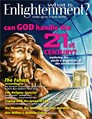
When it comes to predicting the future, uncertainty seems to go
with the territory. But if there is one thing that all of the
futurists and visionaries we spoke with for this issue seem to
agree on, it is that whatever course our collective destiny
takes, navigating the years ahead is going to be a challenge. As
the unpredictable forces of change transform every sector of
planetary life and culture—societal, technological,
environmental, geopolitical—the terrain of our global
village is morphing beneath our feet, bringing with it an
increasingly complex, interwoven web of problems requiring our
attention, demanding a response. But what sort of response will
truly meet the challenges ahead? To whom can we look for a
vision all-encompassing enough to embrace the complexity of the
conditions that confront us at the dawn of the twenty-first
century? If Einstein was correct in his assertion that "problems
cannot be solved by the same level of thinking that created
them," then what sort of new thinking and what sorts of new
thinkers are going to take us beyond the existential conundrums
of tomorrow?
Now, if you've been following the evolutionary trajectory of
What Is Enlightenment? over the past couple of years,
you may have noticed that a new kind of thinking has indeed been
finding its way onto more and more of our pages. Call it
integral, second tier, holistic, or
systemic,
this new thinking is the hallmark of a growing wave of
visionaries with the eyes to look beyond the surface turbulence
and grapple with the multilayered complexities undergirding our
global dilemmas. Challenging us to face the elaborate interwoven
forces that are shaping our destiny for better or worse, these
evangelists of higher-order thinking offer what many feel may be
the best chance we have at meeting the demands of the years
ahead.
So, in attempting to come to terms with our uncertain future,
and particularly with the role that religion will play in it,
for this issue we decided not just to speak with a number of
these leading-edge thinkers but to bring them together and have
them speak with each other. As firm believers in Plato's
assertion that the highest form of knowledge is that which
emerges in dialogue, we couldn't imagine what could give us a
better chance of seeing the biggest possible picture than a
roundtable discussion between some of today's brightest integral
minds, who are each attempting, in their own way, to forge a
more evolved course through our present and future world.
Those who read our last issue will remember Don Beck as the
psychologist and geopolitical wizard behind Spiral Dynamics
(for a quick intro to Spiral Dynamics
click here), a
revolutionary model of human values development that is finding
its way into the offices and toolkits of an ever-increasing
number of global and organizational leaders. Drawing on the
pioneering work of psychologist Clare Graves, Beck's theory
presents a comprehensive picture of the progressive stages
through which individuals, organizations, and cultures evolve,
and in so doing provides a key to understanding and untangling
large-scale conflicts. By showing that most major conflicts boil
down to a clash between different "memetic codes," or core value
systems, Beck has played a key role in such major undertakings
as the ending of South African apartheid and the societal
restructuring of Singapore. Founder and CEO of the National
Values Center, and Spiral Dynamics Group, Inc., Beck has most
recently teamed up with integral philosopher Ken Wilber to form
Spiral Dynamics Integral (SDi), a joint initiative aimed at
"managing large-scale interventions, change, and
transformation."
Large-scale transformation, it turns out, is also at the core of
Brian Swimme's work, and in his case,
large is the operative
word. A mathematical cosmologist with the heart of a nature
mystic, Swimme has spent the past two decades bringing to life
the awe-inspiring tale of cosmic evolution that has been
unfolding as our universe since it exploded into existence some
fifteen billion years ago. Author of
The Universe Is a Green
Dragon, The Hidden Heart of the Cosmos, and
The
Universe Story (coauthored with his friend and mentor
Father Thomas Berry), Swimme has dedicated his life to awakening
others to the wonder of our cosmic heritage and the unique role
and responsibility of the human in carrying evolution forward.
In his speaking and teaching work, conducted through his Center
for the Story of the Universe, he implores people to consider
the profound implications of being conscious and to embrace our
uniquely human potential to express a "comprehensive compassion"
for all of life.
Changing the world means changing institutions, and there are
few who have explored the territory of institutional
transformation like "management giant" Peter Senge. Widely
regarded as "the world's most extraordinary thinker on creating
learning organizations," Senge shook the foundations of business
thinking with the publication of his 1990 book
The Fifth
Discipline, in which he transformed the abstract ideas of
systems theory into practical tools for grappling with the
complexities of large-scale organizational change. A senior
lecturer at MIT and founding member of the Society for
Organizational Learning, Senge speaks extensively throughout the
world, calling leaders in business, education, health care, and
government to bring vision, purpose, reflectiveness, and systems
thinking into their organizational culture. Today, thirteen
years after he burst onto the management scene, Senge is still
leading by example, evolving his own ideas, and most recently
teaming up with others to explore what the world's corporate
leadership might be able to learn from the spiritual wisdom of
the East.
So for this issue of
WIE, we are more than pleased to
have an opportunity to bring these three pioneering voices of
change together in a roundtable discussion moderated by
WIE
founder Andrew Cohen. A spiritual teacher with a planetary
perspective and a passion for evolution, Cohen has spent the
last seventeen years engaged in a living investigation of our
collective potential that is helping to redefine what it means
to be a human being at the dawn of the third millennium. In the
pages ahead, this cadre of visionaries grapples with the
extraordinary challenge our moment in history presents,
providing a real-time demonstration of what it means to bring
the future into the present and a testament to the kind of
shared exploration that may truly reveal the way ahead.
–Craig Hamilton




 printer friendly
 email the editors
 advertise
 reprints