Journal Entry - July 30, 2004
I have often asked myself what it would have been like to live
in the time of Jesus, to be a monk in the time of the Buddha, or
to live in Greece in the company of Socrates. No longer. After
the earth-shattering events of today, people in the future may
very well be asking what it was like to live on this planet in
the year 2004.
The day started like any other. I was at the office early,
working on some reports for the week. But there was a heavy
feeling in the air. The news was bad. Pakistan seemed to be
teetering on the edge of chaos and the Middle East on the brink
of war. The recent attacks in L.A. were still on everyone's
mind, and the talk in the office was of little else.
Around six, I left work. It was a warm evening, and as is my
habit, I decided to walk the twenty blocks home. I usually pass
through Times Square on my way, and tonight it didn't take but a
glance down the street to see that something strange was
happening on Broadway. Even from several hundred yards away, the
scene was bizarre. Traffic was stopped, taxis were parked in the
middle of the street, and everyone was standing still, as if
someone had hit the pause button during a crowd scene. As I
approached, the gathering, maybe several thousand strong, seemed
unusually quiet. New Yorkers are never this quiet, I remember
thinking—not on their own, not in public, and
certainly not in Times Square on a summer evening. There was a
strange intensity in the air, and everyone was looking up at
something I couldn't see—probably one of those new
giant television screens hanging above the street. Had something
happened? For a moment, frightening images burst into my mind—another chemical attack on an American city, exploding
nuclear weapons in South Asia. I rushed around the corner and as
I did, a voice pierced the quiet night—a voice that
seemed to be speaking directly to me.
Startled, I looked to see who was addressing me, but even as I
did, it began to dawn on me that the voice was not coming from
outside, but from inside my own head! "What the hell?" I
exclaimed, and I must have said it louder than I thought because
a couple of people a few feet away turned and caught my eye.
Saying nothing, they just put out their hands and pointed
upward, at the television screen, the focus of everyone's rapt
attention. The scene on the screen looked simple enough, a news
conference from London. A dark-haired man, dressed in a flowing
white robe, was gazing beatifically into the camera. And as far
as I could tell, he was not saying a word. Then it hit me. The
words I was hearing in my mind were coming from the man on the
screen. "Oh my God!" another exclamation slipped out of my
mouth. But I felt no fear, only a growing sense of amazement.
"Yes! Yes! I understand," a woman next to me cried out, falling
to her knees in response to some unseen inner dialogue. I
recognized that my experience was being shared by what must have
been almost ten thousand people at that point, stopped in the
street, all hearing the inner words of the figure on the screen.
In perfect English, he addressed us, a clear and compelling
voice that spoke of the spiritual crisis now facing humanity. He
explained that the time has come to change the course of human
destiny. Forever. A wave of peace and bliss welled up within me
as he boldly declared, "I am the One, the one who so many
religions have waited for: the Jewish Messiah, the Christian
Christ, the Kalki Avatar, the Maitreya Buddha, the prophesied
Mahdi of Islam. I have come for all of your sake, to bring hope
and salvation. I have come to establish a true and lasting
brother- and sisterhood among all of the races and peoples of
the world. Together we are going to build a new civilization
based on the principle of love."
Something cracked inside. I began sobbing uncontrollably. The
hard inner shell born of years of frustration and despair seemed
to dissolve, melting away in the warm summer evening. I knew,
without any doubt, that the man speaking these words inside my
own soul was the holiest of men. Awestruck, I stood there for
what seemed like an eternity.
Then the voice became quiet and the scene on the television
changed. CNN started showing images from around the world—hundreds of thousands of joyous people celebrating,
singing, and dancing in the streets; crowds praying in mosques,
churches, and temples. Everywhere, it seemed, people had heard
His message. The entire world, from the tip of Africa to the
coast of California to the edge of Siberia, had heard this new
Christ, this divine messenger, and everywhere you could feel the
ecstatic release. As for myself, standing there with thousands
of stunned New Yorkers on a summer night in one of the great
bastions of our modern material civilization, I knew that
humankind was finally unified as one—one world
civilization, changed forever. He has come—and from
now until eternity, nothing will ever be the same.
The scenario described above might sound implausible, even
ridiculous, to the modern ear, and who would argue otherwise?
The Second Coming? The Messiah? Isn't that strictly the arena of
late-night televangelists and New Agers who have spent too much
time in the California sun? After all, now that we have passed
the millennium with our computers still functioning, our oceans
still within their relative boundaries, our nuclear weapons
still in their silos, all rogue asteroids still keeping a safe
distance, and the prophesied Four Horsemen still absent from
yonder sky, you might think that those voices telling us that
the end of the world is near, that a new age is dawning, that an
apocalypse is brewing, or, in this case, that a messiah is
coming would be muted. But you would be decidedly wrong. In
fact, as we enter a new millennium, the sheer number of
individuals insisting, warning, hoping, and even praying that
the trajectory of human destiny is about to undergo some serious
alterations is unprecedented. And before you dismiss these
cultural Jeremiahs and go back to the morning paper, it might be
good to take a closer look . . . at the morning paper. Iraq,
Israel, SARS, genetics, India/Pakistan, 9/11, nanotechnology,
nuclear missiles, North Korea, global warming, cloning, famine,
AIDS. The list of radical breakthroughs, dangerous flash points,
and volatile issues on the human horizon is long, and getting
longer. Indeed, it seems safe to say—and many of the
individuals interviewed in this issue would concur—that we are living in a unique time in our species'
development, a time of transition, a time of convergence, a time
of culmination. But just
how unique is it? After all,
transition is one thing, but apocalypse? A new age? The Second
Coming? Who would go that far? Well, millions and millions of
Americans for a start. Indeed, if you ask the average American
where human history is ultimately headed,
forty percent
are going to tell you that we are destined, sooner or later, for
Armageddon, the final Biblical battle between good and evil,
often seen as a prelude to the Second Coming of Christ. If you
don't believe that statistic, keep in mind that the
Left
Behind series, which novelize the events foretold in
Biblical prophecy with a cheerfully apocalyptic perspective,
have sold over fifty-five million copies to date. And it's good
to remember that this isn't just an American phenomenon. For
that matter, it's not even a Christian phenomenon. Almost every
major religion has some version of events that signal the coming
of a great messianic figure who will rescue the world from
darkness and usher in a new age of light and peace. Hindus speak
of the next great avatar, the Kalki Avatar; Muslims foretell the
coming of the Imam Mahdi; Christians, the Second Coming of
Christ; Jews, the coming of the Messiah; and Buddhists, the
future Buddha, Maitreya. Each does have its own particular
emphasis, its own version of the events that will herald the
coming world teacher, but the similarities among them are
nevertheless quite striking, especially given that these
traditions weren't exactly developed in a time of global
internet collaboration. And that's not to mention the similar
notions in Zoroastrianism, countless references in New Age
literature, centuries of esoteric and occult traditions
prophesying a world teacher—the list goes on and on.
And let's be clear—these myths, these prophecies, are
much more than superficial stories sprinkled on top of religious
theology, a little sugar and spice to go with the main course.
They are fundamental components of their respective traditions.
So what really is going on here? Is there a messianic figure
waiting in the wings of the new millennium? Should we give any
credence at all to this often dismissed yet near universal theme
in the great religious traditions? Is this how God plans to
handle the challenge of the twenty-first century? With a
personal messenger who can set right the troubled ship of our
global state? A divine proxy battling for the salvation of the
world? If so, then when and where might this messianic savior
arrive on our planet? And the most intriguing question of all
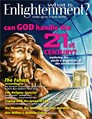
may be: What if he or she were already here? For this issue of
What Is Enlightenment? we were curious to look a little
deeper into the messianic myths of humanity and discover what,
if anything, they might have to do with spirituality in the
twenty-first century. Given the volatile nature of this moment
in history, it seems important—indeed, absolutely
essential—to stand back and take a look at our
spiritual legacy, just in case, in our collective rush toward
the future, we might be missing the fact that God has already
stacked the deck.




 printer friendly
 email the editors
 advertise
 reprints