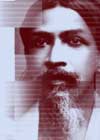
Sri Aurobindo
"But Sri Aurobindo
is cool!" I exclaimed to Andrew Cohen, my spiritual teacher and editor-in-chief.
"Yes,
we know that, but how are you going to communicate that to our readers?" he asked.
"Won't it be enough for me to just tell them his incredible story? I mean, check it out:
Controversial freedom fighter attains enlightenment in jail and relinquishes leadership of the revolution to become one of the greatest philosopher/yogis and evolutionary thinkers to have ever lived. You've got to admit, that's one hell of a headline."
Andrew smiled. "Okay. Maybe for the
Enlightenment Times. But listen, there's one problem. He's a dead guru. A great dead guru, no doubt. An amazing dead guru. Probably one of the most extraordinary dead gurus the world has ever known. But face it, he's old news. We're
What Is Enlightenment? We're cutting edge. This is about
living inquiry. We don't do dead gurus. As Adi Da said . . ."
". . .
dead gurus don't kick ass!" My colleagues finished his sentence in chorus.
I couldn't believe we were having this conversation. "What about Babaji?" I leapt up. "Nobody can seem to prove that he was
ever alive! And we're doing
him!"
"Immortal sages are one thing. But Sri Aurobindo has been decidedly buried for fifty years. I know the doctors were all amazed that his body didn't start to decay for four days, but I'd hate to see it now," Andrew laughed.
"Well, Swami Vivekananda's in this issue and he's not exactly tearing up the conference circuit these days, is he?" I was sure I had him with this one.
"It's okay to print an excerpt from someone's book," he replied, "but you're asking us to fly you all the way to India to do in-depth research on someone we can all read everything we need to know about on the web."
"But look," I pleaded, "we're doing an issue on evolutionary enlightenment.
How many people even know what that is? Everybody these days thinks enlightenment is the end, the grand finale, the ultimate blast-off into
nirvana never to return again. But Sri Aurobindo GOT IT. He was the first one to get it. And he got it like few have ever gotten it since. Sure, people can read about him on the web, but first they have to find out how amazing he was. That's why I want to do this piece, to tell them. And to really do it right, I think I have to go to India, to visit his ashram and talk to the people who knew him, to get the real inside story."
Andrew motioned for me to sit down. "Okay, listen," he said. "I can't argue with what you're saying. And I'm not going to say there's no way you can do it. But before I agree to send you halfway around the world, you've got to come up with some kind of angle, some way to bring Sri Aurobindo alive that is hip, modern, intriguing, and, most of all,
relevant to enlightenment in the twenty-first century. This can't just be another rehash of the old story. Give it some thought and we'll talk again tomorrow."
As we wrapped up our daily editorial meeting, it was all I could do to contain my excitement. It had been tough going, but I had gained the foothold I'd been hoping for.
I had shown up at that afternoon's meeting with a stack of books on the pioneering twentieth-century sage Sri Aurobindo, knowing I probably had my work cut out for me. Although I had no doubt that everyone on the team had tremendous respect for his work, I knew that a feature story about a great figure from the past—particularly in an issue about the future—would be a tough sell.
"Isn't he extremely hard to read?" one of my colleagues had asked straightaway, "as if somehow he accidentally got his genes crossed with a German philosopher or something?" I couldn't deny that he was in fact a tough read, having first learned to write in Latin and Greek, two languages in which the construction of long sentences is actually a sort of high art. But nonetheless, I knew that my only chance to win my case lay in reading a few passages aloud:
The animal is a living laboratory in which Nature has, it is said, worked out man. Man himself may well be a thinking and living laboratory in whom and with whose conscious co-operation she wills to work out the superman, the god.
That got their attention. I read a little more:
. . . for the full and perfect fulfillment of the evolutionary urge, [the spiritual] illumination and change must take up and re-create the whole being, mind, life and body: it must be not only an inner experience of the Divinity but a remoulding of both the inner and outer existence by its power; it must take form not only in the life of the individual but as a collective life of gnostic beings established as a highest power and form of the becoming of the Spirit in the earth-nature.
After reading a few more pages in the same vein, I looked around at their faces. They were captivated. I wasn't surprised. In the course of our research for this issue, we had already come upon some extraordinary evolutionary thinkers, but Sri Aurobindo's words carried a spiritual weight like no one else we had read. A weight that, in light of our issue topic, and our reasons for choosing this topic now, meant a lot. For the idea to do an issue on evolution and enlightenment had been triggered by a series of unexpected breakthroughs in the collective practice of our own spiritual community. Breakthroughs that, unless we were all crazy, seemed to suggest a great deal about the relationship between enlightenment and humanity's potential for a further collective evolution. So far, however, none of the traditional religions had been able to shed light on our experience. But on page after page, Sri Aurobindo was coming through in spades.
Although reading aloud from Sri Aurobindo had made our entire editorial team curious to learn more about his teachings, it had only brought me a hair's breadth closer to my goal. As I left the meeting that afternoon, it was clear that I still had a lot more persuading to do before I would be on my way to India. That night, while ruminating over how I could possibly convince the world that Sri Aurobindo was cool, I got a sudden flash of what I hoped was inspiration. And after spending the better part of the night trying to put it into words, I showed up at the next afternoon's meeting ready for another round.






 printer friendly
 email the editors
 advertise
 reprints