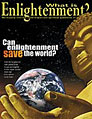
Toward Homo Noeticus


An interview with John White
by Craig Hamilton

 
introduction

Envisioning the earth's future is an exercise in paradox. For while it's hard to imagine a future planet earth dominated by anything other than Homo sapiens, it is perhaps equally hard, given our current course of multilateral destruction, to imagine just what kind of future the earth will have if Homo sapiens continues to dominate. In our quest to find out if and how enlightenment might resolve our global predicament, we came across one intriguing thinker who has dared to stretch his own imagination through and beyond this apparent double bind and has arrived at a solution that is nothing short of evolutionary. According to consciousness researcher John White, despite all trends to the contrary, humanity and the earth do indeed have the makings of a promising future together. But the form of human being that will be here to participate is a primate of a very different order than the human as we know it today. He calls it Homo noeticus—the next step in human evolution.

Called to the spiritual life in 1963 by a spontaneous experience of what he describes as 'God realization,' John White has never had a problem telling others he's enlightened, provided he can quickly follow up with the qualifier, "but just barely." And for the past twenty-seven years, that "just barely" has been the fuel behind his insatiable interest in exploring our higher human potential. Ask him about his achievements in this domain, and one of the last things you'll hear about is the enlightenment experience that sparked his journey. First, you'll learn about his alliance with Apollo 14 astronaut Edgar Mitchell, whose spiritual experience in the space capsule led him to found, with White's help, the now internationally renowned Institute of Noetic Sciences. Then there was the book manuscript he received from a struggling young writer named Ken Wilber back in 1974 entitled The Spectrum of Consciousness. The book so impressed White that he devoted himself to getting it published, a task which he eventually accomplished, thirty-three publishers and four years later, launching Wilber's rise to become one of the most highly respected spiritual thinkers in modern times. A freelance writer and editor for much of his career, White might also mention that he has himself published dozens of articles and over fifteen books, including The Meeting of Science and Spirit, A Practical Guide to Death and Dying, and the anthologies Kundalini, Evolution, and Enlightenment and What Is Enlightenment? In his forthcoming book, Enlightenment 101, White describes the radical evolutionary shift that his research and experience have convinced him is already under way in the human race.

Living at the forefront of consciousness exploration, in the company of many of today's leading spiritual visionaries, has given White an unusual appreciation for our higher human capacities and no doubt an inside look at where we might be headed as a species. But, White confesses, the source of his conviction in our imminent evolutionary potential does not lie ultimately in his research and study but in that first spiritual experience he had back in 1963. As he tells it, "There was a flipping over in consciousness which showed me the illusion of the separate self and the identity of true Self. It was a moment of cosmic consciousness. My sense of body self was just absolutely blown away and there was only 'I' as the universe, as the cosmos. Now that didn't confer all sorts of omniscience on me, but it conferred certitude. I knew beyond any doubt whatsoever who I am, why I'm here, where I'm going, what the way home is, to God. And in that, I saw that if there's any such thing as human nature, what was potential for me was potential for everyone. I saw in my past, the human past. I saw in my future, the human future."

One day last fall, we had the pleasure of a neighborly visit from John White, who drove up from his Connecticut home to our center in western Massachusetts and spent the afternoon sharing his vision of an enlightened humanity.



interview

WIE: Many futurists, scientists, and social thinkers feel that humanity is facing an evolutionary crisis. They predict potentially devastating global transformations over the next several decades as environmental destruction, overpopulation, rapid globalization, and technological experimentation place our species and the planet as a whole in an ever more precarious balance. Many leading thinkers have suggested that given the enormity of the challenges we are facing, the only solution that could hope to get to the root of the problem is a spiritual solution—a transformation of consciousness. What do you think about this idea? Can enlightenment save the world?

JOHN WHITE:
Enlightenment is the only thing which can save the world. The only thing.

When I was working with Apollo 14 astronaut Edgar Mitchell, we had the idea that the Institute of Noetic Sciences, which he founded back in 1972 and for which I was the Director of Education, could study the human mind in order to apply our findings to the problems confronting humanity. It was clear to Ed, from the moment he had an epiphany or a religious experience in the space capsule coming back to Earth, that the problems besetting humanity are not inherent in the natural world. Social divisions and conflict and strife and all the political troubles—he saw that those problems arose at the level of the human mind, or human consciousness, and wanted to study that in order to solve those problems at the root level. As Einstein said, you can't solve a problem at the level which originated it. You've got to get up-level from it. So that was the hope for the Institute of Noetic Sciences: to better understand the nature of consciousness and our potential for transcending the state which generates all the problems facing humanity. Without that, we very well could end up as just a cindery speck in the night sky, or a debilitated, weakening planet with dead species.

So yes, we face various crises, but my recent research and my personal experience tell me that we will make it through those crises. That is part of the grand design of creation. That is part of the intelligent purpose behind the universe. God didn't bring us forth through five million years of human evolution to snuff us out just like that. We have the means; we have the potential to deal with crises in an intelligent way, which is aligned with the teleological drive that we have for self-transcendence.

But it's not absolutely certain, as far as I can see. We could OD as a planet, so to speak. I don't think we will. We have weathered many, many crises in our long history, and I see all sorts of hopeful signs telling me that we will weather these too. In fact, as a friend of mine said, "Hope is an acronym for Help Our Planet Evolve." And I am ever hopeful.

WIE:
In your forthcoming book, Enlightenment 101, you state that humanity is in fact evolving into a new and higher form of life, which will be able to transcend many of the difficulties that we currently face. You've labeled this new evolved form of humanity "Homo noeticus." What is Homo noeticus?

JW:
Homo noeticus is the term I use to designate what I see as a higher form of humanity emerging on the planet now, characterized not by genetic changes but by noetic changes. In other words, consciousness is the guiding principle by which to define Homo noeticus. There's a radical transformation of consciousness that characterizes Homo noeticus, a movement from self-centeredness to God-centeredness. Members of Homo noeticus may look very much like Joe Six-pack and Harriet Handbag who are walking around the sidewalks of New York today, but they nevertheless are characterized by a profound change in consciousness. And that change in consciousness is part of the process of enlightenment.

Now, I don't have an anthropological checklist of how to define Homo noeticus. If we were alive at the time of the Neanderthals and the emergence of the Cro-Magnon, how would we know how to distinguish Cro-Magnon from Neanderthal? Physically, they had pretty much the same appearance. But in retrospect, we can say that Cro-Magnon was a new and superior type of humanity characterized by things such as being the world's first artists, with their cave paintings and female statuary. The Cro-Magnon invented the bow and arrow, the world's first weapon beyond just simple stone tools. And there are a few other markers that distinguish Cro-Magnon from Neanderthal. Likewise, with Homo noeticus. The markers that I feel would indicate full-fledged membership in the species Homo noeticus are primarily reflections of one's consciousness moving from self-centeredness into God-centeredness, which recognizes the presence of the Divine in everyone and operates in the world on that basis. In that, there's not competitiveness but rather cooperation, and the thought process is not a simple, linear, sequential, either/or type of thought process, but one that's multileveled, integrated, and inclusive. And emotionally speaking, you will not find hatred, vice, or any of the nonvirtuous feelings which make for such suffering and pain in the world today, so much destruction and death and violence. You could say that you'll know that Homo noeticus is the dominant life-form on the planet by the absence of war, the absence of oppression, the absence of all the competitiveness, acquisitiveness, greed, and other vices, which have pretty much defined the human condition as we experience it today.

WIE:
What are the signs that you see in the world today that have led you to the conclusion that Homo noeticus is emerging, that we really are evolving?

JW:
In my book The Meeting of Science and Spirit, I include a long list of indicators which, taken together, say to me that a profound transformation of consciousness is underway in the world. Not that each and every one of these indicators is globally present, but we can look at every aspect of current human affairs and see things, movements, groups, perspectives which are not just counter to the status quo but which indicate a new and higher way beyond it. Economics, education, military affairs, political affairs—every aspect of human activity is showing signs here and there of something emerging from it which not only transcends it but projects an influence back into it for the further transformation of that domain.

The hunger for growth in people is widespread, and it's breaking out all over in a variety of ways: physical, mental, and spiritual. Look at how the human species is pushing the envelope just at the level of athletics and exploring the planet. For the first time, we now have mastered underwater exploration to the point where people can scuba dive to hundreds of feet and go even farther down in technological devices like submarines or bathyscaphes. So we're pushing the boundaries in the depths of the ocean and to the extremes of the atmosphere and beyond, with space travel and ultralight aircraft and all sorts of aerial sports. And just plain physical sports themselves have blossomed into things that were totally undreamed of a century ago. The records themselves are falling, falling, falling as we develop better training programs and better nutrition to support them.

Also, a good deal of my background is in parapsychology, psychic research. I see that as part of an awakening of consciousness in humanity where people want to know more about who they are at deeper or higher dimensions. For the first time in all of human history, there is a widespread public recognition of the psychic potential of people. And that is being applied very practically in the holistic, or alternative, health movement. All over, the human species is just pushing at the limits of our physical, mental, and spiritual condition.

So, those are a few of the indicators.

WIE:
Would it be accurate to characterize Homo noeticus as an enlightened humanity in the way enlightenment is traditionally understood?

JW:
It would be what I call the first stage of enlightenment, where there is a psychological conversion, a radical change in consciousness from self-centeredness to God-centeredness. But that has got to work itself out physiologically as well. Many years ago, I stated what I think of as the first law of noetics: "Body follows where consciousness goes." Now, when there's a radical change of consciousness, moksha, that provides a stable platform for the outworking of itself in all aspects of our activities. And there necessarily follows, in the grand design of human evolution, as I understand it, the conversion of the body itself, the body and mind, which are junior to the spirit.

WIE:
In your opinion, how far away are we from the kind of transformation of consciousness that could actually prepare us for the radical changes ahead? What percentage of people need to evolve into Homo noeticus before there will be a hope of turning things around and bringing a larger vision to these problems?

JW:
As I see it, the full emergence of Homo noeticus, that is to say, to the point where it is the dominant life-form on the planet, is still several hundred years away, at least. Now that seems like a long time from the point of view of us sitting in a room with a watch on our wrist. But anthropologically or evolutionarily speaking, that's just the blink of an eye.

The first form of life on the earth theoretically emerged from the primordial ooze four billion years or so ago and held sway for one or two billion years. The next higher succeeding form emerged and held a dominant position for a successively briefer period, and each emerging new higher form of life has dominated for a decreasing period of time. In other words, the emergence of higher forms is increasing. So when you reach the human level, we're talking about you and I sitting here in this room on the basis of a mere five million years since our progenitors stood upright in the center of the African plain. And Neanderthal was three hundred thousand years ago; Cro-Magnon, thirty-five to forty thousand years ago; Homo sapiens sapiens, modern man, ten thousand years ago.

If noetics rather than genetics is governing the changes in evolution, as I feel is the case from here on, and with the potential we have for mass communications and technology to spread information, we are in effect taking control of our own evolution at this point. We have the capacity to disseminate information for transformation. And so I'm very hopeful that this change not only is proceeding but is accelerating. Even so, it's still several hundred years away before Homo noeticus would be the truly dominant life-form. But we don't need to think that it's going to be three hundred years before we deal with all the global crises facing us. One transformed being in the world can affect hundreds and thousands.
WIE:
As you've said, there are obviously a number of positive signs, and more and more people are becoming interested in bringing greater awareness to the challenges that we face. But you've also pointed out that the mass of humanity still seems stuck in an extremely materialistic, egocentric worldview driven by short-term self-interest. You've written, "Simply saying that humanity can accelerate its own evolution is not the same thing as convincing humanity it can, let alone should." What do you see as the most important factor in convincing human beings to take up the evolutionary call and transform themselves?

JW:
I would point to two factors. One is the presence of enlightened teachers in the world whose very being just radiates the message. In their example, we have the demonstration of our human potential. Second, we have the increase of suffering, and suffering is the first grace. It's nature's way of giving us a kick in the astral when we won't learn through gentler means. If we aren't drawn by attraction, we're going to be driven by repulsion. And that has probably been perennially the case. The level of suffering is so great in the world in certain areas, and at the same time the level of awareness of our potential for transformation is so great in the world in certain other areas, that there's now a synergistic process in which those who are enlightened, awakened, and compassionately concerned with the suffering of the world are directing their attention in ways which immediately and practically address that suffering. So that's why I say that I'm very, very hopeful. I see this transformation happening before my very eyes.