Rabbi
Michael
Lerner
"I simply cannot understand how somebody can be a spiritual being and not be
actively involved in transforming the world," says Rabbi Michael Lerner. Political revolutionary, humanitarian, spiritual mentor, psychologist, and editor of
Tikkun
magazine, Michael Lerner is a powerful voice for
radical change in this new millennium. His indefatigable commitment to transform this world from one dominated by ego-centered, mean-spirited, materialistic values to one rooted in the spiritual revelation that we are all one indivisible whole is inspiring, to say the least. He is a passionate man whose deeply compassionate call to awaken to the truth of our undivided spiritual nature is inseparable from his plea for us all to awaken to our own conscience. Rabbi Lerner is an idealist who is actively engaged, not only philosophically but practically, in
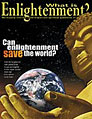
how we can actually transform this world that seems to be heading toward disaster. With his uncompromising demand for a comprehensive transformation of society and culture informed by deep spiritual values, his contribution to our investigation of the question, "Can enlightenment save the world?" seemed to be invaluable.
Lerner was deeply inspired in his youth by Abraham Heschel, one of modernity's greatest Jewish theologians. A radical while he studied philosophy at U.C. Berkeley in the sixties, Lerner ultimately decided that the liberal and progressive movements were defeating themselves because they were not addressing the ethical and spiritual dimensions of the human experience. He went on to get his second Ph.D. in clinical psychology and founded the Institute for Labor and Mental Health where, as a psychotherapist, he realized that many working-class people were "moving to the right because the liberals didn't seem to understand or address the alienation and meaninglessness fostered by the me-firstism of the market economy." A tireless political activist, he also became a leading figure in the Jewish Renewal movement. Eventually deciding that liberals needed a "politics of meaning," and that Judaism had the foundations for such a politics, he founded
Tikkun
magazine in 1986. In 1993 Lerner achieved national fame when the
Washington Post dubbed him "guru of the White House" during his short-lived association with the Clintons, who had been inspired by his influential book
The Politics of Meaning. In 1996 he was ordained by Rabbi Zalman Schachter-Shalomi
and founded Beyt
Tikkun
Synagogue in San Francisco.
Being a spiritual teacher myself, I found Rabbi Lerner's uncompromising views refreshing to hear. In our Western spiritual marketplace—where more often than not the endless fears and desires of the ego are assuaged rather than honestly challenged, where the always profound implications of spiritual experience are endlessly watered down—his intolerance for materialism and for those approaches to spiritual transformation that are ultimately only self-serving is an important wake-up call. While I agreed with Lerner's emphatic declaration that spiritual evolution should result in active transformation of the world, the automatic association of the spiritual and the fiercely political was not always as obvious to me as it was to him.
An unstoppable hurricane of compassionate concern, Rabbi Lerner compels each and every one of us to question the actual depth of our commitment to our own highest convictions. This lively interview was conducted in his living room in the Berkeley Hills last December.



 printer friendly
 email the editors
 advertise
 reprints