Sign Up for Our Bi-Weekly Email

Expand your perspective with thought-provoking insights, quotes, and videos hand-picked by our editors—along with the occasional update about the world of EnlightenNext.

Privacy statement

Your email address is kept confidential, and will never be published, sold or given away without your explicit consent. Thank you for joining our mailing list!


From What Is to What Ought to Be


An interview with Michael Lerner
by Andrew Cohen
 

AC: The status quo.

ML:
Right. The spiritual status quo, the material status quo, the selfishness status quo. Now, because of that, when any individual acts in the public sphere according to a different standard, they often find themselves laughed at, ridiculed, or just deeply disappointed. Other people have turned their backs on them when they opened themselves and made themselves vulnerable. And as a result, they are fearful of making themselves vulnerable again. So out of fear of that humiliation, people begin to develop a deep cynicism about where everyone else is. I've found that the most cynical people are the ones who, at earlier stages in their life, opened themselves up to hope and were disappointed by others—and often were disappointed by others who themselves had been disappointed by others. So there's a cycle of despair in which we believe that nothing fundamental can happen, and then we convey this to others. And that develops a cynicism.

AC:
You express a fiery optimism that displays an unusual strength of conviction in the inherent goodness of the human heart, and you demonstrate that optimism while remaining firmly rooted in the trenches—passionately fighting for true sanity, real equality, and justice for all in a brutal world where man's capacity for selfishness and inhumanity often seems literally overwhelming. Without the kind of optimism that you are grounded in, it would be impossible to fight the good fight for as long and as hard as you have without becoming discouraged and disheartened. What's the source of your enduring optimism, and how can others realize the same strength of conviction that you have to fight the good fight for everyone else's sake?

ML:
My own optimism is based on the history of the human experience as I have understood it—in particular, the history of the Jewish people and how we came from being in the most degrading of all possible positions, slaves, to becoming free. And how we shaped our path and faced, over the course of the past thirty-two hundred years, an incredible amount of suffering and pain and yet, at the same time, were able to transcend that and keep going. So the experience of the Jewish people is the one in which my own particular optimism is rooted.

And then, of course, there's an act of faith—because in the end, there is no set of facts about the universe that will be sufficient to generate a basis for either optimism or pessimism. The facts can be arranged in such a way as to sustain an optimistic account, or they can be arranged in such a way as to sustain a pessimistic account. And in the end, there's a faith act there, and the only thing I want to say about that faith act is that it's as much a faith act to choose to believe in the triumph of evil and negativity as it is to choose to have faith in the triumph of hope and goodness.

AC:
The experience of enlightenment, or nonduality, reveals to us that what is happening here in this world is only a part of the whole of reality, only a part of the totality. And it is said that the direct experiential knowledge of that totality alone has the power to liberate the individual from the distorting and corrupting influence of the human ego. Indeed, from the perspective of enlightenment, it is only freedom from the fears and desires of the ego that enables the human heart and mind to experience what could be called true objectivity in relationship to all temporal experience. Without that degree of objectivity, how would it be possible to fight the good fight that we all have to fight if this crazy world is really going to change without making important errors of judgment? Interestingly enough, a respected enlightened master, Eckhart Tolle, recently responded to a question I asked him about right action in the world by saying that it absolutely wouldn't be possible for a human being to truly live the Ten Commandments or the teachings of Jesus, such as "love your neighbor as yourself," unless they were already fully enlightened. What is your view on this?

ML:
My view is that there is no possibility of saving this world without overcoming all the distortions that our ego presents to us. And that the more we're able to do so, the more we are potentially able to be engaged in the struggle to transform the world. So spiritual practice, to me, is absolutely central to building a transformative social movement and to sustaining oneself as an agent of transformation. Having said that, I then want to say that from my perspective, most people who claim to be enlightened seem to not be where I would want to be. The reason I say this is that I think there are far too many people in the spiritual world who seem to be involved in a process of overcoming ego that doesn't lead them to action to transform the pain and suffering of everyone around them. And that is a level of consciousness that is not close to what I understand by enlightenment. I simply cannot understand how somebody could be a spiritual being and not be actively involved in transforming the world.

AC:
Although there are exceptions, teachers of enlightenment are generally not passionate idealists. In fact, many tell us to be less concerned with the chaos of the world, and more concerned with the cultivation of liberation from it. They say that idealism is merely a construct of the unenlightened mind and that excessive concern about the transformation of the world is a sign of a lack of self-knowledge in the individual. They say that the perfection and wholeness that the idealist strives to manifest in the world is in fact already the inherent state of all things at all times—which the individual would recognize if only they could let go of their need to see things in any particular way, if only they could let go of their idealism. And yet, one of the fundamental tenets of Judaism is Tikkun olam, which is also the name of your magazine—Tikkun. Tikkun olam speaks of the obligation, as you described earlier, to be God's partner in the healing and transformation of the planet. So my question to you is, What is the relationship, if any, between the revelation of wholeness, perfection, and completeness—the revelation of enlightenment—and the commandment to bring the perfect goodness of God into the world through our own actions in the world? What's the relation between the inherent perfection of all things and Tikkun olam?

ML:
When one has a true understanding of all of reality, and is present to all of reality, one also understands one's role as part of the unfolding of the goodness of the universe and one's obligation to act to transform and heal it. And that is not in opposition to an understanding of the totality—

AC:
But there are some perspectives that would say that any desire to do anything except absolutely nothing is ego. They say that from the highest position there would be no desire whatsoever to do anything other than absolutely nothing.

ML:
Yes. But to that I would say, this is a way of doing nothing. This is a way to transcend all ego desire and simply be a manifestation of God in the universe. The way to be a manifestation of God in the universe is to heal and transform the universe, as a transcendence of all desire, ego, and particularity—not as an expression of ego-driven desire.

AC:
Teachers of enlightenment often tell us that it is our attachment to the world and to everyone and everything in it that is the root cause of our suffering—of all false and wrong views. They say that true compassion for the world can only be a result of detachment from the world. They say that as long as we are attached to the world, our passions, our lusts, our fears, and our desires will obscure or distort our vision, making the emergence of true or enlightened compassion impossible. At the same time, when we put too much emphasis on the cultivation of detachment, there's always the danger of becoming lost in a not-so-subtle form of spiritual narcissism and even indifference to the suffering in the world. And also, if we all wait until we're fully enlightened and have become perfectly fit vehicles for enlightened compassion before we are ready to respond to the overwhelming needs of this world, nothing will ever change. So in your view, what is the relationship between compassion and detachment in our response to the suffering of the world?

ML:
Detachment is an extremely important element in moving to the level from which one can engage in compassionate transformation of the universe. When one is truly detached from one's ego and one's own needs and one's own desires, one can simply be a manifestation of God's energy in the world. And the way that one will be a manifestation of God's energy in the world is to be passionately involved in social change movements to transform the world. But that passion is a passion that is a manifestation of nonattachment to any particular outcome or to a fulfillment of one's own needs. One would merely be a clear vehicle through which God, the energy of the totality of all Being, pours itself out into the universe.

AC:
You couldn't say there would be absolutely no investment in any particular outcome. I mean, that would be a little too extreme, wouldn't it? There would still be investment in a positive outcome, wouldn't there?

ML:
No ego investment. No personal ego investment. It's not for oneself. And it's not with some illusion, for example, that one is going to make the changes oneself, that oneself is the critical vehicle. Oneself is just one of the billions of divine energy cells of the universe that are working together to manifest the spiritual energy of the universe in a particular way. And that particular way is through the accumulation of greater and greater love and caring, justice, and awareness.

AC:
What would you say to those who feel that the greatest blessing that the deeply realized individual can bestow upon humanity and all of life is to silently, in a state of reverence and meditation, infuse the world with his or her love, energy, and consciousness—that that kind of blessing may have the greatest benefit for the world, even though its effects may not be immediately seen, recognized, or felt?

ML:
Well, I'd say two things. On one level, I am not in a position to know all the possible ways to serve God and bring God's goodness into the universe. So it seems to me perfectly possible that the total spiritual unfolding of the universe requires both people like me and people like the ones you just described. But the second level of my answer is that, from my limited perspective, I actually don't understand how somebody could be a full manifestation of the goodness and love of the universe and not be so deeply affected by the pain and suffering of others as to want to alleviate it directly. Now, I know that the answer of some people in the traditions you're referring to would be, "Yes, this is the way to alleviate that suffering, through this kind of spiritual practice." To which I would say, "As far as I can see, over the last few thousand years that hasn't actually been working so well in those communities where this kind of view is held by the spiritual leadership." For example, within the Hindu world, I haven't seen the level of suffering decrease so dramatically there. The accounts of suffering that I hear from that world seem not to have been affected enough by that form of spiritual action. So I want a different form of spiritual action, one which, for example, pays attention to not having a caste of people who are untouchables. Or that is concerned about a way of treating women that involves, among other things, having widows throw themselves on the burning funeral pyres of their husbands. There are a number of things that happen in that world in which the suffering of people doesn't seem to have been dramatically decreased by the spiritual traditions. The sensitivity to these issues didn't emerge from the spiritual traditions you're talking about. Now you might say, "Well, that isn't real suffering. The only real suffering is attachment." But from my standpoint, that's another way of saying, "I don't really care about the suffering of certain kinds of people." And to not really care seems to me to be a lower level of consciousness, a consciousness that really doesn't connect to the totality of all Being. So again, from my standpoint, I see many people who put themselves forward as spiritual masters as actually being people who have absorbed a certain amount of powerlessness into their consciousness. I actually believe them to be caring people who have given up on the possibility of eliminating the suffering in the world on any level except the one that they themselves could immediately control—which is very different from what it would take to change the rest of the world. Because to change the rest of the world would mean having to work with other human beings. And when you're working with other human beings, you can't control them. Whereas you have at least a better chance of being able to control what's going on in your own mind. And so because of this despair about the difficulty of working with others to change the world, people then enter into a spiritual tradition which says, "Okay, go as far as you can by yourself." That, I believe, is a misunderstanding of the unity of all Being and the interconnection of all human life; it's actually a spiritual consciousness that isn't evolved enough. I think there needs to be a different level of evolution in which one could get to the point of recognizing that, yes, the world is in pain. It needs healing and the healing requires working with others.

Now once you get to that, you then find this next point: In order to work with others, you're going to have to work with others who are not fully evolved, who are not as developed in their consciousness as you are, let's say. And I want to emphasize here that I don't put myself forward as being at the highest level of that evolution of consciousness myself. But what I argue, what I believe, is that to heal this planet, to save it from the ecological destruction that is facing us, to keep us from the various ways in which we are on a fast-track toward the destruction of the human experiment or the human experience, we are going to have to recognize that we need each other to transform this world. And to need each other means that we have to build social transformation with millions and millions of people who are themselves deformed—psychologically, spiritually, emotionally, at every possible level. In my view, that's all there is on the planet. There is nothing else. There is nobody who hasn't been somewhat spiritually deformed and that includes these people who sometimes put themselves forward as fully realized beings. What's their deformation? That they have given up on hope and have isolated themselves to a point where they think that the highest goal is to get themselves into this place of transformed consciousness and are able, as a result, to turn their back on the pain and suffering of so many others. That is a form of deformation that is every bit as much a deformation in my view as all the other forms of deformation. There's nothing else on the planet but us deformed beings, and it's us deformed beings who are going to have to build the transformation to save this planet from destruction. So consequently, the appropriate attitude is one of much greater compassion for our own failure to be fully at the point of enlightenment and for the failure of everybody else to be fully at the point of enlightenment. The movement that will change this world will be made up of limited, unenlightened human beings who, through more compassion, can move toward that enlightenment. But we can't wait for everyone to achieve it before we act to at least stop the greatest crazinesses that are going on at the present moment.

[ continue ]


Subscribe to What Is Enlightenment? magazine today and get 40% off the cover price.

Subscribe Give a gift Renew
Subscribe
 

This article is from
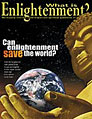
Our Save the World Issue


Advertisements


» Advertise with us