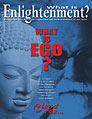
Self-Acceptance or Ego Death?


Featuring: Deepak Chopra, Cheri Huber, Paul Lowe and Saniel Bonder

 
introduction

Enlightenment equals ego death. For millennia this equation has held true. While the term "ego," meaning "I" in Latin, is obviously a relatively recent addition to the English lexicon, just about every major enlightenment teaching in the world has long held that the highest goal of spiritual and indeed human life lies in the renunciation, rejection and, ultimately, the death of the need to hold on to a separate, self-centered existence. From Shankara's rantings against the ego as a "strong and deadly serpent" to Muhammad's declaration of a "holy war against the nafs [ego]" to the Zen masters' fierce determination to use any means necessary to break the ego's grip on their students, this "ego-negative" interpretation of the spiritual path has remained enshrined in enlightenment teachings for ages, for the most part unquestioned and unchallenged.

Yet in the course of our research for this issue, it became increasingly apparent that the meaning and significance of ego death are undergoing radical revision in our Western spiritual culture, a culture steeped in the values of autonomy and self-reliance and informed by a psychological understanding of human nature. In some contemporary spiritual teachings, this revision is a shift in emphasis, some might even say a translation of older values into a modern context. But in others the rejection is more total, a radical reformulation of both the path and the goal of the spiritual life. In fact, the ideal of ego death is more and more often viewed with suspicion rather than respect, skepticism rather than reverence—as a chimera, an illusion, a pot of fool's gold at the end of a mythical spiritual rainbow.

It was perhaps never more obvious to us that the tectonics of the spiritual world had profoundly shifted than when, last September, a series of books crossed our desks that seemed to capture this changed landscape in stark relief. Titles like Relax, You're Already Perfect and There Is Nothing Wrong With You: Going Beyond Self-Hate, A Compassionate Guide for Learning to Accept Yourself Exactly As You Are made crystal clear a conclusion that had been dawning for some time: that the teachings of self-acceptance have earned wide recognition as an alternative approach to the path of liberation. "Much of spiritual life is self-acceptance," popular Buddhist meditation teacher Jack Kornfield writes in his best-selling book A Path with Heart, "maybe all of it." To Kornfield and many other harbingers of this kinder, gentler spirituality, it is a crippling self-judgment or self-hate (rather than a narcissistic ego) that is at the root of our spiritual dilemma—a core psychological wound that true spiritual work enables us to acknowledge, uncover and ultimately heal. "We must accept ourselves as we are" is a common refrain of these teachings—in order that all the parts of ourselves that have been hidden away in the dark corners of the psyche, including the ego, can be reconciled and integrated within a whole and unified vision of self. To the advocates of this approach, the traditional ideal of ego death is simply an anachronism in today's eclectic and democratic spiritual culture, a relic from another era that invokes a patriarchal, hierarchical and dualistic view of the spiritual life in which man is separate from God, and the spiritual seeker is called to engage in a self-defeating effort to kill the "bad" part of their personality.

What most intrigued us about this new paradigm was not that the message of self-acceptance plays an important role in the burgeoning Human Potential movement—after all, the groundbreaking book I'm OK– You're OK has been popular since the seventies—but rather the fact that the philosophy of self-acceptance has now found its way into teachings that have enlightenment as their goal. But is that where it belongs? What role should self-acceptance play in the lives of those who aspire to profound spiritual liberation?

In a break from our usual interview format, we approached four spiritual teachers who emphasize self-acceptance in their own work and asked for a written reply to a single question addressing this important issue. We contacted the omnipresent pioneer of new age spirituality Deepak Chopra; one-time heir apparent of Osho Rajneesh and maverick therapist, now independent spiritual teacher, Paul Lowe; Zen meditation teacher and author of a popular series of books on Zen and psychology, Cheri Huber; and former long-term disciple and spokesperson for Da Free John, now independent teacher of the way of "white-hot mutuality," Saniel Bonder—and they each graciously agreed to participate. And while these four diverse teachers did not always confirm our suspicions about this new face of East-meets-West spirituality, their articulate and illuminating answers force one to question many traditional beliefs about what's truly important on the path to liberation.

–Carter Phipps



interview

QUESTION: The goal of traditional spiritual teachings has generally been understood to be ego death—the final destruction of our attachment to a separate sense of self. But in today's rapidly evolving spiritual culture, what is often taught as the means to liberation is not ego death, but self-acceptance—acceptance of every aspect of ourselves, including our egos. The message of self-acceptance has become increasingly popular and is now commonly seen by spiritual teachers from almost every tradition to be the most effective and holistic way to address the suffering of contemporary Western spiritual seekers. As someone who works closely with many seekers, guiding them on the delicate and subtle path to liberation, why do you emphasize the importance of self-acceptance in the pursuit of spiritual freedom?


Deepak Chopra: When people get in touch with themselves, they become aware that the inner core of their being contains opposing energies. The human soul, because of its karmic baggage, is a place of ambiguity. It is a place where sinner and saint, the sacred and the profane, the divine and the diabolical coexist in seed form. When we get in touch with this part of ourselves and accept it for what it is, we simultaneously lose the need to judge others. Christ said, "He who is without sin shall cast the first stone." I believe what he was saying was that self-acceptance makes us compassionate, forgiving and nonjudgmental of others. This is the first stage of liberation.

Cheri Huber: "Kill the ego" is a phrase that is easily misinterpreted. Who is identifying "ego"? Who is killing whom? Who is seeing whom as the problem? Who is right and who is wrong? Who is making these decisions? There are two things we can count on where egocentricity is concerned—One: It is very clever; Two: Its only job is survival. Ego will take anything—ANYTHING—and use it for its purposes, even the notion of killing/ dissolving/ transcending/ accepting itself. You can see the danger, spiritually speaking, of misinterpreting "kill the ego."

These words are interchangeable: I, ego, egocentricity, conditioning, karma, suffering. The definition they share is that they are the illusion of a self that is separate.

I offer this as a working definition of self-acceptance: The realization that there is nothing separate—from All That Is, from "God," from Essence. It is the moment-by-moment living awareness that the self who struggles is not who we are but is, instead, karmic conditioning, a learned response to life, a survival system that served us as children but has lost its efficacy for us as adults and now needs to be appreciated, embraced and relieved of its job.

The desire to get rid of ego is very different from ceasing to identify with a karmically driven, egocentric, socially conditioned illusion of a separate self. The first implies a contest: Ego is charged with killing ego; ego battles with ego; ego wins! The second implies letting go of the illusion of control; it is the end of struggle, and the means to that end is awareness.

The processes that I teach for ceasing to identify with conditioning are threefold: pay attention, believe nothing, take nothing personally. I don't actually teach self-acceptance. I encourage people to see that the things they believe about themselves are not true. When you see through all that you have been taught to believe, when you realize who you are, self-acceptance becomes irrelevant.

All suffering is held in place by false beliefs. All beliefs are false. What is, is. Believing it is not helpful. Believing is what the illusory separate self does to maintain an existence outside the present moment. The process of not taking any of this personally allows us to see that we are all in the same boat. We can take responsibility for ending suffering, but we don't have to blame ourselves for being born into it.

Paul Lowe: If I emphasize self-acceptance it is because it is the deepest level of the spiritual path I have found that people will allow me to share with them. I have not found people who are ready to share at the level of, let's say, radiating nothing. When I share more deeply, it is not about self-acceptance, it is just being, including everything, with awareness.

This is not new. Jesus said, "Take no thought of the morrow, let the morrow take care of itself." It is an inclusive, positive approach, and to me, it is living what IS real. Is it good or bad? Does it benefit or harm? It just is!

On one level we have the illusion that there is an ego; on another level there is no ego. It is the same with self-acceptance. Self-acceptance is still a movement away from what is. At a certain level of realization, there is no self; therefore, self-acceptance does not exist.

We think we can accept or not accept, but the fact is: Existence is existence and we can either say yes or no to it. With "no" we go into the mind and conditioning, whether it is Christian conditioning or the new waves of Eastern influence. But when we live a total, unconditional "yes" to what is happening, we evolve.

Science says we use five percent of our brain and experience one-billionth of reality. People who have entered the depths of Eastern wisdom tell us there is much more. And there is. We get there by being ourselves, unconditionally, in each moment. And the method I have found most supportive is absolute ruthless honesty with yourself, and when you are ready, sharing the truth with others. Be in the truth of each moment—all that you are sensing in the body, thinking in the mind, feeling with the emotions. Don't suppress it and don't support it. Be with what is.

I have come to see that this focus on enlightenment is outdated. It was a goal for a while; it gave us something to head for. But enlightenment is another myth, another idea of God, something outside of ourselves to look toward to comfort ourselves.

In my search I have often felt, "This is it!"—and then discovered another level. It seems there are endless levels of awakening, of consciousness expanding; and yet, there's only One—there is the unformed. From the unformed we create what we call reality through saying yes or no.


Saniel Bonder: You're asking for what amounts to (a) a rationale for profoundly tantric, nonexclusive, genuinely liberating dharma and practice, or (b) a rationalization for why contemporary Western seekers need to be let off the hook that many of our Eastern forebears have swung from for lifetimes. I'll shoot for (a).

The phrase "self-acceptance" seems to imply resigning yourself to karmic limits. I prefer the term "greenlighting," which, as in Hollywood, gets real changes going. I welcome people to greenlight their limited egos and even the sense of separateness instead of chronically wasting energy fighting all that. For every Olympic spiritual gymnast who proclaims that he's blown the moon of ego out of his sky and now there's only sunshine, there are thousands of people (excuse the pun) mooning around!—wishing they could have really done it; practically, or actually, giving up hope of ever transcending the vise of separateness, which still grips them day and night.

What needs to die is separateness. Not "I-ness" itself. "I" is just the natural, organizing function of individual personhood. We need it to navigate space-time—even in dreams and visions. "I" can't blow "your" nose. Limited, egoic "I-ness" is OK. It's also not identical to chronically suffered separateness. And I suggest that it's possible, and much more natural and feasible, to transcend the separateness—and thus to enter fundamentally liberated existence—without assuming it's necessary in advance, or ever, to flatline the thinking mind, banish reactive emotions, exterminate "I-ness," and always be gloriously blissful no matter what!

Transmission of the fundamentally nonseparate, nonexclusive state is crucial. You can then template on an awakened helper's radiant nature and, with good counsel and wise friends, greenlight your heroic, tantric identification with your previously cut off, detested, shadow parts. But you don't get reduced to just being all that. You get to recognize it. Your own infinite conscious nature is cooking alive and awake, so you're suddenly noticing what has made you tick in separateness all along, in ways you never could have before. And you get more and more confident that your "I" and all its stuff cannot sabotage your awakening into integral, nonseparate freedom of Being.

That awakening, when it occurs, is not perfection. Paradoxically, it's not without limited "I-ness." It also detonates a massive, endless, spontaneous transformation of that local self and all its parts. But nobody I know who's gone through it would trade it in!