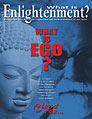
Enlightenment equals ego death. For millennia this equation
has held true. While the term "ego," meaning "I" in Latin,
is obviously a relatively recent addition to the English lexicon, just about
every major enlightenment teaching in the world has long held that the highest
goal of spiritual and indeed human life lies in the renunciation, rejection
and, ultimately, the death of the need to hold on to a separate, self-centered
existence. From Shankara's rantings against the ego as a "strong and deadly
serpent" to Muhammad's declaration of a "holy war against the
nafs
[ego]" to the Zen masters' fierce determination to use any means necessary
to break the ego's grip on their students, this "ego-negative"
interpretation of the spiritual path has remained enshrined in enlightenment
teachings for ages, for the most part unquestioned and unchallenged.
Yet in the course of our research for this issue, it became increasingly
apparent that the meaning and significance of ego death are undergoing radical
revision in our Western spiritual culture, a culture steeped in the values of
autonomy and self-reliance and informed by a psychological understanding of
human nature. In some contemporary spiritual teachings, this revision is a shift
in emphasis, some might even say a translation of older values into a modern
context. But in others the rejection is more total, a radical reformulation
of both the path and the goal of the spiritual life. In fact, the ideal of ego
death is more and more often viewed with suspicion rather than respect, skepticism
rather than reverence—as a chimera, an illusion, a pot of fool's gold at the
end of a mythical spiritual rainbow.
It was perhaps never more obvious to us that the tectonics of the spiritual
world had profoundly shifted than when, last September, a series of books crossed
our desks that seemed to capture this changed landscape in stark relief. Titles
like
Relax, You're Already Perfect and
There Is Nothing Wrong With
You:
Going Beyond Self-Hate, A Compassionate Guide for Learning
 to Accept Yourself Exactly As You Are
 made crystal clear a conclusion
that had been dawning for some time: that the teachings of
self-acceptance
have earned wide recognition as an alternative approach to the path of liberation.
"Much of spiritual life is self-acceptance," popular Buddhist meditation
teacher Jack Kornfield writes in his best-selling book
A Path with Heart,
"maybe all of it." To Kornfield and many other harbingers of this
kinder, gentler spirituality, it is a crippling self-judgment or self-hate
(rather than a narcissistic ego) that is at the root of our spiritual dilemma—a
core psychological wound that true spiritual work enables us to acknowledge,
uncover and ultimately heal. "We must accept ourselves
as we are"
is a common refrain of these teachings—in order that all the parts of ourselves
that have been hidden away in the dark corners of the psyche,
including
the ego, can be reconciled and integrated within a whole and unified vision
of self. To the advocates of this approach, the traditional ideal of ego death
is simply an anachronism in today's eclectic and democratic spiritual culture,
a relic from another era that invokes a patriarchal, hierarchical and dualistic
view of the spiritual life in which man is separate from God, and the spiritual
seeker is called to engage in a self-defeating effort to kill the "bad"
part of their personality.
What most intrigued us about this new paradigm was not that the message
of self-acceptance plays an important role in the burgeoning Human Potential
movement—after all, the groundbreaking book
I'm OK– You're OK has been
popular since the seventies—but rather the fact that the philosophy of self-acceptance
has now found its way into teachings that have
enlightenment as their
goal. But is that where it belongs? What role should self-acceptance play in
the lives of those who aspire to profound spiritual liberation?
In a break from our usual interview format, we approached four spiritual
teachers who emphasize self-acceptance in their own work and asked for a written
reply to a single question addressing this important issue. We contacted the
omnipresent pioneer of new age spirituality Deepak Chopra; one-time heir apparent
of Osho Rajneesh and maverick therapist, now independent spiritual teacher,
Paul Lowe; Zen meditation teacher and author of a popular series of books on
Zen and psychology, Cheri Huber; and former long-term disciple and spokesperson
for Da Free John, now independent teacher of the way of "white-hot mutuality,"
Saniel Bonder—and they each graciously agreed to participate. And while
these four diverse teachers did not always confirm our suspicions about this
new face of East-meets-West spirituality, their articulate and illuminating
answers force one to question many traditional beliefs about what's truly important
on the path to liberation.
–Carter Phipps




 printer friendly
 email the editors
 advertise
 reprints