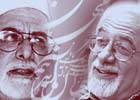
Sheikh Ragip/
Robert Frager
This interview was re-edited and reprinted with a special introduction for our 15th anniversary edition.
Click to read the new interview or to view the full issue.
"Two interviews? Sure. You could call it 'conversations with a schizophrenic,'" the voice on the other end of the line chuckled warmly, "because I'll probably contradict myself. When I'm wearing my Sufi hat, I often say terrible things about psychology."
It was an early fall afternoon—the first day of school at the Institute of Transpersonal Psychology—and Dr. Robert Frager, the school's founding president, was in good form. Having called the soft-spoken professor with a proposal I was almost sure would be met with at least some hesitation—to interview him twice about the same subject—I was glad to find my unorthodox idea landing on what seemed to be receptive ground. From his comments, it was clear that we weren't the first to have pondered the seemingly unbridgeable gap between the two sides of this human-potential pioneer's life.
To the many students and faculty members of the progressive academic institution he helps guide, Dr. Frager is a dedicated teacher, a Harvard-trained psychologist and the author of, among other works, the psychology textbook
Personality and Personal Growth. To the twenty or so members of the Redwood City, California, branch of the Halveti-Jerrahi order of Sufis, however, he is Sheikh Ragip, or "Baba," the man whose hand they kiss, whose words they revere and obey and whose life they seek to emulate—their spiritual guide.
Prior to this issue, we had been aware of Dr. Frager's pioneering work in the field of transpersonal psychology and of his role in establishing one of the country's first institutions dedicated to this emerging field of research and practice. Yet it was only when, in the midst of our research into Sufism's teachings on ego, a review copy of his new book,
Heart, Self and Soul: The Sufi Psychology of Growth, Balance, and Harmony, arrived in our mailbox, that we began to learn of his role as a spiritual leader in this deeply devotional Turkish branch of Sufism. We were immediately intrigued. How was it, we wondered, that one man could stand so firmly in two worlds that—at least where the ego is concerned—seemed, well, worlds apart? Having spent at that point several months exploring both spiritual and psychological perspectives on the ego, it had become undeniably clear that while Sufism and psychology have both dedicated themselves to the study of the nature and workings of the ego, they have come to wildly different conclusions about both what it is and the role that it plays on the path to wholeness.
To the God-intoxicated sheikhs and dervishes [practitioners] of Sufism, the ego has always been public enemy number one. Indeed, among all the wisdom traditions of the world, Sufism, the thousand-year-old mystical branch of Islam, may (with the possible
exception of Orthodox Christianity) hold the fiercest stance of any regarding the nature and treatment of this timeless foe of the spiritual life. Known in Arabic as the
nafs ammara or "self commanding or inciting to evil," this "rebellious," "tyrannical" aspect of the self is considered by many Sufi masters to be "harsher than Satan" in its capacity to drive the spiritual practitioner away from the path. In its endeavor to prove and maintain our separation from and superiority over others, Sufis hold, the cunning, deceitful and ever resourceful ego—"the greatest veil between us and God"—will go to any length necessary to deter us from progressing spiritually—a fact that many Sufis feel warrants often extreme counterforce.
Upon returning from his historic battle with the Meccans, the prophet Muhammad is said to have turned to his followers and declared: "We now return from the lesser holy war to the greater holy war—the war against the
nafs." And throughout Sufi literature, whenever the subject of the ego is raised, the term
"mojahada," or "spiritual combat," is likely soon to follow. Using words like "mortification," "destruction" and "annihilation" to describe the ends to which they hope to send the ego, Sufi masters speak with fire and conviction about the struggle required to overthrow the tyrant within. "Resistance to the
nafs is the basis of all spiritual practice and the perfection of all spiritual endeavor," the eleventh century Sufi text Kashf al-mahjub asserts. "Unless this combat is waged from the beginning, nothing will be achieved on the Path," cautions
Sheikh Javad Nurbakhsh, current head of the Nimatullahi order. "Unless you condemn your
nafs, resisting it at every moment and in every situation, and deny yourself even that which is permissable, you will constantly be deceived by it," warns ninth century Sufi master Abu Hafs Haddad. And finally, the renouned fakir Abu Bakr Saidalani states, "There is no attainment of Reality without the death of the
nafs."
Yet while the great masters of Sufism—like the greatest sages of all religions—are unified in their contempt for the ego, it is nonetheless clear that here in the dawn hours of the twenty-first century, religion no longer holds undisputed authority when it comes to defining the territory of the self. Indeed, under the reign of the scientific worldview, if anyone retains proprietary rights to the mysteries of the psyche, it is the psychologists, hands down. And where the ego is concerned, they are singing a decidedly different tune. Championing the ego's vital role as a "functional center" and organizing principle in the personality, as the indispensable mediator between opposing psychological forces or as the core sense of individuality without which the personality would be unable to develop, the theorists and therapists of Western psychology, while their emphases and theories vary widely, appear unified on one important conclusion—the ego, rather than being an adversary in our quest for freedom, may well be our greatest ally.
In part, of course, this vast ideological gulf can be attributed to a difference in the way these two camps define their terms. Pride, narcissism and attachment to self-image don't automatically translate to character, "functional center" and healthy sense of self. Yet, definitions aside, what is undeniably clear is that in the major schools of Western psychology, the notion that there is an "enemy" within us that seeks to actively undermine our spiritual development or that it is our very attachment to an identity that must ultimately be relinquished if we are to reach our full potential does not exactly find a receptive hearing. Indeed, even in the pioneering field of "transpersonal psychology" where mystical wisdom and developmental theory have recently become bedfellows, one is much more likely to find discussion of the ways and means of "healing the wounded ego" and "accepting ourselves as we are" than of the need for absolute renunciation in the face of the ego's insidious and unrelenting barrage of temptations. Indeed, wherever the psychological paradigm is allowed reign, the implicit or explicit goal seems to be one of healing rather than transcending, of repairing the self rather than losing the self altogether.
In light of the apparently irreconcilable aims of these two approaches to human development, we wondered how Sheikh Ragip/Dr. Robert Frager—a man whose life and work seemed passionately and perhaps equally dedicated to both—would reckon with the always tricky terrain the ego presents? How could these two approaches really come together in one man? Would he indeed be the "schizophrenic" he'd warned us we'd meet? Or would he, like others in his field, have worked out a way to somehow combine the two views into a unifying "theory of everything"? And if he had, would it be a truly happy marriage?
Intrigued at the unusual opportunity that had presented itself, we traveled to California last October and spoke with Sheikh Ragip during the Saturday evening gathering at his Persian-decorated Sufi Center outside Palo Alto. And the following Monday, across a conference table at the Institute of Transpersonal Psychology, we met with Dr. Robert Frager. The result was a fascinating exploration of the lives and views of one of the human potential movement's leading innovators, illuminating both the depth and wisdom of two powerful traditions and the subtle and often confusing territory that reveals itself when they attempt to find common ground.




 printer friendly
 email the editors
 advertise
 reprints