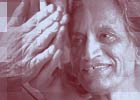
Yogi Amrit
Desai
I had always wondered if the practice of yoga had anything to do with ego death. I have been teaching the path to liberation for the last fourteen years and before that I had several teachers, but my first guru was a true master of yoga. His life was a literal embodiment of the Bhagavad Gita, the bible for any aspiring yogi, and he could, simply through taking one breath, dive deep into the mystical ecstatic trance of
nirvikalpa samadhi, considered to be the highest attainment on the path of yoga. Indeed, he was a true master who could at will transcend body consciousness—a feat few have equaled in any time. And yet, in this world, the amount of chaos he attracted to himself and all those who gathered near him never ceased to amaze me. And then there was the renowned master Swami Muktananda, who in his time was considered to be the greatest yogi of them all and whose powerful transmission of
shaktipat awakened the dormant kundalini energy in hundreds of thousands of Western bodies, but who disillusioned multitudes of seekers worldwide with revelations of his "tantric" escapades with the young daughters of his disciples. In those days (the late seventies/early eighties), I also heard intriguing reports of the incredible experiences that were occurring for many in the presence of Yogi Amrit Desai.
Yogi Desai originally came to America in 1960 to study fine art and design in Philadelphia, after which he worked in various design and textile firms while pursuing a career as a talented artist. A close disciple since his youth of Swami Shri Kripalvanandji, a master of kundalini yoga, Yogi Desai began teaching the then largely unknown art of hatha yoga in his new home of Philadelphia soon after arriving in America. The school of yoga he started became so successful that he eventually abandoned his career as an artist to devote himself wholeheartedly to teaching. It was not until 1969 that Yogi Desai received formal
shaktipat initiation from his guru, and it was then, in the early seventies, that he went from being a successful yoga teacher to a true guru in his own right, a master of kundalini yoga who had the ability to awaken the
kundalini-shakti in others. Many experienced powerful awakenings through being in his presence. One man described his experience as follows:
My body filled with a brilliant white light, and I allowed myself to be absorbed in it. I felt that my life, as I previously had known it, literally came to an end. My ego identity became meaningless; there was no time; past and future did not exist. All that existed was pure light and pure bliss. I was content to remain in this state forever. When I opened my eyes again, I noticed that my body had bent forward: my forehead was touching the floor. I do not remember assuming that position. I was actually bowing down to Yogi Desai. I had never bowed down to anyone in my life, but some inner unknown force had prompted me. I knew I wasn't bowing to Amrit Desai, but rather to my own higher self, which he had helped me to see.
Yogi Desai founded an
ashram in Sumneytown, Pennsylvania, and as word of his dramatic effect on people spread far and wide, he soon was invited to teach all over America and Canada. After several years, Yogi Desai began to decrease the focus of his
teaching work on
shakti experiences and began to once again put more emphasis on hatha yoga and the principles of holistic living. "I eventually stopped the intensive outward flow of the
shakti energy because so many were not ready to handle the intensity of the physical, mental and emotional purification that it brings," he said. "I realized that my disciples needed more grounding, more clarity in their thoughts and emotions, and more purification in their bodies before moving to this deeper level." He now focused his teaching on a new style of yoga that he created, which he called "Kripalu Yoga," the basis of which is a gentle practice of yoga postures supported by the breath in an unbroken flow. In this new style of practice, the cultivation of a detached, conscious awareness of the
process itself is the goal rather than the perfection of the postures or breathing techniques. Then, in 1979 he opened the Kripalu Center for Holistic Health in Lenox, Massachusetts. According to his biography, Yogi Desai felt that "holistic health would be the most effective way to introduce yoga to people who needed it but were not yet open to its more traditional forms. The services of the center would incorporate the teachings of hatha yoga and raja yoga, adapted to the modern Western approach to healthy living." The center soon became a phenomenal success, eventually welcoming more than a thousand visitors a month to its facilities, which were staffed by nearly three hundred full-time yogi residents. The rest is history.
Yogi Desai, who himself was married, encouraged strict celibacy in his disciples. In 1994, a scandal erupted that tore his community apart when it was discovered that the master had not been living his own teaching and had in secret been sleeping with several of his students. Disgraced and literally thrown out of his own ashram, he left behind him a wake of intense anger and profound disillusionment.
As shock waves penetrated throughout the American yoga community, I remember my own disappointment, for I had seen Yogi Desai as the last of the few modern pioneer masters of yoga in the West who, up until that point anyway, had remained free from scandal. What
is going on here? I found myself asking over and over again. These great men were true masters after all, men who not only had experienced glorious heights of bliss and ecstasy that most only dream about, but in this case, who also had the power to transmit that experience to others. These men had also, through the cultivation of unusual self-discipline, mastered the art of concentration, the very foundation of true yogic attainment. One would think that that powerful combination—mastery in self-discipline, concentration and spiritual ecstasy—
should result in a very high degree of self-control, detachment, awareness and profound spiritual conscience. And yet, much of the time, the norm for these
masters seemed too often to be one of shockingly less than conventional levels of self-control, detachment, awareness and . . . "So, what gives?" I kept thinking to myself. I also was frustrated because now Yogi Desai had given all the doubters yet another reason to have little faith in our power to transcend our lower instincts and become living embodiments of radiant spiritual purity in this dark and cynical world. For many years, in my own teaching work, I had received a lot of flack for daring to say that it was possible to become an expression of absolute simplicity in this painfully divided human world, and events like this made me feel more and more alone. After all, I had discovered that the cynics, many of whom wear spiritual clothing, write spiritual books and lead seminars,
like it when a master falls on his face. Why? Because it lets them off the hook.
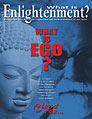
When the opportunity arose to speak with Yogi Desai about the topic, What is ego?, for this issue of
WIE, I leapt at the chance. What would the master have to say about this all-important question and its relationship to the ultimate goal of spiritual practice, considering everything that he himself has gone through? Did his experience verify my suspicions that yogic mastery didn't necessarily equate with death of the ego, the perennial enemy of enlightenment? And if that was true, what did it mean about yoga as a path to enlightenment? What did it mean about the ultimate significance of mastery and its relationship to ego death?
Yogi Desai, after a period of retirement, has resumed his teaching career and is now once again growing in popularity and gaining success and recognition as a master of yoga. He travels around the world and teaches as he once did, and was recently invited by Deepak Chopra to give a presentation at his millennium celebration. Yogi Desai was also asked to be the leading spiritual teacher at a new ashram that Chopra plans to found.





 printer friendly
 email the editors
 advertise
 reprints