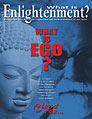
Bannanje
Govindacharya
Flying in India is always a frightening proposition. In
a land where daily power outages are more predictable than train schedules,
and where traffic signals (when they work) hold about as much authority as The
Clean Water Act, the thought that aircraft maintenance and air-traffic control
could be anything more than sophisticated guesswork is, at the very least, a
stretch. But as our chartered eight-seater twin-prop plane began its descent
back into the Bangalore Airport that stormy evening last December, despite the
trepidation with which we had begun our journey that morning—and the wind and
rain buffeting our thin sheet metal hull—somehow the only experience any of
us could relate to was bliss.
Only a few hours before, we had been deep in the jungled foothills of southern
Karnataka at the beautiful new ashram of the man we know only as Ajja or "grandfather"—the
extraordinary sage of Advaita Vedanta whose moving declarations of absolute
freedom graced the pages of our Fall/Winter 1998 issue—a man whose rare spontaneity,
uncontainable joy and infectious peace of being had left all of us convinced
beyond a doubt that we had encountered one whose ego truly was no more.
Our meeting that afternoon—our third in as many years—had been a seamless
experience. As always, Ajja had been welcoming, generous, delightful, radiant—and
absolutely uncompromising in his insistence that for him, there is no personal
existence. As a delicious South Indian lunch soon gave way to dialogue, in
a matter of minutes the discussion was hovering on that most important and delicate
topic that always seems to come to the fore when we encounter a teacher of the
ancient Indian nondual philosophy of Advaita Vedanta: How does Advaita, a teaching
that proclaims the absolute unity of all things, deal with the complexity of
the human experience?
Like the words of the great twentieth-century sages Ramana Maharshi and
Sri Nisargadatta Maharaj—men immortalized in the modern spiritual canon as legends
of nondual attainment—Ajja's emphatic declarations that "there is nobody here,"
"the person who sees has gone" and "there is only bliss, there is no one to
experience that bliss" were alive with the undeniable presence of that which
is forever beyond time and action, name and form. It was clear from his rare
purity and simplicity of being that when Ajja said, "There is no ego," he was
simply articulating his own ongoing experience.
But coming from contemporary America—where two-day Advaita-based "enlightenment
intensives" have become the latest addition to the health spa weekend workshop
circuit, and where the unreality of the ego is being boldly declared by a "newly
awakened teacher" in nearly every town large enough to have a Wal-Mart—we felt
it was worth asking whether Advaita, at least in its contemporary Western form,
might be oversimplifying the enormous challenge of genuine spiritual transformation.
So when we began our research for this issue and simultaneously began planning
our tour of India, we had left open the possibility that perhaps,
somewhere along our journey in the land of mystery, we would stumble upon someone
who could bring further insight to our ongoing questions.
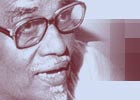
Enter Bannanje Govindacharya. A pundit and guru of great renown, Govindacharya
is known throughout India as a man for whom the scriptures are second nature.
With over fifty books and five hundred published articles to his name, the largely
self-taught teacher draws enormous audiences nationwide to his public discourses
on Vedanta and many other aspects of Indian religion and philosophy. He had
first come to our attention two years before as the legendary pundit who had
"discovered" the previously unknown Ajja—a fact all the more interesting in
light of his own philosophical allegiances. For although Govindacharya is regarded
by many to be one of India's foremost experts in Advaita philosophy and had
the eyes to recognize Ajja, one of the purest expressions of nondual attainment
in modern times, he himself is not an
advaitin, but a
dvaitin
or dualist—a proponent of the devotional Tattwavada school of Vedanta which,
in contrast to Advaita, does not deny the reality of the manifest world. Curious
to find out what this avowed dualist would have to say about the modern incarnation
of Advaita that is capturing the imagination of so many Western seekers, we
had been hoping to at some point have the opportunity to speak with him. By
luck, our chance to do so all but fell in our laps when a few of Govindacharya's
disciples attended a talk by our spiritual teacher,
What Is Enlightenment?
founder Andrew Cohen. Eager to arrange a dialogue between the two teachers,
they invited us to join them at the pundit's home on the evening of our return
from Ajja's ashram.
As our plane touched down with a lightness and agility that seemed to paint
the morning's fears as merely the play of
maya [illusion], our group was abuzz with
talk of the coming meeting. What would this classical pundit have to say about
Vedanta's views on the ego? Would he only be a man of knowledge or would he
also be a man of experience? Looking forward to what the next leg of our journey
would bring, we thanked our pilots for our safe deliverance and climbed aboard
a motor-rickshaw, hoping we would fare as well in our journey across town as
we had in India's friendly skies.





 printer friendly
 email the editors
 advertise
 reprints