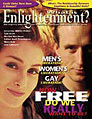
"She converted to Orthodox Judaism after being a feminist!?" my colleagues exclaimed to me. "We have to speak with her!" We were discussing the work of Tamar Frankiel, author and educator, whose book The Voice of Sarah portrays the purpose and meaning in the traditional roles for women in Judaism. Drawn by the spiritual depth she felt in the Jewish ritual observances for women and by the unusual strength of character of the Orthodox women she had met, Frankiel underwent the unlikely conversion from liberal Christian feminist to practicing Orthodox Jew.
"As I grew to know [Orthodox women]," she says in a candid description of her experience, "my first feelings of condescending pity toward these victims of patriarchy changed to admiration and wonderment. I knew I could never live like that, but I appreciated that they were living a life of integrity with a spiritual richness of its own. That was ten years ago. Today I find myself speaking in much the same way to others as those women spoke to me then. . . . I don't expect such statements to be any more believable to feminists than they were to me ten years ago. I can only assert that there is truth behind their simplicity."
The fact that Frankiel, who has taught comparative religion at Stanford, Princeton and U.C. Berkeley, found the message of this gendered belief system so compelling that she left her liberal feminist freedoms in favor of a far more restrictive lifestyle led me to question many of my prior assumptions. And mainly, I began to wonder: Could Judaism, whose "faceless" God nevertheless seems to have a very masculine face, really offer women a spiritual life of equal depth and significance to the one it offers men?
The Judaic religion is built on traditional roles for women and men, with elaborate commandments governing all aspects of the observant Jew's life, from conjugal relations to time and place of prayer. Its very structure depends on man fulfilling his
distinct duties and woman fulfilling hers. Men hold the positions of authority as the religious leaders and lawmakers while women are relegated to hearth and home. "Separate but equal," some may argue, but as far as feminist scholars such as Rita Gross are concerned, Judaism practically tops the list of patriarchal religious offenders. So when Tamar Frankiel, with her background in the feminist and equal rights movements, praised this "separate but equal" tradition primarily because of the position of women, we raised more than an eyebrow.
Among observant Jews, the rabbi is meant to be the final authority on all issues spiritual and mundane, including everything from whom to marry to the finer points of theological debate. So I called Rabbi David Edelman, leader of the Lubavitch Orthodox congregation in western Massachusetts, to gain some insight into this gendered way of life. As presiding rabbi over a large Jewish community for the last forty-nine years, Rabbi Edelman, I thought, would be well-versed in both the theory and practice of the Orthodox tradition.
"Can you tell me about the traditional roles for men and women in Judaism?" I asked him last December. "You want to know how men and women should be?" he began. "All the answers are in the Torah." Then he proceeded to tell me about the great Biblical matriarchs and the exalted position of women in Judaism. "Women are more spiritual than men," he said, to my astonishment. "They naturally have a closer connection to God. Men need to be reminded to pray. That's why they have to come to the synagogue. Women can pray by themselves because they pray deeper. And you know, it is said that when the Messiah comes, men will be raised to the spiritual level of women."
His description stood in stark contrast to the Orthodoxy I had pictured. I had expected Rabbi Edelman to explain why, in Judaism,
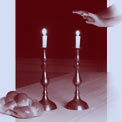
women are prohibited from chanting the holy scripture; why they sit behind a screen during public prayer; why they are considered impure, unclean and not to be touched every month because of their physiology; and why men utter a prayer every morning thanking God for not making them a woman. But the rabbi then told me, "I have six daughters. They never missed out on anything. You should have seen them all together, walking down the street to the yeshiva school—what a picture! They were modest, but they were always nice-looking, with a little lipstick. You should talk to them; they'll tell you they never missed out on anything!" In
Yiddish there's a special word, "nachas," used to describe the often less-than-objective pride parents can take in their children. So was Rabbi Edelman kvelling [gushing] with nachas? Or had this way of life actually given his daughters a deep sense of self-fulfillment?
I couldn't help wondering what Rabbi Edelman's daughters were really like. Would I find them to be meek or subservient, with a narrow scope of interests centered around teething and bread making? Would they be restless in their restricted sphere, with all the freedoms of the modern world tempting them from just around the corner? Would they be passive and accepting of their lot, reluctant to question, challenge or reform, fearful of retribution from an angry God or a conservative rabbi? Or was Rabbi Edelman accurate in saying they really hadn't missed out on anything? My curiosity piqued, I arranged to meet Esther Kosofsky, one of Rabbi Edelman's by now, at least to me, illustrious daughters.
Esther Kosofsky is the director of the Jewish Educational Resource Center in western Massachusetts, mother of eight and wife of a rabbi. We met in the Springfield yeshiva school, the very school that the rabbi had mentioned. Walking down the hallway, alive with sounds of children singing Hebrew songs, I was struck by her quiet confidence and self-assurance. She was all that her father had described her to be. Not only was she attractive, but there was a light in her eyes, an unusual serenity and vitality. As she spoke about her love, appreciation and respect for this gendered tradition, I found myself reflecting on the great Biblical matriarchs—the Sarahs, Rebeccas and Deborahs who had deep spiritual passion and had served God with valiant devotion, powerful faith and rare wisdom. As I glanced around the book-lined office, the white-bearded Lubavitch rabbis seemed to smile and twinkle at me from their picture frames on the wall.
Unlike Esther Kosofsky, most of the women I have known are women who grew up in the wake of the feminist movement, beneficiaries of many newfound and hard-won freedoms. But in spite of all the opportunities available to us, most of us have had to grapple with insecurity, confusion and self-doubt around our role, position and even spiritual path in a world of shifting values. In grocery stores and newsstands around the country, magazine racks sport colorful arrays of women's magazines, all eager to help us navigate our perplexity with "how-to" recipes for finding fulfillment in work, relationships, sexuality and motherhood. In light of the simple confidence of these Orthodox women, I began to consider what had been for me, at least up until now, an inconceivable question: Could it be possible that women adhering to a traditional feminine role in this patriarchal religion might actually end up having more inner strength and higher self-esteem than women free to explore an infinite number of lifestyles in the postfeminist world?
I listened carefully to what Esther Kosofsky and Tamar Frankiel had to say as we talked about some provocative and pointed issues. Their unswerving conviction in their own rich experience as observant Orthodox women speaks for itself.




 printer friendly
 email the editors
 advertise
 reprints