WIE: It seems to be common practice today to label qualities such as compassion, receptivity, sensitivity and intuition as "feminine" and qualities such as aggressiveness, competitiveness, ambition and reason as "masculine." Near the end of Fire in the Belly
, in writing about what you call "the gender game," you speak at length about these binding polarities that have come to define our conceptions of gender. You state: "Manliness and womanliness are both defined by a process of decision, and denial. Each gender is assigned half of the possible range of human virtues and vices. . . . We do not know what human beings would be like if encouraged to develop their innate promise without the systematic crippling effect of the gender game."
SK: Yeah, well, in the first place, I go on to say there that I think that no self-respecting person who's thought about these things should ever use the word "masculine" or "feminine" and attach any kind of general predicates and virtues to it. That's just nonsense. It's time to get rid of that stuff. It may be helpful on the spiritual journey to ask myself the question: How have I been crippled by my effort to become a man or a
real man, or a woman or a
real woman? That's not a bad question to begin with. But there is a far, far more important question which is far more subtle and that is: Who am
I? Who is Sam Keen and what does
he experience and what does
he need to do and where are
his injuries? So much of my approach is the effort to go beyond mythology to autobiography, to take my own story and the uniqueness of my own situation, my own gifts and my own wounds, with a kind of ultimate seriousness. In other words, to put it metaphorically, God does not issue something to me that says, "To whom it may concern," nor does he say, "To all men" or "To all women" or "Directive to twentieth-century man." No, the still, small voice addresses me with my name: Sam Keen, do this. Sam Keen, experience that. It's individually tailored, you see. And the fact is that my way of being a man is probably different from your way of being a man. And it's my task to find out what that is. I'm always going to be a man. Biologically, I'm going to be a man. I have the male equipment. But what that means is going to be so governed by my own experience as to be something that would be almost totally, perhaps, strange to you.
WIE: Along these lines, at another point you state, "Far better to remain with the real mystery of man and woman than the false mystification of the masculine and the feminine." What do you mean by "the real mystery of man and woman?"
SK: I don't know. I know what the false mystery is. The difference between a false mystery and a real mystery is that you can tell what a false mystery is, but I'm not sure that you can ever say what the true mystery is. It's like when I'm in the presence of a woman who has gone beyond the gender crippling stuff in herself, and I am at least endeavoring to go beyond it in myself, and we face each other, no longer as masculine and feminine, but as unique individuals, then there is the real mystery of that other person. I think I said in the book it's sort of like what Satchmo said when somebody asked him what jazz is; he said, "Man, if you don't know, I could never tell you."
WIE: Jungian psychology holds that within each of us, male or female, there are both masculine and feminine energies, which need to be brought into balance if we are to become whole. For instance, Marion Woodman in her book Leaving My Father's House
states, "We all function with these two different energies. As health and growth depend on both dark and light, so maturity depends on an inner balance between yin
and yang, Shakti
and Shiva,
being and doing." Do you agree with this notion that a fundamental polarity of masculine and feminine energy exists in the psyche?
SK: No, I think it's boring—it's a boring idea. I could put it this way. There are two kinds of people: those who divide the world up into two columns and those who don't. I am a person who does not believe in setting the world up in terms of two columns and then saying, "But you see, there's a little of the
yin in the
yang and a little of the
yang in the
yin, and we have to get the two columns together." Well, why start with two columns? Why start with making your basic concepts about the human psyche goose-step along? I think that's intellectual tyranny. It's not helpful! It
is helpful for me to say, "Now, Sam, what are you experiencing?" It's helpful for me to sit quietly in meditation and try to get in a witness space and to identify my feelings and images. It's totally unhelpful for me to say, "Now I've gotta get my
yin balanced with my
yang! Am I too
yang or too
yin?" And again, to label these virtues and/or vices as masculine and feminine is part of the problem. Don't start with an artificial separation. Think in different categories. If all I can think of is, "I've got to do this or that," if all I think of is masculine or feminine, it's a shotgun to my head. That's why I don't like Jungianism—just like I detest the idea of archetypes.
WIE: Why is that? There are more than two of those.
SK: All right. Let's take the most recent thing. Tell me what the archetypes of man are?
WIE: The king, the warrior, the lover and the magician.
SK: Now, the idea is that these archetypes are different ways of structuring our experience that we all somehow have to go through. To show you how ridiculous that is, let's go back to the earliest notion in the West of what constituted the dignity of a human being, which was what? The citizen. In the Greek world, the word for "idiot," as a matter of fact, meant somebody who was not a citizen. Now tell me, why isn't the citizen in the archetypes? Because the Jungians are apolitical, because they're interested in inner psychodrama. They're not interested in the transformation of the world. You see, if those are the four archetypes, then we don't have to worry about what's happening in Kosovo or anywhere else. That's just stuff that's going on
over there. We don't have to worry about the educational system deteriorating because that's something citizens worry about. Give me a break! King as an archetype?! That's why we came to this country—to get rid of those archetypes! That's what America was all about, "Screw kingship! Screw dominion!" And the warrior? That's the hair of the dog that bit us. That's what's been driving us all along. If the Jungians would say, "There are endless numbers of metaphors that help us to understand ourselves, and here are four," I'd say, "That's a good start. Now give me five or six. How about giving me, oh,
garbageman." Now, that's a good archetype, right, because isn't half of the problem cleaning up the trash in our psyche? Well, sure it is! Separating the wheat from the chaff, you know. Or how about
fool or
hobo or
wanderer or
friend? How about friend! Now, that's an interesting archetype. Aristotle's
Nicomachean Ethics has a great deal to do with friendship,
philia. I'm not much of a fan of Jungian thought because it ignores two things: politics and the body. They're largely a disembodied movement.
WIE: It seems as though much of the men's movement has centered around Jungian thought.
SK: That's right. It has. And I don't think it's helped them.
WIE: In this issue, in addition to exploring the relationship between gender and spirituality, we're also looking into the relationship between sexual orientation and the path to liberation. In our time, there are many gays and lesbians who view their experience of sexual orientation as the very basis of their spiritual path, a path employing unique forms of practice and worship. Some advocates of a distinctly gay spirituality have even suggested that because the male and female polarities are theoretically more fully integrated and balanced in homosexuals, theirs is an inherently superior form of spiritual practice. Andrew Harvey, one prominent spokesperson of this view, states that "in earlier times . . . homosexuals . . . were seen as sacred—people who, by virtue of a mysterious fusion of feminine and masculine traits, participated with particular intensity in the life of the Source." What do you think of the notion that sexual orientation constitutes the basis for a distinct and separate spiritual path?
SK: I don't like it at all. I think that sexual orientation is an individual thing that shouldn't be politicized. And I don't think, in that sense, it should be spiritualized, either. In the life of the spirit, the question isn't whether somebody is gay or straight. From a spiritual perspective, I think that's meaningless. In the life of the spirit, the question is whether you're loving or unloving, and to what degree you can enter a relationship with the fullness of who you are. And this theoretical construct that the polarities are more balanced in gays and lesbians? Well, who says that and by what possible jump can we get there? Maybe they just don't
have the polarities. To make gay or lesbian a category is itself a sin. It's a mistake and a sin. I have friends who are largely homoerotic who would never call themselves gay. And people who are homoerotic are as different from each other as people who are heterosexual are. I'm all for anybody being able to do what it is that they want with any consenting adult of either gender, but let's not raise it to the level of something superior. Let's not make homosexuality
or heterosexuality spiritually superior. It's not the issue.
WIE: In our research for this issue, we also came across the idea among Jungian psychologists, some feminists and a number of contemporary spiritual thinkers that our ultimate human potential is the realization of a kind of androgyny in which all human qualities find equal expression in everyone, regardless of gender. Describing the fruition of the spiritual path as the birth of what he calls the "sacred androgyne," Harvey, again, writes: "The main mystical traditions agree that this birth of a new being can only take place through a long, arduous, and increasingly conscious intermarriage of the masculine and the feminine within each one of us, male or female," and that "only such an intermarriage can give birth to the sacred, androgynous, free child of the Source that is potential in each of us." Do you agree with Harvey's view? Is the fullest expression of our spiritual potential the realization of androgyny?
SK: HO HUM. I mean, why try to press every old idea into service? Why not try to think about things differently? The idea of androgyny is just the romantic myth taken into the interior. "Oh, boy. Finally, now, the man in me and the woman in me are going to get together and have this marvelous romance and I'm going to be whole." It's like thinking with wooden blocks. I mean, that idea comes up all through the alchemical tradition, and it was okay to talk about it then. But isn't it time to think creatively, to get some new categories, new ways of thinking, instead of just trying to knit new wool on these old needles?
WIE: You brought up Mary Daly earlier. She and other radical feminists hold that most if not all of the ills in our individual psyches and in society at large are the result of the overwhelming influence of men—male values, attitudes and dispositions—on everything from the structure of government and commerce to the structure of language. Citing the widespread, catastrophic effects of patriarchy on not only the status of women but on the quality of life on this planet, they call for a return to a gynocentric spiritual culture with values and institutions akin to those of the peaceful, agrarian world that existed thousands of years ago. Is Mary Daly right? Would placing all power in the hands of women be enough to bring about a peaceful, harmonious culture rooted in deeply spiritual values?
SK: Yeah, yeah. Of course. I mean, you know what they did to build the pyramids—they went out and they got union labor and they asked for
volunteers because it was all a "cooperative culture." And in those matriarchal cultures, they also
asked people if they wanted to be human sacrifices because they were nice and kindly in those days. You know . . . it's the chalice and the blade.
What all of that really is is a disguised rewriting of history in order to do male bashing. Men and women have been in this thing together all along. If you want to bash patriarchy, you can bring it right up to the modern era and speak about how these brutish men, these terrible men, went over to Vietnam and killed all those people. I mean, they were nineteen-year-old kids who had no more choice about what they did than Mary Daly did. Anytime that you put the blame on one of the genders, you have rendered the other inferior. If it's true that men just dominated women all that time and women had no power, then they probably needed to be dominated.
WIE: Do you think putting the blame on men is a complete misappropriation?
SK: Yes. But I also want to say that I do believe that Mary Daly is one of our great prophetesses. I have learned enormous amounts from her. I want to affirm so much of her analysis, but I don't want to affirm her anger. It takes a good deal of courage for a man to really read Mary Daly and to open himself up to her arguments. Many of them are brilliant and are necessary medicine to help most men to understand the injuries that women have experienced in this culture. But there are certain feminists whose anger gets in the way of their clarity.
WIE: I think they would argue that they've got a lot to be angry about.
SK: And they do. They do.
WIE: In your view, what does it mean to go beyond gender?
SK: Again, it means
get over it! This question of gender is something, by and large, to be gotten over, to get on the other side of. I don't ask myself the question: Am I a man? Am I manly enough? I ask myself the question: What am I about? In other words, I think we need to stop making gender a primary way of asking the question:
Who am I?
WIE: What do you think becomes possible within the individual and between human beings when we do "get over it," as you put it?
SK: Well, I would ask—and this question is at the very center of Buddhism and Christianity—What does it mean to be wise and compassionate? That's a hard question for me to answer. In my daily life, how do I be wise and compassionate in relationship with my wife when I'm in conflict, or with my children or my friends? What do I do about Kosovo and my government to be a decent human being? This is an age in which, somebody said, you have to become heroic just to be decent! And that isn't a gender question. What's injuring the world here isn't gender. In America, women are just as injurious to the world as men are. They're out there in the malls. The mall is where we vote about values. Why did we do what we did in Iraq? So we could drive to the mall. And again, I think what I object to about your magazine is the lack of the real political kinds of questions. All afternoon you haven't asked me anything about the
politics of gender.
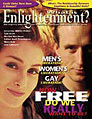
WIE: Well, our magazine is about enlightenment.
SK: Well, that's what's wrong with it, then. Frankly, that's what's wrong with it. It's kind of narcissistic. There's a lot of spiritual narcissism, I think. Now, that's not to say it's completely that way. You do come out of it and you do have the courage to speak with people who aren't particularly in sympathy with your major point of view. But let me ask: What would it be like if, on your cover, underneath the words "What Is Enlightenment?" you put: "One definition of an enlightened person might be that the first question they would ask is: What is just? How do we establish justice?" Because that takes us into the political realm. That takes us beyond the obsession. And the obsession with enlightenment can be just like the obsession with gender. People who are obsessed with enlightenment are never going to get there.
WIE: This is a common argument against the pursuit of enlightenment. But I don't see the question "How do we establish justice?" as being in any way removed from the question "What is enlightenment?" If we look at the human condition, if we look at what's behind the atrocities in Kosovo or Nazi Germany, it seems to me that we have to confront the question: How is humanity's problem going to be solved without individuals making a change, without individuals coming to a reckoning with themselves, with their own motivations? Our magazine is actually founded in the idea that there is a strong moral and ethical component to liberating ourselves from delusion.
In this issue, for instance, we're questioning the core of gender identity because, as you've pointed out, it seems that the strong identification most of us have with gender is one of the fundamental structures underlying the conflict we see in the world. And the idea is that if enough light can be brought to something so fundamental to our makeup, then hopefully we can begin to see, and even respond to, another possibility.
SK: Well, good. Transforming the self and transforming our society are warp and woof of the same tapestry. It takes both to weave anything hopeful, beautiful and new.