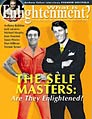
Susan Powter
During one of our discussions while researching this issue of
What Is Enlightenment?, one of our editors, a man, asked, "When you were five years old, did you want to be enlightened, or did you want to be Superman?" The three men present immediately and enthusiastically exclaimed, "Superman!" I and the other woman in the group shrugged and looked at each other blankly. We simply couldn't relate. It was as if they were speaking another language; the meaning just didn't penetrate. When we told the men about our experience, they said, "Okay, well, what about Wonder Woman?"
We were still unmoved. Even though, as young girls, we had been offered a politically correct superhero with an hourglass figure and long flowing hair, we both knew that we had never identified with her. We had never aspired to leap tall buildings in a single bound, to be a defender of the weak, to be a hero, to be a master of the universe.
This Superman conversation is one that we two women reflected upon a lot while working on this issue of
WIE, for it somehow seemed to shed light on the difficulties we were encountering in our search for women who boldly exhibit the character, characteristics and overall panache we had come to identify with self-mastery. While there are, of course, extraordinary women who excel in many fields of endeavor, we found few women who are specifically interested in the pursuit of self-mastery, and who are committed to the kind of discipline, independence and confidence that it involves. In many cases, we'd come across women who had achieved unusual excellence and mastery in, for example, a particular sport, and who were astounding in their commitment and courage in breaking through limitations of all kinds, but who nevertheless didn't speak about their achievements with the confidence, charisma, independence and power that their male counterparts did.
That's why we were delighted when we first discovered the outrageous, outspoken health and fitness crusader Susan Powter. She does, without question, exude the confidence, charisma, power and seize-the-reins-of-your-life self-determination that we had identified as central to self-mastery. In the years since she began teaching her unique brand of renegade aerobics in Dallas, Texas, after turning her own life around and losing 133 pounds, she has experienced a meteoric rise as one of America's most compelling motivational speakers, writing six books—three of which were
New York Times bestsellers—creating a series of enormously popular infomercials, appearing as a regular guest on ABC's
Home show, developing both a television and a radio talk show, and giving standing-room-only lectures and seminars all over the country.
Powter has re-created herself and her life again and again and has learned many hard-earned lessons well. With warmth, humor and bravado, she shares her tales with other women looking to transform

and empower their own lives. An unusual energy, zeal and, as she puts it, a "one hundred percent raw-to-the-bone honesty" bursts out of her and emits a kind of shock wave that envelops everyone in the vicinity wherever she goes. In her books, videos or wherever you may encounter her, onstage or off, she tells it like it is, no matter the consequences. In a world where men and women so often live in thrall to the opinions of others—women perhaps especially so because they may have more to lose—her guts and candor demonstrate a dynamic and refreshing freedom. And while her in-your-face style has been known at times to irk or offend, millions of women have found her message and example a positive, uplifting and empowering force in their lives. Indeed, as I learned more about the impact of her work, it occurred to me that in some ways, Powter was sort of a nineties version of Wonder Woman—albeit with a bleached-blond buzz cut.
When I finally got the opportunity to speak with her, I was very eager to find out if Powter really was the Self Master she had appeared to us to be. I was also curious to discover the source of her high-voltage inspiration, passion and positivity, since to us this has been one of the most intriguing questions in our investigation into the relationship between self-mastery and enlightenment.
Her emphatic answer to my first question set the course for the entire interview to follow: "I would
never use the word 'mastery.' I have no respect for that term. I think it is very male and very arrogant. I don't think that there is any such thing as a master. I mean, 'master' suggests that there is something under you—usually a slave. It's the mastery of the world that has gotten us into the mess we're in! . . . This needs to be said because it's a different perspective; it's a
female perspective." While Powter's visceral response to the word "mastery" wasn't entirely a surprise—we had by this point come across the same sentiment among women (and particularly feminists) many times before—her disdain for the idea of "self-mastery" and all that it connotes, including discipline, self-control, willpower and decisive action, was incongruous with her no-nonsense and in fact quite decisive and disciplined approach to weight loss and fitness.
"Well, we're off to an interesting start," I thought, only one question into an interview focused entirely on the relationship between self-mastery and enlightenment. One of the two central concepts of our dialogue was clearly a red flag to a woman who, although her claim to fame is as a diet and fitness guru, has in recent years become increasingly known for her commitment to feminist consciousness-raising and the activation of women's consumer, social and political power. Thankfully, the ever practical Powter agreed to use the term "self-mastery" for the sake of the interview—but creatively suggested that we cross out the word in print whenever she used it. And as for enlightenment, transcendence, God or Divine will—the other half of the central question of this issue and, of course, the focus of our entire magazine—I soon found out that we were in equally tricky territory. "The nice, blanket, politically correct way to cover God is to say, 'however you choose to describe it.' But somebody needs to start talking about the truth, which is the fact that God is inevitably always referred to as 'He,'" she insisted. "The only God that you are really allowed to find is male. . . . Surrendering to a higher being is slavery!" Powter's spirituality is staunchly immanent and earthly. Her passion for the symbols of birth, blood and dirt is effusive and her rejection of ideas associated with traditional religions fierce. Needless to say, I quickly discovered that both terms central to our discussion were loaded, which made for interesting navigation as well as true-to-form Powter fireworks.
Much as Powter dislikes the term "self-mastery" and would never apply it to herself, her message often rings with the "just do it" self-mastery theme. "If you want to be fit, there's no magic. There's no mystery. . . . There is no fairy godmother who comes down and taps you on the head," she says adamantly. "You have to get up and work your ass off—literally. . . . Laziness doesn't fly. It
does take work and it ain't easy—but man, the rewards!" She doesn't for a moment buy self-pity or victimization as an excuse, and has no patience for approaches that encourage lengthy psychologizing before simply getting on with the work of making the changes we have determined to make. And, like the other Self Masters we spoke with, she has a voracious appetite for life. She transmits an unbridled "Yes!" a boundless "More!"
But unlike other Self Masters, Powter is vociferous in insisting that she not be cast as a role model or as an example of someone who lives by the principles she speaks about. Where Jack LaLanne says, "How could I be an example, and how could you believe in Jack LaLanne, if I didn't practice what I preach?" and Anthony Robbins freely acknowledges the importance of his own example to the credibility of his message, Powter exclaims, "I do not see myself as an example to
anybody for
anything. I think that is arrogance at its best. That is obnoxious; that is so offensive." Despite the unavoidable fact that she
is a very visible and vocal example of self-transformation and empowerment for many, many people, she insists, "I'm a forty-one-year-old mother of three, schlepping through the day every day. . . . I'm just a housewife who figured it out and started talking with other housewives. . . . No, I would
never call myself a 'role model.'"
So . . . is Susan Powter a Self Master? Well, yes and no. Although she's clearly the master of herself in many ways, her feminist philosophy seems to be at odds with, and to prevent her from fully embracing, that role. It would appear that Powter, in spite of the heroism she has demonstrated in a number of areas of her life, never aspired to be a superhero, to be Wonder Woman. The deepest reasons for so many women's visceral aversion to this kind of strength and responsibility are a fascinating subject, perhaps to be further explored in a future issue of
WIE. But for this issue, we are pleased to present the gale force musings of our reluctant Self Master, Susan Powter.





 printer friendly
 email the editors
 advertise
 reprints