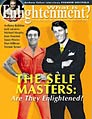
Andrew Cohen: How would you define "self-mastery"?
Michael Murphy: Self-mastery involves the conscious control of a particular capacity or set of capacities, even though such control involves surrender at times, and openness to the radically unexpected, and to a kind of "cascading effect"—let's call it the
momentum of mastery. I'm sure that when Mozart started writing a symphony, for example, he didn't know exactly how it would all sound at the end. Even though he may have seen it
tout ensemble, all at once—and Mozart was famous for this—nevertheless, as it all unfolded, I'm sure that Mozart was truly surprised
. Or let's look at self-mastery in basketball: Earl "The Pearl" Monroe, remember him? They used to call him "the black Jesus." He was a six-foot-one-or-two-inch point guard who played for Baltimore and then for the Knicks, and he would make these runs to the basket—I mean, my God, he was in some ways more impressive than Michael Jordan because he was so much shorter. And somebody once asked him, "Earl, do you think up what you're going to do before you do all that?" And he said, "Hell, no!" He said, "If
I don't know,
they don't know."
So mastery involves exquisite control, supreme excellence—and an openness to surprises that astound even the person who is masterful. It involves surrender to unexpected moves if we're talking about sensorimotor mastery, to new and unexpected responses of the heart if we're talking about interpersonal mastery, to new illuminations and complete surprises if we're talking about cognitive mastery, and to even more surprises if we're talking about spiritual mastery.
AC: The significant element of what you're saying seems to be that on the one hand there's extraordinary control, and on the other there's a kind of spontaneous freedom that makes miraculous things possible.
MM: Yes, and I would say that by whatever definitions you and I were to agree on for self-mastery and enlightenment, one of the great things they
both involve is bringing something radically new into the universe moment by moment, because that seems to be part of the secret of the game: utter delight, surprise, novelty, the
lila—play, in Sanskrit—and the
ananda—the self-existent delight—translated into this movable feast which is the universe, horrifying as it is at times.
AC: Right you are.
MM: "A catastrophe," as Zorba the Greek said.
AC: And how would you define "enlightenment"?
MM: Well, at Esalen in the old days we used to have this exercise of a group of us sitting in a circle and all of us who were interested in such things giving our respective intuitions about the nature of enlightenment. And after having done that several times, all I can tell you is that when it comes to defining that word, I'm deeply confused. I mean, there are so many ideas about enlightenment that I personally don't use the word any more—I kind of gave up on it because people have so many different ideas about what it means. If you're interested, though, I could read you a quote from Sri Aurobindo, who has influenced me more than anyone else—
AC: With all due respect, I'm much more curious to find out what's going to spontaneously come forth from your own lips.
MM: Well anyway, Aurobindo makes the point that different types of spiritual experience that have all been called "enlightenment" have long been recognized in India, where they have these huge lists of all the types of enlightenment. For example—
AC: Isn't there some defining principle that they all share?
MM: Well, yes. Running through all of them, I think, is a recognition of the beginnings, at least, of a condition of
release from all those limiting programs that impel us through the day, a sense of identity with a timeless order, a sense of union with the All, with a fundamental essence of things that we perceive, somehow, as being
within us—or, conversely, a sense that some essence of us is within
them, within anything that we look at or anything we perceive. It's an experience that, as I understand it, is like looking at lamé or a sari: when you hold it up to the light, different tones and reflections come off of it, and in this experience we can feel very high or very low—or we can feel boundless—but it's a fundamental connection with what could be called the "ground of being" that leads us to say, "We're home at last."
AC: That's beautiful. And what do you feel are the similarities and differences between self-mastery and enlightenment?
MM: Self-mastery as we commonly think of it is limited to some particular domain. As I said, it could be sensorimotor; it could be interpersonal; it could have to do with the introspective, with command over one's emotional life; it could be in the cognitive domain or it could be spiritual. Whereas "enlightenment," as it's usually used, refers to a fundamental kind of realization that puts us, it seems to me, on the track to our
greatest life and returns us to the secret of why we're here in the first place—although I also really believe that many enlightenment experiences can serve, for some people, to
keep them from realizing the deepest intention of this universe. So it's a paradox.
In thinking about this question for our talk here, I've tried to come up with some of the ways in which what we'd call "self-mastery" is similar to what we might call "enlightenment" or "revelation," and one similarity is that in order to achieve self-mastery in any domain, you've got to—it seems to me—
practice. Practice is fundamental. As in all types of learning, you often have to persevere when there is no apparent improvement; or as my friend George Leonard likes to say, we have to learn to love "the long plateaus of the learning curve." But at the same time, as I said before, we have got to be flexible enough and open enough to take the sudden inspiration, and to surrender to it when it comes. Again, Mozart might see his symphony
tout ensemble, and have it there in the space of seconds, but it would take him a couple of weeks to write it down—and the writing down, I'm sure, was filled with delightful surprises. Earl "The Pearl" Monroe going to the basket probably had an intuitive sense that he was going to go left or right or cut around this one or that one, but when he actually came to do it—at least if we're to believe
him—he totally surprised himself.
I've interviewed many, many athletes over the years and I can tell you lots of stories about these kinds of surprises, but my point is that it's the same in meditation practice aimed at enlightenment. My friend Richard Baker Roshi says that enlightenment experiences are always an accident but that meditation practice makes you "accident prone." The golfer Ben Hogan would make shots under pressure that were unbelievable—he could curve the ball left, he could curve it right, he could make it go low, he could make it go high, he could hit it out of all different lies. After one of the big tournaments, they asked him, "Ben, how come you make more of these extraordinary shots under pressure than anyone else?" "Well," he answered thoughtfully, "because I'm luckier." They said, "But Ben, you practice more than any other player who ever lived!"—which is true, he did. And he said, "Well, the more you practice, the luckier you get." So in relating mastery to enlightenment, this principle is at work.
Now a second principle that I feel they have in common is what I referred to earlier as the "cascading effect" of grace, or the
momentum of grace. In other words, with reference to what Hogan calls "luck," in religious language we could say that "grace is given." Now this is more a Christian or Jewish term, but in Buddhism it can be recognized in the doctrine of "nonattainment": you practice and then suddenly a miracle happens that is an enlightenment experience. It's
given to you.
AC: That's very clear.
MM: Yes, and it's not only that something is given, but that something
else is given. And then something beyond that is given. And then something way beyond
that is given. Now, many people experience this in lovemaking, and for a lot of people that is perhaps their most ecstatic moment—in making love. But this surprise of what is given, and then beyond what is given—that's the momentum principle. Now, in sport this is so interesting to talk about because, you know, God is in the particulars, and when you go into this it gets to be more and more fascinating. But my point is that this principle operates both in particular forms of self-mastery
and in all those practices that are designed to lead toward enlightenment. Now why that to me is fundamental is because it leads, I think—and this is what my book
The Future of the Body is about—toward what I call "integral transformation." I was oriented to this through studying Aurobindo, and you could also refer to this as "integral
enlightenment" if you wanted to.
The idea, in other words, is that at the end, or let's say not at the end, but
unfolding through all forms of self-mastery, are glimpses of what has commonly been referred to in the religious traditions as "enlightenment." For example, I have become the repository of people's stories about epiphanies on golf courses. I wrote this book,
Golf in the Kingdom, which was published in '72, and since that time people have been telling me about their illuminations on golf courses to such an extent that I tend to think of myself as Father Murphy taking confession. Here's an example: A lady is at the end of her golf round, and she's going up to the clubhouse—mind you, you can get into this peculiar exhilaration playing golf, what with these gorgeous gardens, and the wonderful fragrance of the pine trees, and the sunset, et cetera—and she tells me the sun's light was replaced by
another light, and the world became transparent so that everything she looked at seemed to be nothing but a radiant pattern! And she said that after the round was over, this experience lasted for several days! It reminded me of Jacob Boehme, the great Protestant mystic who was a shoemaker in the seventeenth century. Boehme had one of his illuminations while working with a crystal globe that he used to focus light in order to burn the leather. One day, he got to a point where the light that would come through that prism never left him, even when he was walking down the street! And that light revealed the face of God to him everywhere. So this lady's experience reminded me of him, but it came to
her while playing golf—the point being that in mastering a game, she had an enlightenment experience.
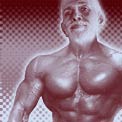
Or take the bodybuilder Frank Zane. Frank thought he could win the Mr. Olympia championship but he was five-nine and Arnold Schwarzenegger was six-four, two-hundred-and-fifty, and the whole movement had been toward size and grandeur, so Frank had to show that small is beautiful. Well, about the time he was starting his quest he met a Buddhist priest who gave him some beads and got him saying
namu amida butsu ["I take refuge in the Buddha of Compassion"]—you know, the
Nembutsu mantra? And he took a vow that he was going to do one million
namu amida butsus before the competition. So he started his training, which consisted of pumping iron, lying in the sun and saying
namu amida butsu. It's a good life! Well, pretty soon he got to a point where the mantra was saying itself—in other words, he didn't have to try, all he had to do was listen to it because by now it was—
AC: Self-generating.
MM: Yes. But what he noticed was that his training was way ahead of schedule. Bodybuilders have to train to peak at the right moment, but he discovered that his body had become more responsive to the intention he had. Well, it's a curious thing, but I found out later on when I first met Frank that at the same time this experience was going on in him, he was reading my novel
Jacob Atabet, which is
about this sort of thing, and by another tremendous coincidence I had seen him
win that Mr. Olympia contest on television one day. Now this was a couple of years before I met him, and I was just channel-surfing—so in other words, I had seen what I'm about to tell you without knowing any of this, and I had been so astonished by what I was looking at that I called out to my wife, "Come and look! I don't believe what I'm seeing here!"
What I was seeing was this guy in front of the audience engaged in this stupendously narcissistic-seeming activity, with his body all greased up, and here he is all flexed up and the crowd going nuts every time he would flex to show a different configuration. And he was beaming and emanating in such a way that I said to my wife, Dulce, "Look at this! Isn't he in an astonishing state of mind!" So that stayed with me.
Now Frank tells me the following story: The day comes for this competition, he says, and this
namu amida butsu thing was going so much that he was simply in a constantly exalted state, and he knew he was going to win. Before the competition they have a drawing, and everyone goes and draws a number out of a hat. So he draws a number and it was the number one.
AC: Wow.
MM: And he knew instantly that it meant three things. First, of course, it meant he was going to be the first one to come out and do his stuff; the second thing was, it confirmed his sense of the ultimate oneness of all existence; and then the third meaning was that he would win—he would be "number one." So he was going to come out first, he was going to win, and it confirmed his sense of oneness. Anyway, he went out there and he says that the first thing that happened was that his consciousness seemed to go to a point about a foot above his head, and he had never had that experience before. That's a feature, you know, of many people's ecstatic moments, or
satori [awakening] experiences, that experience of kind of going up above the head; it's not necessary, but it's a curious thing that it happens a lot. And the other thing he said was that he and the audience were absolutely
one.
AC: And it was this extraordinary moment that by coincidence you had watched on television?
MM: Yes, I had witnessed it! And another very fascinating thing had happened, too. I'm very much interested in a particular feature of integral transformation, which is the appearance, in a radical form, of these
siddhis—or in the Catholic tradition, the charisms
—you know, these are the special powers. In the Sufi tradition, they're called "the adornments of the man of light." Now, you can take different attitudes toward this, but one of the things I wanted to talk about today is the relationship of these
siddhis to enlightenment because they are, to me, part of the connection between self-mastery and enlightenment. In any case, one of them that has been recognized in every tradition is that there is sometimes this emanation of light either from the body or from some part of the body of the enlightened person. Well, when I had shouted to my wife to come look, I swear to God, Andrew, his body was giving off—and they were visible to everybody—these emanations of light! Now Frank and I have discussed this—in fact, we did an interview about it in one of the muscle-building magazines—and he tells me that it was in fact debated afterwards whether this was perhaps caused by the floodlights being jiggled and the vibrating light bouncing off his greased-up body, or whether the light was actually
coming from his body. It was
discussed afterwards!
And I saw it!
Now this is a longer story, and it goes on, but maybe I've told you enough to make the point that all of these marks of what I call "integral transformation" were there in that experience that Frank had. In other words, as you rise to the further reaches of self-mastery, those marks of enlightenment which are called
siddhis, charisms, adornments, appear. And for me, this is evidence that the world
wants integral transformation or, if you will,
integral enlightenment. That is the flowering, in all our parts, of all our attributes, of all the various capacities we have, of this latent divinity—do you see what I mean? And that's why I take great delight in your question about the relationship between these two—because I think that what's dawning on the world is the
perception of integral transformation, or integral enlightenment. In other words, that all our parts are meant to have the opportunity to grow into this, to exhibit it, to unfold; and that's where this cascading effect of grace or the momentum of grace operates because it carries us beyond what we intend. That lady only wanted to play a good round of golf and she got this illumination, you see? Frank Zane mainly wanted to win the Mr. Olympia contest, and instead he got all of this other stuff.
AC: Was this woman's relationship to life transformed forever as a result of that experience?
MM: Well, you know, I don't know, Andrew. I get these letters from folks, and I've got a whole file full of them; but I haven't followed up on their lives, so I can't tell you.
AC: You see, I'd agree that through these extraordinary feats or experiences, or just through the practice of self-mastery, many people do seem to find access to extraordinary being, to extraordinary depth and mystery—that they can be catapulted into a perception of reality that was hitherto unknown. In terms of our definitions, though, one distinction I think we could make between self-mastery and enlightenment is that in enlightenment, one has come to that point where one is at least to some degree anchored in the ground of being, and that as a result of being anchored there, there is some permanent shift—something has happened that is irrevocable—versus, as a result of having done some kind of practice, finding oneself catapulted into an extraordinary state, an extraordinary experience, an extraordinary revelation, only to return once again to an ordinary state.
MM: Well, my observation of life is that for most people it's the latter. They have a moment of illumination and then they return to their ordinary state. To get anchored in a primal recognition of who we really are as deep Self,
Brahman, or however we want to talk about it—to be anchored in that to some degree and to have a practice that supports it—that's not automatic; and it's not necessarily true that people
do follow up on these experiences. Many of these things come spontaneously, but I firmly believe that to anchor them in our life we need to live life in accordance with the Tao, as it were. At the same time, though, it says in the Bhagavad Gita that it is better to fail in your own dharma than to succeed in someone else's, and while I do think there's a principle of anchoring your practice in who you truly are, the discovery of who you truly are is easier said than done. In these experiences, people typically find access to only a
part of their potential, so I think our best chance lies in what I call "Integral Transformative Practice"—in other words, a practice that is anchored in developing our understanding of who we really are.
AC: It's interesting, though, that the experiences you've been describing occurred as a result of the pursuit of self-mastery. Self-mastery, as I understand it, is cultivated through the consistent development of greater and greater control over the body, mind and senses. And some Self Masters tell us that a profound experience of freedom and a deep sense of fulfillment can be attained, as your examples show, directly as a result of developing such control. At the same time, many of the great enlightened
masters, ancient and modern, have told us that true fulfillment and real freedom can only be realized through unconditional surrender to the great mystery of being
itself.
"Thy will be done," they say, in the end, is the only door through which final liberation can be found. So what do you think? Can the path of self-mastery—the path of greater and greater control over the body, mind and senses—ultimately bring us to the state of perfect fulfillment and an experience of profound inner freedom? Or, in the end, do we have to be willing to relinquish any notion of control in order to become fulfilled and win our own perfect liberation here on this earth?
MM: Well, as I implied in my previous answers, it's "both/and." Because you've got to set the table for the heavenly feast, and setting the table involves work, you know? But then, also, you have to be able to make this tremendous surrender. I should repeat, though, that I've been thinking of self-mastery as being typically limited to a particular set of skills in some domain—not, in other words, as an ultimate program of development in the sense of religious practice.
AC: That's an important distinction.
MM: Yes, but to me, you see, part of the wonder of this, and more evidence of what the world is about—what the
secret of this world is—is that we also have this possibility for integral transformation, and that even someone who has got only a very limited notion of mastery can stumble onto this secret. So the important point is that if they don't have a philosophical context for it, if they don't know what to
do with it, then they'll lose it.
AC: Because they don't know what it means?
MM: Right. Or because they don't have a practice that is sufficient to cultivate or to open them to what has been given to them. Human beings are creatures who mainly look a gift horse in the mouth. That's what most of us are doing all the time. It's been given to us, and we're just turning away. And I'm the worst offender, by the way. I'm not putting myself above anyone else. I know whereof I speak.