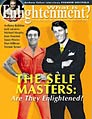
WIE: What is your definition of "self-mastery"?
Dan Millman: Self-mastery involves recognizing what we are
not responsible for—the thoughts that enter our mind and flow out, and the emotions that pass like the weather—and what we
are responsible for, which is our behavior. My view of self-mastery focuses on acting with kindness whether or not we're in the mood, based on three principles: Accept your emotions; know your purpose; and then do what needs to be done—whether or not you happen to feel like it at the time.
You see, we humans are filled with tendencies. We tend to be lazy or to overwork. We tend to let our emotions drive our behavior. We tend to indulge or to deny ourselves. We tend to be passive or aggressive, lackadaisical or obsessive, to act without thinking or to think without acting. We tend to deny or avoid dealing with problems until the eleventh hour or a crisis. We tend to be self—centered, defensive and resentful.
Daily life—spiritual life—tests us, teaches us, challenges us to transcend our tendencies by observing the consequences of our actions; it's a natural, evolutionary process of living and learning. And self-mastery occurs in those moments when we subordinate our little will—our personal tendencies and preferences—to the dominion of our higher will, higher self, higher integrity or higher ideals. It's a conscious movement from "What's in it for me?" to "What will serve the highest good of all involved?" George Bernard Shaw put it well when he said, "Forget about likes and dislikes. They are of no consequence. Just do what must be done. This may not be happiness, but it is greatness."
WIE: And how would you define "enlightenment"?
DM: Arbitrarily we can say that there are two realities: a transcendent reality and a conventional reality. For example, the idea that "we are all One" is certainly not true from a conventional viewpoint. If I stub my toe, it doesn't hurt you. If I have a feeling or a thought, you may not have the same feeling or thought. So conventionally speaking, we're separate individuated beings, physically, emotionally and mentally. But transcendentally speaking, from the viewpoint of higher truth, we're one awareness shining through all these different gift wrappings, these different eyes. At that level, we're One. So there are different truths operating at these different levels.
Now if we're talking about enlightenment, traditionally speaking, it's a transcendent matter that has nothing to do with fixing one's personality, making things work, succeeding, reaching worldly goals, or even with achieving self-mastery. It's realizing
who we are, and it's been described in many different ways, such as seeing life from the bigger picture, from a viewpoint at the ends of the universe, through the eyes of God—or as a sense of communion, unity and freedom. But really it's beyond words, which is why it's been described in so many different ways. Lao Tzu said, "He who knows does not speak. He who speaks does not know," because we can only point to it. And I've had glimpses of that transcendent state.
But I would add to that cosmic or transcendent view of enlightenment beyond the mind, the body and the world—which has been described by too many people with great credibility to be denied—that I see life as a series of moments, and I often say I've never met an intelligent or neurotic or enlightened being; I've only met people who have more intelligent, neurotic or enlightened
moments. I've also studied with different masters who were acknowledged by many to be enlightened—or who had declared themselves so and seemed to manifest many capacities that might be equated with that state. And having seen them in what struck me personally as some pretty
unenlightened moments, I think it's more realistic to say that we have a responsibility to realize and live that state from moment to moment rather than thinking that we'll just have an experience and say, "From now on, that's it. I'm enlightened."
WIE: You seem to be suggesting that while enlightenment is in one sense beyond this world, it also must be lived in
this world in a very practical way. From that perspective, what do you see as the relationship between enlightenment and self-mastery?
DM: The Indian saint Ramakrishna once said: "If you try to open a walnut when the shell is green, it's almost impossible, but if you wait until the walnut is ripe, it opens with just a tap." I see the quest for self-mastery as more of a conventional thing we can do. It occurs in the context of everyday life and involves our functional human capacities—our will—and can lead toward the realization of our human potential. I see it as a stage of preparation or ripening. But self-mastery in itself has nothing to do with enlightenment if by "enlightenment" we mean the transcendent state, because I believe that comes by grace. At some point somebody or something, or God working through somebody or something, provides the tap and takes all the credit, but I think
life has been the ripening process, perhaps to help prepare us, to open us. There's a proverb that goes, "There's God, and then there's not paying attention." And what I often mention in my seminars is something Rabbi Hillel once said: "There are three mysteries in this world—air to the birds, water to the fish, and humanity to itself." We're immersed in spirit all the time, whether we call it "God" or "spirit" or "beauty" or "inspiration." It's not like the weatherperson says, "Twenty percent chance of rain, forty percent chance of spirit today." It's always here but we don't notice it. We don't commune with it because our attention is trapped in, "How am I going to pay for the car repair, get to the appointment on time? How am I going to deal with my relationships and emotional issues, my physical issues, my body?" and so on. Our attention is trapped in those areas, and I do think that through mastery of self, our attention becomes more free to notice God or spirit or beauty, and in that sense, it's a ripening process. But I don't say it happens step by step, as in, "Go through this ripening and then you will be guaranteed at the end that, bingo, you will have enlightenment."
There are people in the traditions who have apparently been very ordinary people—and then something happens, as with the Indian sage Ramana Maharshi, for example. And there have been others like him in the various traditions. So I don't think self-mastery necessarily leads to enlightenment. But there are laws of reality I've learned from my athletic training, and one is that if you prepare well, you're more likely to open up to something more. But there are no guarantees. Michael Jordan cannot control whether he makes a basket; he's missed shots. But he can control whether he takes a shot. And that's the best we can do—is to take the shot. And doing so greatly increases the likelihood of making the basket. So life involves work; it's difficult. St. Augustine once said, "Lord, I pray not for a lighter load but for stronger shoulders." I think daily life can give us stronger shoulders.
WIE: Your new book is called Everyday Enlightenment.
Is the "everyday enlightenment" that you've written about the same as or different from the ultimate spiritual realization described by the world's wisdom traditions?
DM: Different from—I would not claim it's the same. There are two great schools of thought operating in our world, it seems to me. And they've been operating since the time of the ancient Greeks and even long before. There's the idealist school and the realist school. The churches, for example, tend to be more idealist. The Catholic Church isn't wrong in its dictums, it's just idealistic. To tell young people, "Just abstain from sex, just don't do it until you're married," is probably best—at least until they're in a committed relationship. But are they going to do it? No. So at the same time as you're telling them that, I would say, "Here are some condoms in case you're going to engage." So it's "Trust in God but tie your camel."
Similarly, some people gravitate to the idealist view that we should wait for genuine enlightenment, for the transcendent, cosmic realization of God, of unity with all things. That's fine, but people can go lifetimes waiting for that and not pay a great deal of attention to what they're doing in the meantime. When I refer to practicing "everyday enlightenment," I'm speaking about actually consciously asking, "How would an enlightened being act in this moment?"—and then acting that way. Some people say, "You mean pretend? Pretend I'm enlightened?" And I say, "Yes. It's like pretending." I give the example of a shy, young boy pretending he's confident and asking a young lady to dance, or a soldier who's terrified, yet pretends he's courageous in saving a comrade under fire. Those are pretending, too. And I think that in that way we can pretend to be an enlightened being, and find our breath relaxing and our body relaxing and opening, and find ourselves smiling, even though our internal reality is that we might be bummed out about something. We might have depressed emotions and still smile at somebody and do a kind deed because that is what an enlightened being might do in that situation. Of course, we can be wrong. We could end up as a caricature like Kwai Chang Caine on the
Kung Fu TV series, thinking that enlightenment means always acting blissful and talking in a certain way. There is that danger. There is that risk.
So I don't believe "everyday enlightenment" is the same as enlightenment in the ultimate sense. But everyday enlightenment is a good practice to adapt our bodies and minds, to prepare them, to make them more transparent, to become a servant, while we're waiting for our insides to be filled with light. That's what I'm saying. And neither am I giving some cheap pop psychology definition of enlightenment for my own convenience. I think the view that we can play the role of an enlightened being is a very meaningful one. It's not a matter of going around saying to people, "I'm enlightened." As I wrote in my book, saying "I'm enlightened" doesn't make one enlightened any more than saying "I'm a pineapple" makes one a pineapple.
So to me this is a very realistic practice of enlightenment rather than an idealistic waiting for that state. Meanwhile, we can talk about that state, work toward it, think about it, dream about it, do exercises we believe will help open us to that state—and there are lots of those, mostly Eastern, but a few Western. But in fact, I've been so presumptuous as to state that the highest practice any human being can do is the practice of everyday enlightenment I've just been describing. And the reason I say that is that it incorporates any other practice one might do. If one's meditating, one can say, "How would an enlightened being meditate?"—and meditate that way. It's based on the fundamental presumption that we have control over and responsibility for our behaviors. One question I ask people is: "Would you prefer to live with someone who's enlightened who behaves in a crazy manner, or someone who is crazy who behaves in an enlightened manner?" I don't have an answer to that but it's an interesting question.
WIE: One of the things we've observed in the course of our exploration for this issue is that individuals who have attained either self-mastery or enlightenment always seem to emanate an extraordinary degree of confidence, a sense of being unbound by limitation. In those who have "mastered themselves," that confidence seems to arise from the discovery that they have the power to break through seeming limitations and do things they never imagined they could, the discovery of an overwhelming sense of "I Can." In enlightened individuals, on the other hand, that confidence seems to arise not from the discovery of their own personal power but from the deep, mysterious and life-changing realization of their essential unity with the very ground and source of all existence—a realization not of "I Can" but of "I Am." What do you see as the difference between the confidence of the Self Master and the confidence of the enlightened person?
DM: Well, I think one kind of confidence is conditional and the other is unconditional. One is confidence in self, small "s." The other is confidence in Reality or God, or spirit working in, as and through the "self," which is a very different kind of confidence. I'm not a big fan of self-confidence courses.
Enlightened confidence is not based on a great self-image or confidence in one's capacities, but in an ultimate trust in whatever happens, and a complete unconcern over whether one is liked, because one rests in the knowledge that one is loved, and that in fact, one
is Love. Most of us, though, just want to feel good about ourselves, want to feel self-esteem and like ourselves and feel confident. And as I've emphasized in
Everyday Enlightenment, for most people, even their "search for enlightenment" is motivated by the desire to feel good: "When I'm enlightened, I'll feel happy and I'll feel good."
However, I have learned from sports that if there's something you don't believe you can do, about which you're filled with self-doubt, and then you find out you can do it, it may generalize out to other things and you'll say, "You know, I didn't think I could do that last thing but I just accomplished it. Maybe I can meet this next challenge, too."
WIE: How does this distinction between the realization of "I Can" and the realization of "I Am" accord with your own experience?
DM: Well, first of all, although I have had some profound experiences and realizations, and have seen the bigger picture of life, I do not describe myself as an enlightened being. I can't talk about my enlightened perspective in terms of identifying myself with one of those transcendent realizations, or being able to live that realization from moment to moment—although I am
practicing enlightenment.
But regarding the idea of self-confidence—this "I Can"—there's something about it that I think is certainly nice enough from a conventional viewpoint. I think it's healthier for people to be able to say "I can," and to go for things, than to say "I can't," and not. I think it was Henry Ford who said, "Those who believe they can and those who believe they can't are both right." I think it's probably a positive thing in daily life to tackle things. But that's just not in the same ballpark as having a deep confidence based on the essential sense that our souls rest safe and secure in the arms of Spirit. But at the same time, I don't necessarily want to use the words "I Am." I don't relate to it that way. To me, what matters about human life on every level but that transcendent moment of realization is what we
do. There's a lot of New Age talk about
beingness.
Being. Don't
do. Just
be. And I say, "What is
be? What does that mean?" Everything that has been accomplished by human beings involves human
doings. So while a lot of people relate to that "I Am," I don't. I just don't know how to respond to those words. Still, I do believe that the cosmic, transcendent state of enlightenment is the ultimate goal and endpoint of human life and human existence.
WIE: You do?
DM: Yes. And that may be what differentiates us from the animals—that we have the consciousness to realize that state. But I know people who are seriously, earnestly working on the Eastern solution, which is going inside, meditating, doing spiritual practices. Their brows are knitted, they're working, so one day, maybe in this lifetime or another lifetime, they might achieve that state. Meanwhile, they're not paying attention to their kids, their finances are down the toilet and they're not functioning very well in life. I think enlightenment is on God's timetable, so while we're waiting for that cosmic state, we might as well spend our time well and live as kindly as we can and live as many enlightened moments as we can, even if we know it's pretending. To me the question is: What do we do in the meantime, while we're aspiring? Do we live well? Are we kind to other people? Do we pick up litter on the street?—which I do, and I don't know how my words impact people, but when I leave a city it's a little cleaner. Little things like that matter.