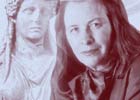
Jean Houston
"I would never use the word 'mastery'! I thought I'd tell you that right away. . . . To me, it smacks of galloping chutzpah!"
This was Dr. Jean Houston's response at the very beginning of our interview, before I had even begun to explain what we meant by "self-mastery" and why we were so interested in exploring the relationship between self-mastery and enlightenment. And we were off! Like a thoroughbred racehorse breaking out of the gate at the crack of the gun, Houston was a rush of churning energy, exploding outward, swirling upward, full of color, imagery, dynamism and personal tales that seemed larger than life, mythic, heroic.
We had wanted to interview Jean Houston for this issue of
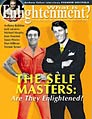
What Is Enlightenment? because of her outstanding and groundbreaking work in the field of human potential. A great thinker, with an extensive background in research on the human mind, creative capacities and emerging social patterns, Houston has proven herself to be one of the most independent philosophers of our time. Central to her work is her exploration of the mythic hero's journey. She has studied the significance, impact and evolutionary effects of mythic lore across many cultures, so we wondered: What would a philosopher like Jean Houston have to say about the modern-day superheroes we are calling the "Self Masters"? What would she think about their prescriptions for and conclusions about life? What does she think they have to teach us? True to our expectations, she had many fascinating things to say but, to my surprise, they were not at all what I had anticipated while preparing my list of questions for her. "I just don't think self-mastery exists," she began, and we proceeded from there.
Houston began her formal research on the nature of the mind in the 1960s when she was only twenty-one, in a government-sanctioned study examining the mind-expanding effects of psychedelics, but her curiosity about the outer edges of our potential and her precocious character were always a part of her nature. Half Sicilian, half Scottish, Houston's variegated ancestry includes not only Robert E. Lee and Sam Houston (the founder of Houston, Texas), but perhaps one of the only Jewish Native Americans—with the unlikely name of Scarecrow Rosenblatt. Daughter of a stage actress and a brilliant comedy writer who helped to create the Abbott and Costello favorite
Who's on First?, Houston spent most of her first eleven years traveling while her father wrote for touring comedians, including Jack Benny, Bob Hope and George Burns. He encouraged the quizzical and outspoken spark in his daughter, which at times got her into hot water, such as when her exasperated first grade Catholic school teacher informed her that she had chalked up a total of 300 million years in purgatory for asking questions like, "Sister Theresa, I've been wondering, did Jesus ever have to go to the bathroom?" Houston's life seemed charmed from the start; her stay in the hospital incubator after her premature birth was indirectly sponsored by the great Henny Youngman—he bought 350 jokes from her father, which paid the bill!
Dr. Houston has been a tireless and innovative researcher, documentarist, philosopher, psychologist, student and teacher of techniques to expand our creative capacities for almost forty years. She travels around the world on a virtually
impossible schedule, logging as many as 250,000 miles in a single year. In the three weeks during which I tried to schedule our interview, she crossed from coast to coast three times to teach weekend courses at her Mystery School in upstate New York, participate in and then present the concluding talk at the Gorbachev Foundation's State of the World Forum in San Francisco, host a radio show, cook a gourmet meal for her family and staff, and so much more. Her travels have taken her to remote cultures from Burma to Morocco, where she has learned the myths of the indigenous peoples and shared her own tapestry of knowledge with them, a tapestry woven with richly hued threads synthesized from her encounters with some of the most outstanding individuals of our time. She has presented her work in over forty countries and been a consultant to the United Nations, UNICEF, CEOs at Xerox, General Electric and Kraft corporations, as well as to First Lady Hillary Rodham Clinton. In 1966 she and her husband Robert Masters established the Foundation for Mind Research, and in 1984 she founded the Mystery School, an annual, nine-month-long program where students practice various exercises designed to increase inner awareness and creative capacity; and in between, she has authored sixteen books.
If Jean Houston's life seems mythic,
it is—in fact, that's how she views everyone's life. An integral part of her approach to cultivating our human potential is seeing our experience as part of a larger story, seeing the patterns of the great myths in our own journeys. This takes us out of what she calls the "personal-particular" and puts us in touch with the "personal-universal," lifting us into a higher and more impersonal view. In one of her recent books,
A Passion for the Possible, she writes, "How we view our life as a story often determines how life treats us. If we see our life as a trivial story, we fall easily into inertia and defeat. Seeing our life as a larger story puts us back on our feet and helps us get on with living."
When I first saw her teach at the Community Church on 35th Street in New York City five years ago, Houston exuded the very stuff that myths are made of. Her talk billowed out of her, wrapping us in participatory imagery, taking us on mythical journeys to expand our horizons, our view and our perception of the context in which the real events of our lives take place. Houston has unusual presence—dramatic, earthy—and an impressive confidence, independence and sense of purpose. Many of her exercises center on discovering and accessing different "selves" within us. Her emphasis on "orchestrating our many selves" is, significantly, not an excuse for mediocrity or a license to indulge. Instead, she wants us to access all of our talents and abilities to serve a purpose greater than ourselves. She is driven by a geyser of energy, by a deep sense of urgency to make our lives count, and it is this passion that she is committed to awakening in others. Deeply concerned not only about our inner selves but also about the state of the earth and our frighteningly destructive capabilities, Houston earnestly proclaims, "
These are the times and
we are the people."
So what did this dynamic woman have to say about the Self Masters—individuals who aspire to excellence and who call us to take action? It turned out that the very intimation of anything to do with a will-driven sense of progress was as inciting to Houston as a matador's
muleta to an excitable bull. In effect, Houston would have nothing to do with the term "self-mastery," nor with the concepts that it generally represents, preferring instead to reinterpret the central questions of this issue of
WIE in light of what she refers to as a "process-oriented" approach. "My problem with those who
will themselves to a certain end," she explained, "is that they lose access to the coding." She feels that in order to realize our deeper potential, we must come into touch with the timeless secrets of life, with the universal stories that she believes are "coded in our inner selves." In Houston's view, the deepening of our potential does not come about through striving and achievement but by accessing "the congregation of personalities within us" and "evoking the many different levels of the possible human." In this, what she calls "a more feminine view," differences are validated and one finds oneself in a large, warm, chaotic nest of possibilities, voices, timbres—a very different place than the singular goal of the Self Master.
The interview that follows provides a fascinating insight into the views on mastery and enlightenment of a woman sometimes called a "midwife of the soul," one of the greatest contributors to the contemporary human potential movement.





 printer friendly
 email the editors
 advertise
 reprints