Ajja
Every other year at the Vivekananda Kendra Ashram outside Bangalore, India, a conference is held entitled "Frontiers in Yoga Research and Applications." The theme is always the relationship between science and spirituality, consciousness research and the medical applications of yoga. On my first visit I didn't know what to expect, but on my second, as an invited speaker on "Enlightenment," I knew that at this conference
anything was possible. At this event, where the mundane and the sacred meet and intermingle on so many levels simultaneously, a most unusual cast of characters comes together in a kind of soup that only Mother India could cook. But in spite of knowing this, when I returned to southern India last December I had no idea that I would have the rare opportunity to spend time with that most precious gem—a fully enlightened
jnani, one who has realized the SELF ABSOLUTE.
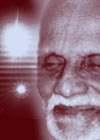
Ajja, or "grandfather," as he is fondly called by all those who know him, is a living example of the extraordinary spiritual legacy of India, and his personal story is as strange and mysterious as it is miraculous. Born in 1916, Ramachandra was a wealthy farmer and landowner who, although he expressed no particular interest in matters spiritual, was said to be naturally possessed of unusual purity of heart and rare simplicity of being. One day at the age of thirty-six, for no apparent reason, Ramachandra was struck by a terrible pain in his heart that gradually moved to encompass his entire body. For six months he bore what he describes as excruciating physical pain, and all the while his family tried desperately to find what it was that was causing him to suffer so. Their efforts proved to be fruitless, as no one could find the cause of his torment. Then, as suddenly as it had appeared, the pain vanished, leaving no trace. Although previously he had not been a deep thinker, this experience provoked an intense inquiry within him that lasted, we were told, for several months. "What was this pain that had been torturing my body?" he asked himself. "What was
bondage? What was
liberation?" Because of his simplicity and the purity of his mind, he was able to go to the very root of these questions in no time at all. What he found in his investigation is that
pain is bondage, and that the root cause of bondage is
karma. Karma is created by mind, he realized, mind being all thoughts that are concerned with the
small self. On the last night of his inward inquiry he asked himself: What is the root of worldly possessions? Of money?
Money, he concluded, was the most important thing in the
world, and all fear and insecurity are rooted in attachment to
that.
In that instant he experienced a powerful vision that was both glorious and terrifying. Before him there appeared an extremely beautiful woman whose entire body was red and who, to his horror,
had blood pouring profusely from her mouth. He recognized her to be
death incarnate. And as he beheld her for some time he had a powerful insight. The root of money, he realized, was
possession. And possession, he realized, was
death. Then the female form vanished and a door appeared, at which point a final inquiry began within him.
"Who am I?" he asked himself. The door then opened and
he left his body through the top of his head. He was met by "divine entities" that guided him further on his journey to what he calls the
"third level." During this entire process, which took place in the middle of the night, he was lying on the floor in his room, apparently physically dead. All the while, Ishmael, a Muslim farmer who was destined to become his closest devotee, was sitting by his side, commanded, we were told, by the unknown to look after his body.
Then, a ball of light appeared and hovered near his inert form—and then entered it.
As the light entered Ajja's body he opened his eyes, and the first words that he uttered were,
"The one who was here is gone—someone else has come." He continued,
"I am not the body, I have no mother, I have no father. I am that brightness."
For the next three months he sat quietly in his house as a profound silence within him grew in intensity. As his mind was gradually adjusting to his new condition, he became so sensitive that even the slightest sound was completely unbearable to him.
At the end of this period he emerged from his house, utterly transformed. Completely intoxicated, he would wander naked, at times dancing and singing for hours in the rain, and at times staring endlessly at the sun. He slept on rocks and under trees. His family thought he had gone mad and finally committed him to an asylum. When the doctors asked him what his name was, he replied,
"I have no name." When they asked him where he lived, he replied,
"Everywhere." After two months, the doctors determined that he was not mad and released him.
He spent the next twenty years as a roaming
avadhuta [one who has cast off all concerns], so deeply immersed in the consciousness of the SELF that most of the time he seemed to be oblivious of the world around him. Ishmael, now his constant companion, looked after the needs of his body. Then, in 1961, when he was in Rishikesh, in northern India, he heard a voice that called out to him,
"Come to me. You come to me. I am here in Ganeshpuri." Responding immediately, he went to Ganeshpuri to see the legendary Swami Nityananda, with whom he spent only five minutes. Not a word was uttered as they stared into each other's eyes. It was this meeting that enabled Ajja to "come back to earth," and soon after he began to wear clothes again and to converse with others.
Back in his small village, he continued to spend most of his time in complete silence. Seven years ago the famous pundit Bannanje Govindacharya was giving a talk about Vedanta in Ajja's village, exhorting the people to "go within!" Ajja, who was listening, followed his instructions to the letter. It was then that the pundit discovered him because Ajja, upon going into
a mystical trance, fell down. When the pundit went to him and asked, "What happened to you?" he replied innocently, "You told me to go inside. I went inside."
Govindacharya recognized Ajja's experience to be in accordance with the Upanishads [the classical scriptures of Vedanta], and as a result of their meeting, which has grown to be a warm friendship, Ajja's reputation as a living master of Advaita or nonduality has begun to spread throughout Karnataka state in southern India.
It was early evening at the conference when Ajja began to speak simply and unpretentiously about the nature of our true identity to a mostly Indian audience. His utter vulnerability was almost painful to behold, and he seemed to be uncomfortable and even slightly suffocated by the role that he had been thrust into, sitting in front of a large number of people. Speaking slowly and deliberately, his words were simple and penetrated deeply to the core of
Being. He spoke of unimaginable bliss and of transcending the mind
completely. He described tremendous energy moving in his spine and the great importance of one-pointed desire for
moksha, or emancipation. Again and again he emphasized the absolute necessity of stilling the mind in order to experience directly that which lay beyond it. As he spoke, his authenticity was made apparent more by how he was than by what he said. This was a man who seemed to have no face, no name and most striking of all, appeared to have
no mind or personality in the ordinary sense. His discomfort with the spoken word was obvious and he continually repeated that "one cannot speak about these things"—they can only be understood through direct experience. To my surprise, who Ajja was seemed not to be apparent to many people in the audience, as some aggressively demanded proof from the gentle man that he was genuine. To make matters worse, some of his ardent devotees began to declare aloud in no uncertain terms that their guru was a living example of the highest attainment described in the Upanishads. A circus-like atmosphere was soon created that spread throughout the crowd. In the midst of the chaos, Ajja chose to remain silent.
Later in the evening I went with a few of my students to meet Ajja in his room. When we arrived, he was on the receiving end of piercing questions from the renowned physicist George Sudarshan who, in addition to having been a candidate for a Nobel Prize, has also been intimately associated with the Maharishi Mahesh Yogi and the great
J. Krishnamurti. "Ajja," the physicist asked, "When two people are standing side by side, gazing at the moon high up in the night sky, why is it that one experiences intense curiosity as to why things are the way they are, and the other has no curiosity at all?" Ajja replied in the way that he answers many questions, "You have to have the experience.
Only then will you be able to understand." The physicist would not accept Ajja's response, claiming that anybody could say that, that Ajja was avoiding the question and that it was simply not an acceptable answer. I found myself going back and forth between two completely different impressions of what was occurring. On one hand, I was impressed with the physicist's courageous unwillingness to accept anything less than a direct answer from an enlightened man. On the other hand, I couldn't help but be equally impressed by Ajja's striking equanimity. Even though Ajja appeared to be unable to respond directly to the question, I was touched simply by the deeply vulnerable nature of his
being. It seemed ironic to me that while the physicist appeared unable to perceive the greatness of the man who was sitting in front of him, neither could Ajja recognize why his own response to the physicist was so unreasonable.
I visited with Ajja on two more occasions, traveling from the ashram where we were staying, half an hour's drive outside of Bangalore, into the city, where he was staying at the apartment of one of his devotees. Attempting to "interview" Ajja for this issue of
What Is Enlightenment? proved to be more challenging than we had anticipated. Being a man so deeply and utterly absorbed in the nondual nature of his own self, he finds any question that in any way requires the consideration of a subject/object relationship almost impossible to comprehend.
Upon leaving Bangalore after our first three-hour interview with Ajja, we were amazed and deeply touched, but also slightly confused. There was no question in our minds that we had just been sitting in the company of a profoundly enlightened man whose "state" or "attainment" was undoubtedly extremely rare. And it became very clear after spending only a short period of time in Ajja's intimate presence that he was one who had left this world and everyone in it far behind a long time ago. But there were some strange tales from his devotees: one was that Ajja was in fact the reincarnation of Mahatma Gandhi. We were told when Ramachandra left his body through the top of his head, the great saint, pacifist and revolutionary's soul entered Ramachandra's empty vessel. "Only in India!" I thought to myself. We were also informed that Ajja had the clairvoyant ability to reveal to others who they were in prior births—but when he did it almost always turned out that in their prior birth they had been foot soldiers in Gandhi's revolution. So on our second visit, I forced myself to ask him if what we had heard from some of his devotees was true. Was he the reincarnation of Mahatma Gandhi? To which he replied, "What I experienced was Universal Soul." But this question was never completely resolved, as Ajja still made room for it to be true, even if only in other people's minds. "We cannot see our own face," he added, "that is left to others."
In the end, more than anything else, what I was profoundly moved by was this extraordinary man's
utter emptiness of a personal self. Indeed, he does seem to be a literal example of one whose mind and body have become a truly empty vessel through which that
One without a second shines through, untainted by even a trace of individuality.





 printer friendly
 email the editors
 advertise
 reprints