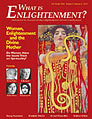
Daughter of the Goddess


An interview with Z. Budapest
by Susan Bridle

 
introduction

This issue of  What Is Enlightenment? would be incomplete without considering the women's spirituality movement and the contemporary pagan and Goddess religions with which it is closely aligned. Modern paganism, loosely based on prepatriarchal Old European myths and traditions, is one of the fastest growing religions in the United States today. It attracts both men and women who feel suffocated by Christianity and who want an alternative to the patriarchal values of domination which have proven so destructive to our planet's ecology and to many of the world's peoples. Worship of nature and a Goddess or "Great Mother" figure are often associated with pagan practices and rituals, and many women's groups have formed in recent years to celebrate a female deity and to create a new religious culture that empowers women.

Zsuzsanna Budapest, better known as "Z," is a passionately committed feminist who sees Goddess religion as a crucial ideological and psychological support to the work of feminism. She is considered to be one of the founding mothers of the women's spirituality movement, and coined the term "feminist spirituality." She is the author of
 The Holy Book of Women's Mysteries, The Grandmother of Time, Grandmother Moon, The Goddess in the Office, and  The Goddess in the Bedroom. A High Priestess within her tradition, she leads Goddess-centered retreats and celebrations throughout the year.

From the moment we began our conversation, Z was utterly unapologetic and often outrageous. I found myself in a refreshingly frank dialogue with a woman who has vigorously rejected the constricting ideas that women should be sweet and meek, seen but not heard. In complete accordance with her about many of her observations, I respect her willingness to look squarely into the painful effects of patriarchy on the race as a whole, and for women in particular. Z is undaunted in her efforts to liberate women from the life-inhibiting conditions that we still confront in so many ways in the world today. Yet at the same time, in speaking with her, I wondered whether the women's spirituality movement, in its reaction against what it sees as patriarchal religions' imbalanced emphasis on transcendence, goes too far in the other direction. And while the feminist critique of patriarchal religions is valid and valuable, I wondered if it overlooks the true spiritual impulse that is the source and inspiration of those traditions.

Though left with questions about her views, I couldn't help but delight in the opportunity of speaking with this remarkable woman. Z approached this interview with the same unbounded passion and generosity of spirit that characterizes her work. I was affected by her fiery independence and natural confidence, and immediately understood why she has inspired countless women to fight for their own self-respect and personal freedom. Despite our differences, we engaged in a lively and penetrating discussion that is exactly the kind of dynamic exploration that
 What Is Enlightenment?  is all about. And Z seemed to enjoy our dialogue as much as I did. At the end of our conversation she told me with her customary directness, "You've been a wonderful, challenging interviewer, I must say. These interviews usually bore me to death."



interview

WIE: What would you say defines women's spirituality as distinct from spirituality in general?

Z. Budapest: Women's spirituality is Goddess-centered. That is a revolutionary idea because all the reigning religions are male-God-centered. And the values taught in those religions are jealousy, possessiveness, exclusivity, obedience, guilt, punishment, fear. They are mostly fear-based religions. When you find a male God you find fear. They're sort of synonymous. In turning it around and saying all children come from the Goddess, then we're all equal, there's no reason for fear, there's no punishment, there's no judgment, there's no possessiveness or exclusivity. It's inclusive in that all come from the Goddess, and it's female values, which is the children are all equal.

WIE: Do you think that the spiritual path or process is inherently different for women than it is for men?

ZB: Well, I don't think the spirit has gender. I do think, though, that once the spirit is manifest in a physical body and therefore acquires a gender, spirituality becomes maybe less important for men than it is for women. And the reason I'm saying this is because men are just not that interested in consciousness raising, otherwise they would have created a vigorous men's movement by now that would be promoting it. The first thing that the women's liberation movement latched on to was consciousness. Right away in the early seventies everybody was going to consciousness-raising groups. There is nothing parallel in the men's movement. And there is no political agenda. For the women it immediately spilled into the political arena, it encompassed the entire reality. You don't see a parallel to this with men. And the other thing that is sort of disheartening is that in all denominations—and that is male god, female god, whatever religion you've got—the people who go and promote it and follow it are women, eighty percent, and twenty percent males. Now why is that? Ask why that is and the only answer I can find is that the shoe doesn't hurt that much for men. The women want change and the men just want what men want, mainly making a living and having a wife—which is a big payoff from patriarchy.

WIE: Do you think women are inherently more spiritually endowed or spiritually inclined than men?

ZB: I think in this time and space, in this age of the earth, yes. But it was different in other times. I think back to when we all worshipped the Goddess and the men did not need a jealous and possessive male god to enforce privileges for them. There was once a vigorous fraternity all over Europe dedicated to Pan or Zagreus, the male principle of the universe, who was a joyous guy. He was a party-goer. He played the pan pipes. He was not a rapist, he was not a master and he definitely wasn't a husband. He was an equal with women, and his celebrations were just as numerous and well attended by men as the women's celebrations were by women. And then on occasions when the theme of the season included both sexes, they celebrated together and gave a very vigorous celebration for life. There would be like twenty-one holidays in a year compared to the measly five holidays we have each year in patriarchy.

WIE: It is sometimes said that the paths are many but the goal is one. But recently I've heard people saying that while men seek enlightenment, women's wisdom is about something altogether different—which has even been called "endarkenment."

ZB: Oh, that's bullshit. That's total bullshit and enlightenment is bullshit too. There's no such thing as enlightenment. Transcendence and enlightenment—these are buzzwords for new goals that are hard to achieve. Like it takes you fourteen million years to learn how to levitate, if ever. This is all hierarchy. It's setting up hierarchy and I already smell something funny here: if the women are "endarkening," it's relegating us to the negative. That's just another way of disempowering women after we have worked twenty-five years to get our power, and I reject that totally. It's dualistic, linear thinking pushed into the spiritual realm—and that this is being listened to by someone like you is astonishing to me. How hard they try to disempower women even here where we reign supreme! It's ridiculous.

WIE: Actually, "endarkenment" is a term I've heard women use to describe a connectedness with the body, with the earth. I think what they are getting at is the question of transcendence versus immanence. Because the women's spirituality movement criticizes Judaism, Christianity, Islam and many of the Eastern traditions for a misguided emphasis on transcendence—and instead focuses on immanence. When you speak of the Goddess in your religion, is there a transcendent aspect to it, or is it purely immanent?

ZB: You mean, is any part of the Goddess beyond nature? No, there's nothing beyond it. There's just more nature beyond nature. Everything is nature even if you don't know it yet. A hundred years from now we may learn something new but that was nature all along, we just didn't get it.

WIE: But the path of meditation points to an experience of something that actually does seem to be outside of nature. Something that is beyond change, beyond time . . . the unmanifest.

ZB: The unmanifest is nature too, it doesn't matter. Whatever we in nature can perceive has to be natural. If the Dalai Lama is doing it, it's natural. Whatever the meditation path has come up with is all nature. They just learned a little bit more about nature.

WIE: I'd like to ask you what your own spiritual experience has been and how you've come to know the Goddess and to recognize the Goddess as your spiritual path.

ZB: Well in my case I was born into it. My mother was a witch and an artist, and she created Goddess images out of clay for home use as well as for shows and museums. She had two statues standing on major plazas in Budapest before she was twenty-four years old. She was a psychic, traveled in other realms, was a medium. I grew up with all these possibilities happening around me and it didn't seem unusual. For example, she would pray on the winds and the winds would rise and I would feel them. And she would pray whenever we needed something and then I would see it a little later come to pass, manifest. So for me the Goddess was just a certainty, easy to contact, no need for temples. All you need is to walk out in nature. If you have nothing, just a blade of grass, you pray with that one blade of grass and she will still come. It seemed like a loving, ever present deity who liked to take care of her own, appreciated being prayed to.

WIE: Your situation is unusual—being born into Goddess religion. How did you begin helping other women find a connection with the Goddess?

ZB: Well, my work as a priestess took a lot more growing than just being born into a witch family. Because nobody else I knew other than our family was into this, I distanced myself from it when I left Hungary. And I sort of fell asleep, my consciousness was asleep. I got married very early, at nineteen, to a childhood sweetheart and quickly I started having babies, two sons, and my consciousness was just totally taken up with that. Things were just smooth and fine and clattered along until my Saturn cycle when I turned thirty, and then a big inner shift happened. This inner shift made me very restless and unhappy and I started asking questions like, "What is my role in life? What am I supposed to do?" I hadn't done anything yet. Even though I had two beautiful sons, I didn't value that. I felt like I myself was not created.

Eventually I ran into a demonstration in Los Angles, a women's celebration of getting the vote. That was what the Saturn cycle brought me: feminism. Then I suddenly had names for the pain. I started seeing myself as a woman, and feminism gave me back my womanhood. And I gave back to feminism, in turn, the center of feminism, which is feminist spirituality—which I carried without really having earned it yet because I was born into it. But I recognized that these two things belong together. Without the Goddess, feminism is not going to work, because you're going to burn out. You've got to have spirituality connected with your political aspiration because that's how this animal works.

WIE: So for you, the spiritual impulse or spiritual passion has been fueled by, and is therefore really not separate from, feminism. In your experience they're synonymous.

ZB: Yes, because feminism gives you your womanhood and an analysis of what it's like to be a woman in this time and space. Without feminism, if you think that you are just like a man, that it doesn't matter what gender you are, you are in a huge denial. Because it matters every bit what gender you are in this time and space. If you can accept that and you get to be female identified, then you can start working with the Goddess in earnest. Because then you are her daughter and you can see your reflection in the divine.

WIE: In your Holy Book of Women's Mysteries you speak about a primitive, instinctive, deep part of the brain, which you have called the "Slothwoman," that you teach women to evoke. But what about the ideal that spirituality is supposed to be a movement toward something higher or more sublime or less primitive?

ZB: Male idea, it's totally a male idea. It's a linear thing to go higher up, it sets up duality, it sets up hierarchy. There is no such thing. We are here, this is it. What's higher? You want to go to space? Fine, watch Star Trek. All of this about questing for higher things, these are male ideas. They need quests. You have to give them goals, they are happier that way because then there's an achievement. They can bring out their warrior, they can have clanking of the swords and male bonding. And then they sell it to women as well. The interesting thing is that when these big quests are happening, there are very few men actually following it—it's mostly women who listen to males. And they learn nothing and twenty years later there they are, gray-haired, and they're doing dishes in the same ashrams. It's a pitiful thing. Women must take themselves back from these places. Anything that sets up hierarchy will leave women out, I guarantee that.

Even the Buddhists, who I like—who is the female equivalent of the Dalai Lama? There's always going to be a male chosen to be the top of that particular path. Even though he himself admits that there have been great female Bodhisattvas and adepts, you never know their names. I wouldn't trust something like that with all my heart and soul, would you? They are so seductive. It's wonderful to applaud these splendid males in their robes. They are not violent, they are not going to hurt us, they want something good. Females like to see males like that because it makes us feel better, it makes us forget that every minute a woman is attacked in this world, either raped or killed by somebody near and dear. And trafficking in women is on the rise in Asia, where Buddhism is practiced, where Hinduism is practiced. You have to look around with open eyes and see behind those good books, because everybody's holy book is a very good book. Nobody's holy book says it's O.K. to traffic in children. But when you actually see what effect this religion has had on people, then you see what the power of this religion is. Can it transform society? Can it create a better world? And then you ask: What are the women doing in this religion? The answers to these three questions will tell you if this is an effective good book or if it can be just passed by, if it's already passé.

WIE: A big part of your work with women seems to be about personal empowerment and personal satisfaction. For example, many of your books contain rituals to accomplish personal aims such as finding a lover or a job or a house. How is this a spiritual matter that is different from just a very practical, self-interested, not particularly spiritual urge?

ZB: Happiness is a spiritual value. The spirituality that puts bread on the table and puts a roof over your head is a very valuable spirituality. A spirituality that disregards that your stomach is empty and you don't have a roof over your head and you don't have any self-esteem is not spiritual, it's just somebody's money-making scheme. Spirituality has to address practical matters. Finding the purpose in your life would find you meaningful work. I think that's spiritual. Finding a mate with whom you share your soul and body is spiritual. Finding your self-esteem, which is my main focus—ninety-nine percent of my work is about self-esteem—is finding your spiritual center and getting the courage to go on and evolve instead of giving up. This is the state of womanhood right now in this time. You have to work on the self-esteem. That comes first. The self-esteem of all women is under a constant barrage of attack—from their environment, the media, the way they are viewed and treated. You have to daily build back your self-esteem: "No, I'm not a sex object. I do count. I am important." Women with no self-esteem shine the shoes of the priest who says that women have no power and no place in the church. With self-esteem women would say, "F— you, shine your own shoes."

WIE: Within your tradition and within women's spirituality in general, the emotional, the instinctual, the sensual realms of experience are considered sacred. But aren't there emotional and instinctual impulses within us that are not so wholesome or sacred, and that can be destructive, like jealousy, competitiveness and anger?

ZB: You see, now that's how politics comes in. If you had been in a consciousness-raising group you would have learned that jealousy is a trait of scarcity. When there's not enough, women have to fight for the meal ticket—the men. The men resent just as much being meal tickets, they would rather be seen as themselves. So it rips off both sexes when there's scarcity, but only in raising your consciousness do you realize these things. Otherwise you think, "I'm a bad person because I'm jealous," or, "I'm a bad person because I'm angry." Anger is sacred when it comes out of a righteous situation. Women should be angry about the way they are treated, and they should guard this anger as a sacred anger because it will help them to say no, help them to say no when it counts.

WIE: Do you think the consciousness-raising work that you're speaking of helps one to discriminate between this anger and anger that isn't so wholesome?

ZB: The anger that's not wholesome comes from impotence, when you feel powerless and you thrash around and hurt everything around you. Yes, if you raise your consciousness you can look at your anger and say, "Where does this come from?"—and you'll be able to tell. And you learn skills of how to let go and how to maintain, how to even grow certain feelings that you really need every day. Women are told not to be ambitious. Why not? Look at my morning glory in the back yard. When I put her in, the first thing she did was send out probes. The next year she took over the garden. I had to cut her back. I said, "Look, morning glory, do not kill my apple tree, my lemon tree, but you can have all this." Nature is very ambitious. Everybody wants to take over, everybody wants to suck up all the energy there is, everybody's striving. If they have one little chance they take it.

WIE: But isn't it part of the spiritual path or the spiritual work to get beyond this urge for survival, this ambition, this desire to be on top? I don't think these are spiritual urges.

ZB: I'll tell you what, the moment they start telling that to men I'll believe it. It seems they've told women not to be ambitious. The moment they tell men not to be ambitious, not to strive, I'll rest my case. It's not going to happen.

WIE: The women's spirituality movement, in its effort to be inclusive, tries not to judge or make distinctions, and tries to make room for everyone to "find their own truth." Yet at the same time there are women who have leadership roles, and within your tradition, you have high priestesses. What is the role of leadership in an environment where everyone has to find their own truth? How does it work in your community of witches?

ZB: Well, first of all the leadership is rotated so everybody gets to learn leadership. This is something women love to do, because even if you watch little girls when they play, they rotate roles. But many women don't want it at all. I mean, I have to really, really push women into leadership because they recoil from it. What is leadership? Leadership is work. Leadership is directing an orchestra. The orchestra is your coven, everybody has a part, they all play their instruments. You're the one who says, "We start now," and then you give space for each of the instruments to do their thing and then at the end you say, "Now it's finished." It's not like a church where you pontificate and the people listen and then they go home, that's not how women's groups work. Women's groups are in a circle and everyone is active at all times and they all have some kind of a role.


WIE: Yet it also seems important that we come to respect individuals who have gone further than we have, or who are examples of a bigger perspective or a bigger heart or a greater passion than we ourselves have. It's important to recognize differences when there are differences.

ZB: I think I know what you are saying. And since I'm one of these persons, I can say that I am not sure if I have a bigger heart, I'm not sure that I have a bigger perspective, but I definitely have a talent that most people don't. And this talent is what was there all along and the work simply sparked it into being. I see that out of every 200 women maybe one more comes out like that. Maybe even 300 women. And when it happens I encourage it and then those women take up the work. And I'm not sure that I'm further on the path because of this talent. I would say that if you would conceive it as a field of flowers, I would be like a special flower that is not very often, that is rare. But I would not say that I am the most magnificent flower because of that, or that I have to have personal service or be compensated. I've just been given this special talent. And the other talent I have is a Hungarian passion which is endless. It will last to the end of my days. And this passion ignites other people's passions. This is why I have been very effective. It's an osmosis kind of teaching. If you have it, it will come out in my presence. If you feel it, it will be bigger in my presence. But again, I would rather say that the simile is a field of flowers and I'm a rare one. In every field there would be two or three flowers like mine and they would not be next to each other. They would be very far apart as if the wind planted us. It is a strange phenomenon, but thank Goddess for it happening.